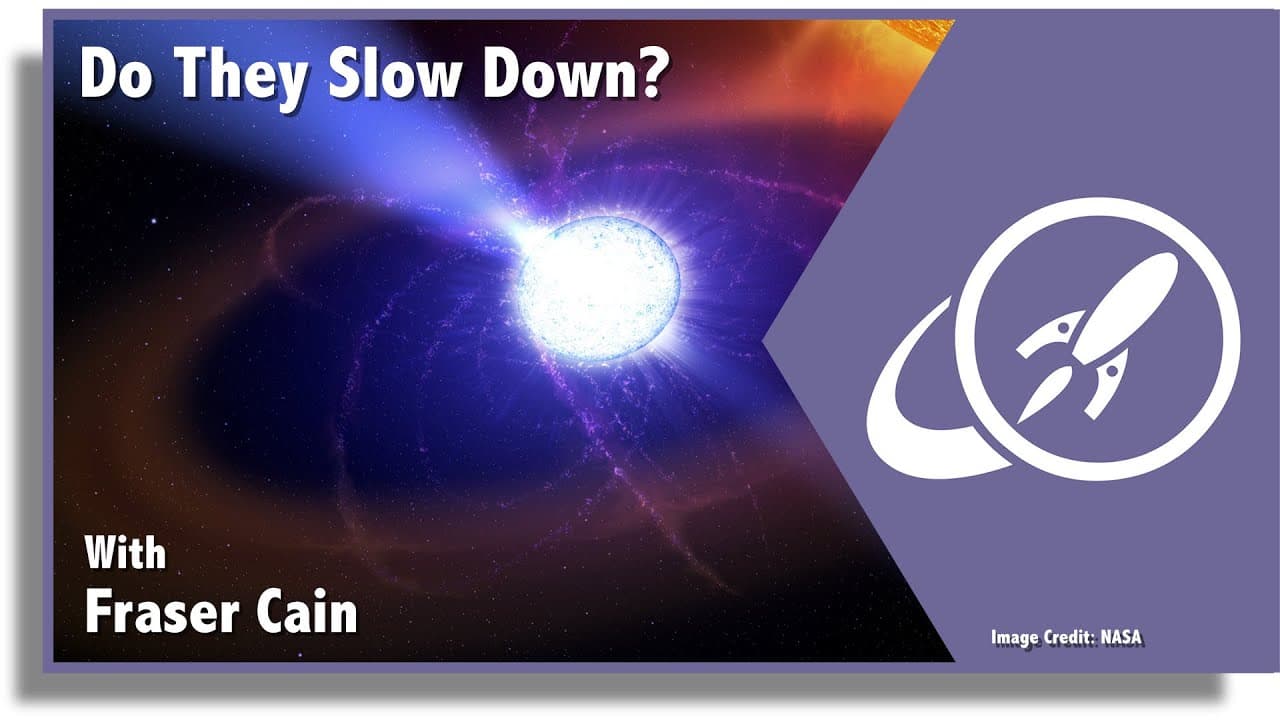
Q&A 142: Do Pulsars Slow Down? And More...
TL;DR
Ask questions to Fraser Cain, as he will answer them live on YouTube every Monday at 5 PM Pacific Time.
Transcript
welcome to the question show your questions my answers as always wherever you are across my channel uh if a question pops into your brain just write it down i will gather a bunch of them up and i will answer them here now of course i record this question show live every monday at 5 00 p.m pacific on my youtube channel so if you want to ask a questi... Read More
Key Insights
- 👋 Pulsars slow down due to the emission of gravitational waves, impacting their rotational speed despite seemingly no external forces.
- 👾 "In situ" refers to acquiring necessary resources on-site, a critical strategy for future space exploration missions.
- 🧑🏭 Dark matter is well-established in the scientific community as a factor influencing the cosmos, but its properties and origin remain a subject of ongoing research.
- ❓ The scientific method remains a robust method for minimizing bias in knowledge acquisition by prioritizing falsification over confirmation.
- 👾 Live Q&A sessions with Fraser Cain provide insights into various space-related topics, engaging a broad audience and fostering interactive learning.
- 👾 Advanced propulsion systems like nuclear thermal rockets pose safety challenges, hindering their widespread adoption for space missions.
- 💁 Addressing the presence of bacteria on spacecraft like the Voyagers highlights the resilience of life forms and the potential for panspermia.
Install to Summarize YouTube Videos and Get Transcripts
Explore YouTube Video Summarizer or Get YouTube Transcript Extractor
Questions & Answers
Q: Why do pulsars slow down despite no direct forces acting against them?
Pulsars slow down due to the emission of gravitational waves, which takes away from their rotational speed over time. Despite the vacuum of space, this process causes a deceleration in rotation.
Q: What is the relevance of the term "in situ" in space exploration?
"In situ" refers to the creation of necessary resources on-site, vital for sustainable interplanetary missions. This approach minimizes the need for resources from Earth, enhancing self-sufficiency.
Q: How do scientists use the Drake Equation to predict the likelihood of alien civilizations?
The Drake Equation estimates the number of advanced extraterrestrial civilizations by factoring in variables like star formation, planets capable of supporting life, and more. It provides a framework for exploring the possibility of alien life.
Q: Are nuclear thermal rockets a practical propulsion system for Mars missions?
While nuclear thermal rockets offer higher efficiency than chemical rockets, their feasibility is limited by safety concerns associated with launching nuclear reactors from Earth. Current rocket technologies like chemical and ion engines are more practical.
Summary & Key Takeaways
-
Fraser engages in live Q&A sessions on YouTube every Monday at 5 PM Pacific Time.
-
Pulsars slow down due to the emission of gravitational waves despite no apparent forces acting against them.
-
"In situ" is a term used by scientists to refer to creating necessary resources on-site, essential for interplanetary exploration.
Read in Other Languages (beta)
Share This Summary 📚
Summarize YouTube Videos and Get Video Transcripts with 1-Click
Try YouTube Summary with ChatGPT & Claude or YouTube Transcript Generator
Explore More Summaries from Fraser Cain 📚


Summarize YouTube Videos and Get Video Transcripts with 1-Click
Try YouTube Summary with ChatGPT & Claude or YouTube Transcript Generator