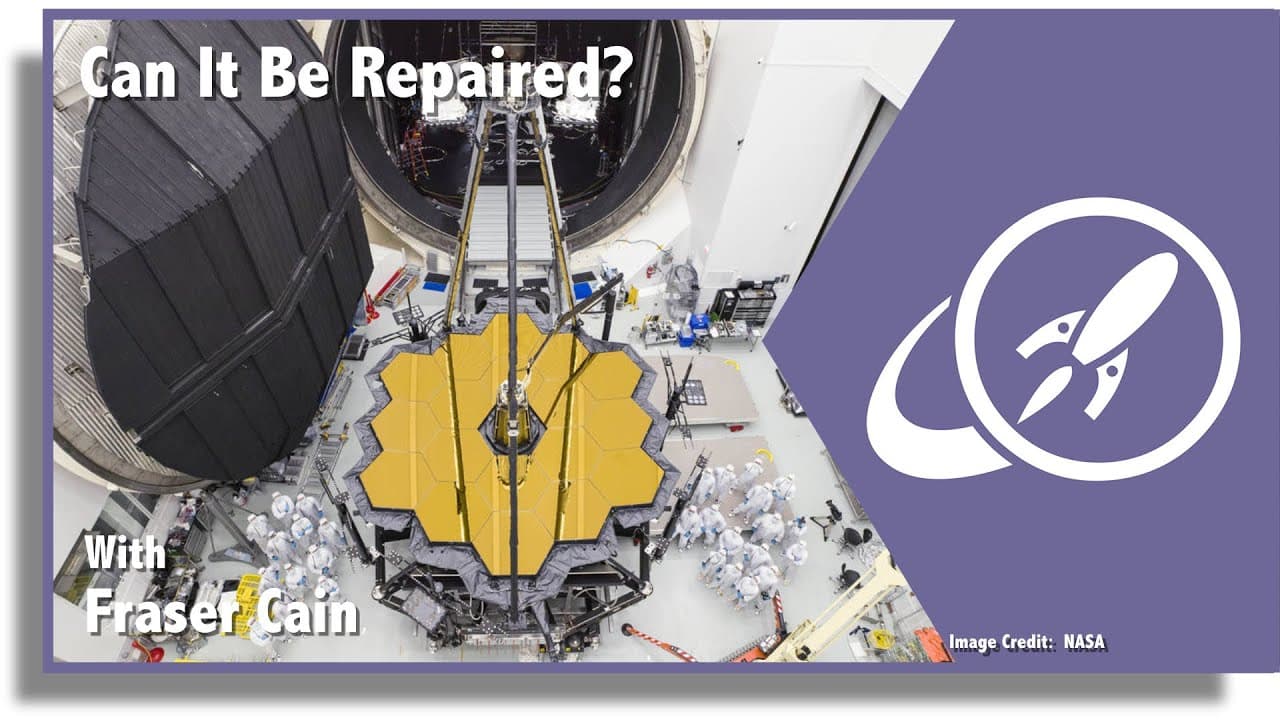
Q&A 163: Is There No Way to Repair James Webb in Space? And More...
TL;DR
Astronomer answers diverse questions on astronomy, from supernovae to Mars expeditions.
Transcript
hey everyone welcome to the question show your questions my answers wait goes backwards your questions my answers so as always wherever you are across my channel if a question pops in your brain just write it down i'll gather them up and i'll answer them here just another reminder i do the show every monday at 5 00 pm pacific time so if you want to... Read More
Key Insights
- 🈷️ Supernova collapses occur rapidly, releasing massive amounts of energy in relativistic explosions.
- 🐎 Black holes have rotational limits, reaching theoretical maximum speeds close to the speed of light.
- 👣 James Webb telescope launch on track, with final assembly and preparations underway.
- 😚 Apophis asteroid's threat level has decreased, featuring a close flyby spectacle in the future.
- ✴️ Magnetars are unique neutron stars with ultra-strong magnetic fields, potentially collapsing into black holes.
- 🛰️ Kessler Syndrome impact on space travel may lead to increased costs and risks, endangering future satellite launches.
- ❓ Lunar and Martian bases represent the next frontier for human exploration and scientific discovery.
Install to Summarize YouTube Videos and Get Transcripts
Explore YouTube Video Summarizer or Get YouTube Transcript Extractor
Questions & Answers
Q: How long does a supernova collapse take?
The collapse is rapid, happening as fast as physical laws permit, at relativistic speeds, leading to bright explosions lasting around 100 seconds.
Q: Can a black hole collapse from spinning too fast?
Black holes rotate rapidly but have limits due to theoretical speed-of-light constraints, preventing their self-disruption.
Q: Will James Webb launch successfully before Half-Life 3?
James Webb launch appears imminent, with final assembly progressing smoothly, possibly launching by December 21st.
Q: Is a permanent moon base feasible within younger generations' lifetimes?
Yes, considering technological advancements and upcoming Mars missions, a lunar base could be established within two decades.
Q: What's the point of sending humans to Mars?
Exploration, scientific discovery, technology advancement, and the inherent human drive to explore new frontiers are reasons to undertake Mars missions.
Q: Could the Moon or Mars have artificial magnetic fields?
Generating artificial planetary magnetic fields through natural means is currently impractical, requiring unfeasible methods like planet impacts for creation.
Q: Can a black hole's mass dictate its gravitational pull?
A supermassive black hole's effect on a galaxy is minor compared to the galaxy's dark matter halo, which accounts for most of its gravitational dynamics.
Q: Will the moon receive an artificial magnetic field for testing purposes?
Currently, there are no practical methods to give celestial bodies artificial magnetic fields like Earth's, excluding destructive processes and magnetic field creation requirements.
Summary & Key Takeaways
-
Astronomer answers viewers' questions on how supernovae collapse, star rotation limits, black hole behavior, James Webb launch, asteroid Apophis, magnetars, Kessler syndrome, Mars missions, and planetary magnetic fields.
-
Venus has a uniform high temperature, but dark side atmospheric phenomena are observed.
-
Idea of a permanent moon base, exploration's relevance, black hole gravitational impact on galaxies, and limitations of creating artificial planetary magnetic fields are discussed.
Read in Other Languages (beta)
Share This Summary 📚
Summarize YouTube Videos and Get Video Transcripts with 1-Click
Try YouTube Summary with ChatGPT & Claude or YouTube Transcript Generator
Explore More Summaries from Fraser Cain 📚
Summarize YouTube Videos and Get Video Transcripts with 1-Click
Try YouTube Summary with ChatGPT & Claude or YouTube Transcript Generator