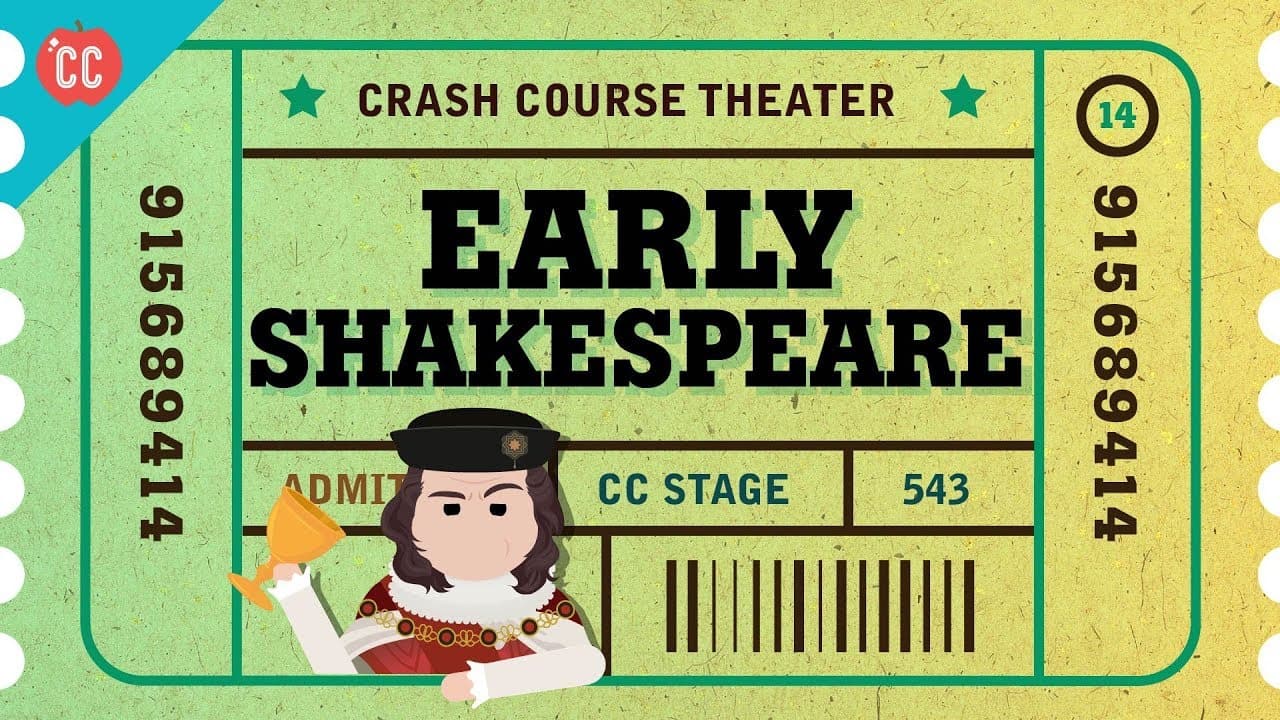
How Did Shakespeare Begin His Playwriting Career?
TL;DR
Shakespeare's journey from Stratford-upon-Avon to becoming a central figure in English theater involved various influences and experiences. He started in a small town, moved to London, and became a prominent playwright and shareholder in a theater company. His works, including history plays, were often collaborative efforts and reflected on political themes of his era.
Transcript
Hey there, I’m Mike Rugnetta, this is Crash Course Theater and remember that guy we said we weren’t going to talk about in the last episode? Well, we’re gonna talk about him for a while now. I mean, of course, Yorick’s pal Shakespeare. And yes, Shakespeare actually wrote all of Shakespeare’s plays, though sometimes he had help. But hey, you don’t b... Read More
Key Insights
- Shakespeare was born in Stratford-upon-Avon in 1564 and baptized shortly after.
- His father, John, was a successful glover and held several civic roles, including mayor.
- Shakespeare married Anne Hathaway in 1582 and had three children with her.
- Shakespeare's move to London remains a mystery, but he became a popular actor and playwright by 1592.
- Playwriting in Elizabethan England was not prestigious, often requiring collaboration and patronage.
- Shakespeare's financial success came largely from being a shareholder in his theater company.
- The First Folio, published in 1623, was the first authoritative collection of Shakespeare's works.
- Shakespeare's history plays often explored political themes, questioning authority and the divine right of kings.
Install to Summarize YouTube Videos and Get Transcripts
Explore YouTube Video Summarizer or Get YouTube Transcript Extractor
Questions & Answers
Q: How did Shakespeare's early life influence his career?
Shakespeare's early life in Stratford-upon-Avon provided him with a solid foundation in classical literature, likely through his education at the local grammar school. His father's civic involvement and the town's exposure to traveling players might have sparked his interest in theater, setting the stage for his later success as a playwright in London.
Q: Why did Shakespeare move to London?
The reasons behind Shakespeare's move to London remain unclear, with stories ranging from legal troubles to joining traveling players. However, his relocation to the city was pivotal, allowing him to immerse himself in the vibrant theater scene and eventually become a leading figure in English drama by the early 1590s.
Q: What was the significance of the First Folio?
The First Folio, published in 1623, was the first authoritative collection of Shakespeare's plays, compiled by his fellow actors John Heminges and Henry Condell. It preserved 36 of his plays, categorizing them into Comedies, Histories, and Tragedies, and played a crucial role in cementing his literary legacy for future generations.
Q: How did Shakespeare make money from his plays?
Shakespeare's financial success was largely due to his role as a shareholder in the Lord Chamberlain’s Men, rather than from direct playwriting royalties. At the time, plays were often published in cheap quartos, with authors receiving little to no financial compensation from these publications.
Q: What themes did Shakespeare explore in his history plays?
Shakespeare's history plays often explored themes of political power, legitimacy, and the divine right of kings. While they could be seen as patriotic, they also questioned authority and depicted complex characters, such as Richard III, who were both tyrannical and charismatic, reflecting the nuanced political landscape of Elizabethan England.
Q: What challenges did playwrights face in Elizabethan England?
Playwrights in Elizabethan England faced challenges such as a lack of copyright protection, leading to unauthorized and erroneous publications of their works. Playwriting was not prestigious, often requiring collaboration and patronage, and playwrights had to continuously produce new works to satisfy the demand for novelty in an emerging theater industry.
Q: How did Shakespeare's plays differ from other works of his time?
Shakespeare's plays stood out for their poetic brilliance, complex characterizations, and exploration of political and ethical themes. While many plays of the time were straightforward in their storytelling, Shakespeare's works offered depth and ambiguity, making them appealing to both audiences and actors, and ensuring their lasting impact.
Q: Why are some of Shakespeare's plays categorized as 'histories'?
Shakespeare's plays are categorized as 'histories' based on their focus on English historical events and figures, as defined by the First Folio editors. These plays typically depict the rise and fall of monarchs and explore political themes, distinguishing them from tragedies, which focus more on personal conflicts and ethical dilemmas.
Summary & Key Takeaways
-
William Shakespeare's early life in Stratford-upon-Avon laid the foundation for his future as a playwright. Born in 1564, he was the son of a successful glover and attended grammar school where he likely studied Latin literature. His marriage to Anne Hathaway and subsequent move to London marked the beginning of his illustrious career in theater.
-
Shakespeare's transition to London's theater scene was marked by mystery and speculation. Despite the lack of concrete details about his early years in London, by 1592 he was recognized as a popular actor and playwright. His involvement with the Lord Chamberlain’s Men as a shareholder significantly contributed to his financial success.
-
Shakespeare's works, particularly his history plays, reflect the political climate of Elizabethan England. While initially perceived as straightforward patriotic exercises, these plays often presented complex narratives that questioned authority. The First Folio, published posthumously, ensured the preservation of his literary legacy.
Read in Other Languages (beta)
Share This Summary 📚
Summarize YouTube Videos and Get Video Transcripts with 1-Click
Try YouTube Summary with ChatGPT & Claude or YouTube Transcript Generator
Explore More Summaries from CrashCourse 📚


Summarize YouTube Videos and Get Video Transcripts with 1-Click
Try YouTube Summary with ChatGPT & Claude or YouTube Transcript Generator