What Are the Different Types of Worms and Their Features?
TL;DR
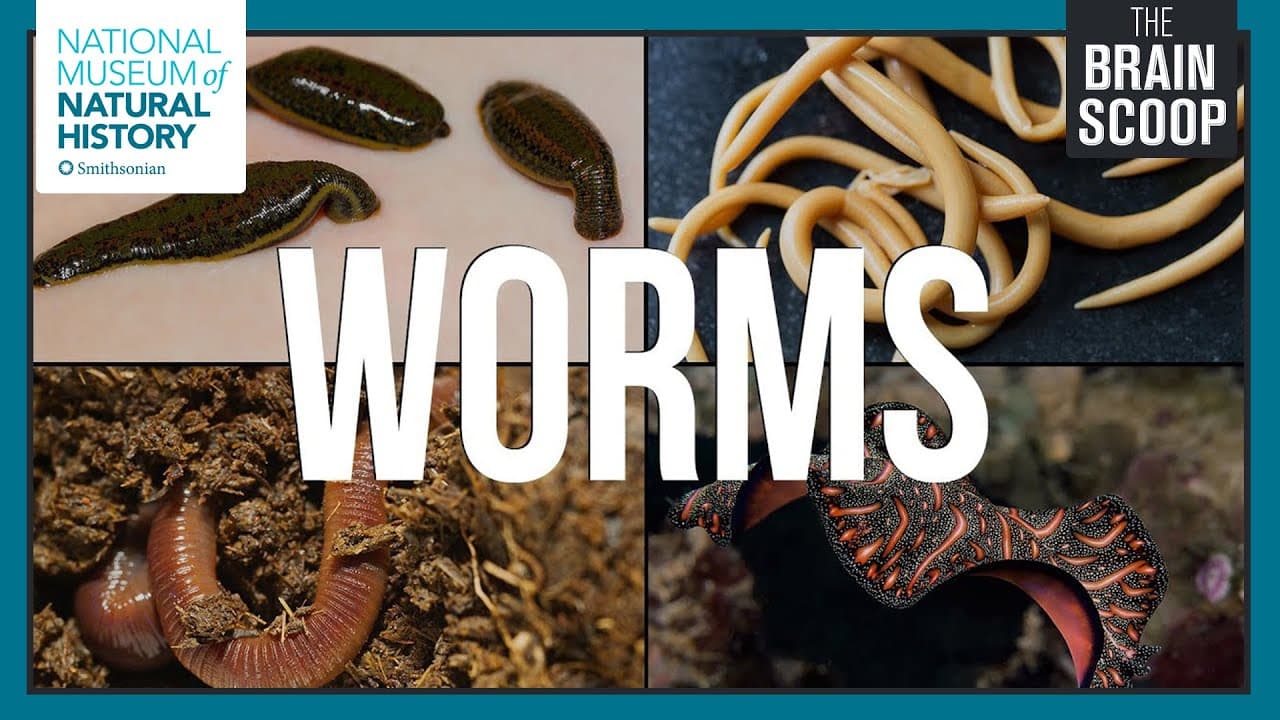
Worms account for an estimated few hundred thousand species, defined as long, thin, and lacking backbones. There are 12 distinct phyla of worms, with each phylum exhibiting unique characteristics and habitats. While around 66,000 species have been described, many more remain undiscovered, highlighting the vast diversity of these creatures.
Transcript
Emily: This episode is brought to you through a collaboration with the Smithsonian's National Museum of Natural History in Washington DC and the Field Museum in Chicago, Illinois. Emily: What do you think of when I say worm? My first thought is these guys, earthworms. The one most people are familiar with is a "Lumbricus terrestris", sometimes refe... Read More
Key Insights
- 🪱 Earthworms are just one type of worm, with an estimated few hundred thousand species of worms in existence.
- 🤔 Worms are defined as long, thin creatures without backbones, but the term encompasses diverse species.
- 🪱 There are 12 phyla of worms, each with their own unique features and habitats.
- 😚 Leeches are a close relative of earthworms, with similarities like hermaphroditism.
- 🪱 Worms have been able to diversify and colonize various environments due to their ancient existence and ability to adapt.
- 🪱 Currently, around 66,000 species of worms have been described, but there could be over 250,000 awaiting discovery.
- 🦿 Collecting leeches involves performing a "leech dance" to attract them and carefully examining each leg for its presence.
Install to Summarize YouTube Videos and Get Transcripts
Explore YouTube Video Summarizer or Get YouTube Transcript Extractor
Questions & Answers
Q: How many species of worms are currently known and described?
Currently, around 66,000 species of worms have been described, but it is estimated that there could be over 250,000 species waiting to be discovered and classified.
Q: What is the relationship between leeches and earthworms?
Earthworms and leeches are close relatives within the phylum Annelida. While they have some differences, such as leeches being blood-feeders, they share similarities like being hermaphrodites (having both male and female reproductive organs) and belonging to the same phylum.
Q: How do scientists collect leeches?
Collecting leeches involves going to lakes, ponds, or streams, creating movement to attract leeches, and performing a "leech dance." Leeches can be examined by lifting each leg slowly to check for their presence, often done while standing in water, mud, and rocks.
Q: How many phyla of worms are there?
There are 12 phyla of worms, each exhibiting different characteristics and occupying various ecosystems. They include earthworms, leeches, and marine worms like bristle worms.
Summary & Key Takeaways
-
Earthworms are just one type of worm, with as many as a few hundred thousand species of worms in existence.
-
Worms are defined by their long and thin bodies, lack of backbones, and varied characteristics.
-
There are 12 phyla of worms, each with its own unique characteristics and habitats.
Read in Other Languages (beta)
Share This Summary 📚
Summarize YouTube Videos and Get Video Transcripts with 1-Click
Try YouTube Summary with ChatGPT & Claude or YouTube Transcript Generator
Explore More Summaries from thebrainscoop 📚





Summarize YouTube Videos and Get Video Transcripts with 1-Click
Try YouTube Summary with ChatGPT & Claude or YouTube Transcript Generator