Absolute Convergence, Conditional Convergence, and Divergence
TL;DR
Understanding the concept of absolute convergence, conditional convergence, and divergence of series and how to determine them using various tests.
Transcript
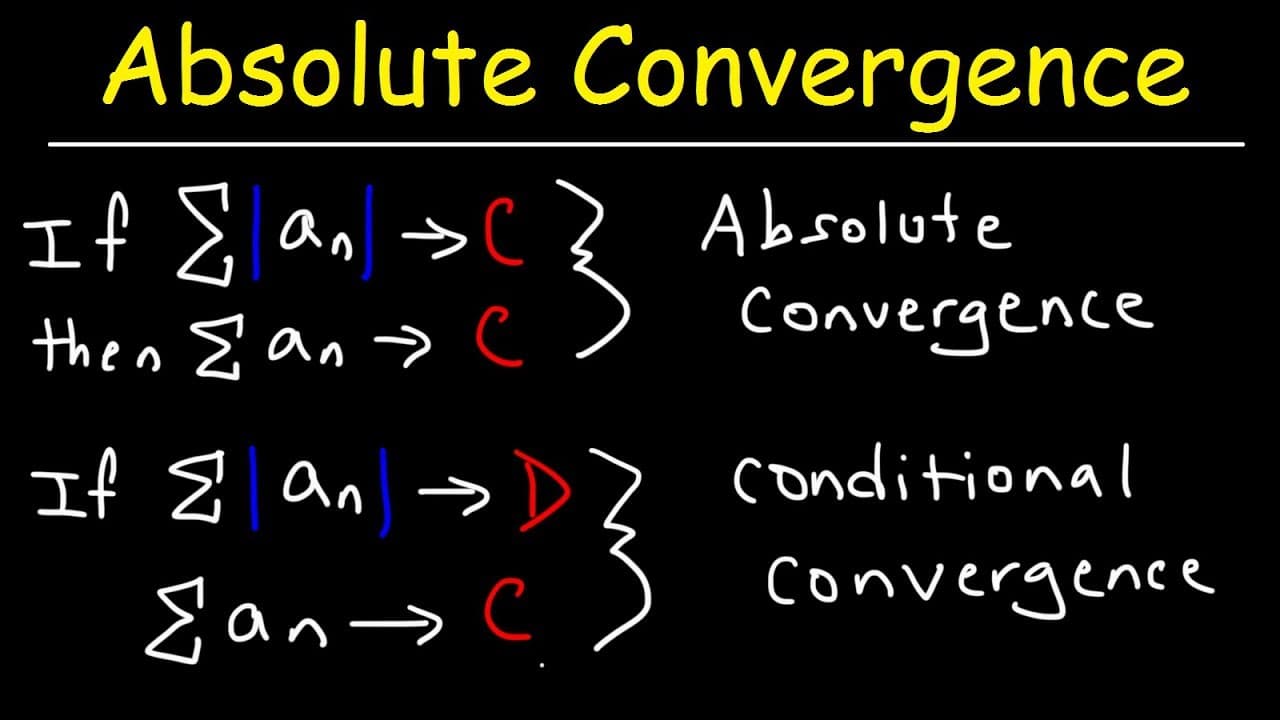
so what does it mean for a series to be absolutely convergent conditionally convergent or diverging well if the series is absolutely convergent that means that the absolute value of the series and the series itself they're both convergent for a series to be conditionally convergent that means the series is convergent but the absolute value of the s... Read More
Key Insights
- ❓ Absolutely convergent series have both the series and its absolute value converge.
- ❓ Conditionally convergent series converge, but their absolute values diverge.
- ❓ Divergent series have both the series and its absolute value diverge.
- 🏆 The divergence test helps determine if the limit of the series approaches zero.
- 🍉 The alternating series test is used for analyzing alternating series and checks if the terms decrease and the limit exists.
- ❓ If the absolute value of a series converges, the original series must also converge.
- ❓ If the absolute value of a series diverges, the original series may be either convergent or divergent.
Install to Summarize YouTube Videos and Get Transcripts
Explore YouTube Video Summarizer or Get YouTube Transcript Extractor
Questions & Answers
Q: What does it mean for a series to be absolutely convergent?
If the absolute value and the series itself both converge, the series is considered absolutely convergent.
Q: How is conditional convergence different from absolute convergence?
In conditional convergence, the series converges, but the absolute value of the series diverges.
Q: What should be done if the absolute value of the series is divergent?
In this case, the original series should be analyzed to determine if it is convergent or divergent.
Q: Can a series be divergent even if the absolute value of the series converges?
No, if the absolute value of the series converges, then the original series must also converge, according to the absolute convergence theorem.
Q: How can the convergence of a series be analyzed using the alternating series test?
The alternating series test can be used for an alternating series, where the series alternates between positive and negative terms. It checks if the terms decrease and if the limit of the terms approaches zero.
Q: What is the significance of the divergence test in determining convergence or divergence?
The divergence test helps us determine if the limit of the series approaches zero. If it does not, then the series is divergent.
Q: When analyzing a series, what does it mean if the absolute value of the series and the original series both diverge?
If both the original series and the absolute value of the series diverge, the entire series is considered divergent.
Q: How can the convergence of a series with alternating signs be determined?
The alternating series test is used to determine the convergence of a series with alternating signs. It checks if the terms decrease and if the limit of the terms exists.
Summary & Key Takeaways
-
Absolute convergence: If the absolute value and the series itself both converge, the series is absolutely convergent.
-
Conditional convergence: If the series converges but the absolute value of the series diverges, it is conditionally convergent.
-
Divergence: If both the original series and the absolute value of the series diverge, the series is divergent.
Read in Other Languages (beta)
Share This Summary 📚
Summarize YouTube Videos and Get Video Transcripts with 1-Click
Try YouTube Summary with ChatGPT & Claude or YouTube Transcript Generator
Explore More Summaries from The Organic Chemistry Tutor 📚
Summarize YouTube Videos and Get Video Transcripts with 1-Click
Try YouTube Summary with ChatGPT & Claude or YouTube Transcript Generator