How to Calculate Your Monthly Mortgage Payment Breakdown
TL;DR
To calculate your monthly mortgage payment and its breakdown into interest and principal, use the formula: MP = P[r(1+r)^n]/[(1+r)^n-1], where P is the loan amount, r is the monthly interest rate, and n is the number of payments. Over time, the portion of your payment that goes toward interest decreases while the portion that pays down the principal increases.
Transcript
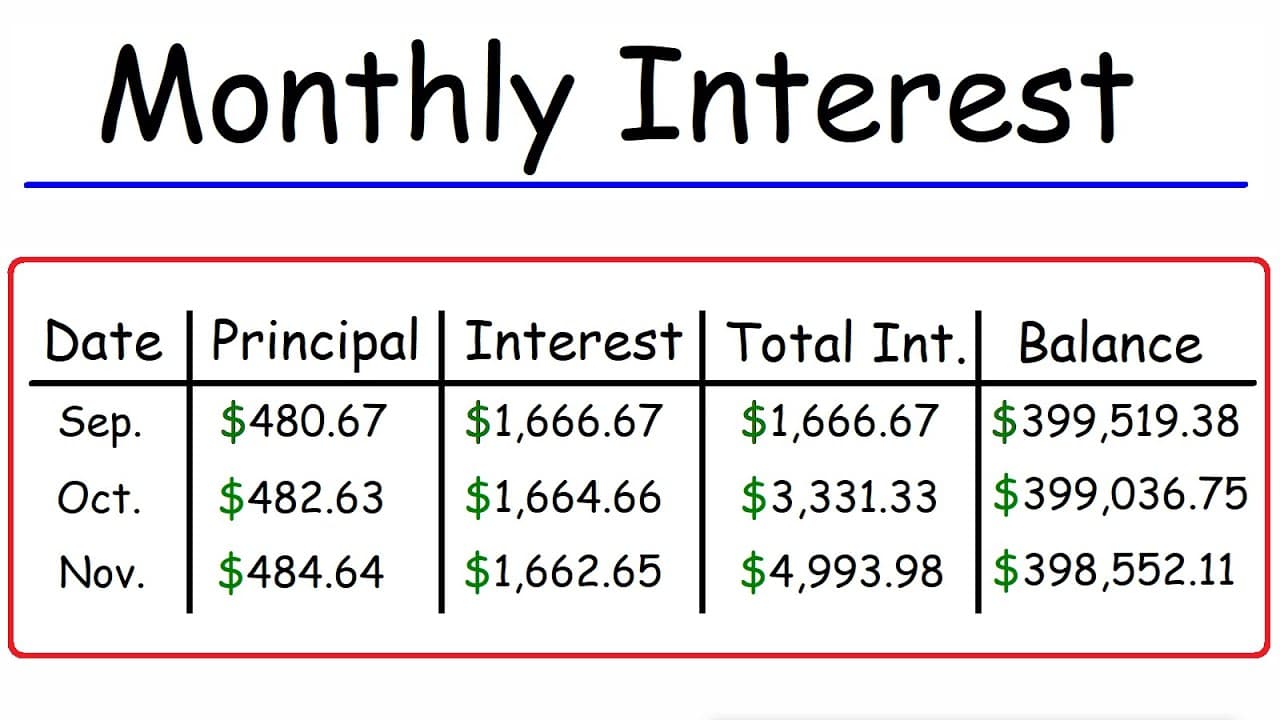
let's say you have a mortgage with a monthly payment of two thousand dollars have you ever wondered how much of that goes into paying interest and how much of that goes into paying down the principal or the loan balance in this video we're going to talk about how to calculate those things through an example problem so let's start with this one kell... Read More
Key Insights
- ☠️ Monthly mortgage payments can be calculated using a formula that considers the principal, interest rate, and number of payments per year.
- 👻 An amortization schedule allows borrowers to track the changes in the principal and interest portions of their mortgage payments over time.
- 🤪 The division between principal and interest in the monthly payment shifts over the loan term, with more money going towards reducing the principal balance.
- 📅 Online calculators and spreadsheet tools like Excel can simplify the calculation of mortgage payments and the creation of amortization schedules.
Install to Summarize YouTube Videos and Get Transcripts
Explore YouTube Video Summarizer or Get YouTube Transcript Extractor
Questions & Answers
Q: How can I calculate my monthly mortgage payments?
To calculate monthly mortgage payments, use the formula: monthly payment = (principal × annual interest rate ÷ number of payments per year) ÷ (1 - (1 + (annual interest rate ÷ number of payments per year)) raised to the power of (negative number of years × number of payments per year)).
Q: How do I convert an annual interest rate to a decimal?
Divide the annual interest rate by 100 to convert it to a decimal. For example, 5% becomes 0.05.
Q: What is an amortization schedule?
An amortization schedule is a table that shows the allocation of each monthly payment between principal and interest over the loan term. It also displays the remaining loan balance after each payment.
Q: How does the division between interest and principal change over time?
Initially, a larger portion of the monthly payment goes towards interest, but as time progresses, more of the payment is allocated towards reducing the principal balance. This shift occurs because the interest is calculated based on the remaining principal balance.
Summary & Key Takeaways
-
The video demonstrates how to calculate monthly mortgage payments using a specific formula and provides an example problem.
-
It explains how to determine the division between interest and principal in monthly payments.
-
An amortization schedule is created to track the changes in principal and interest over time.
Read in Other Languages (beta)
Share This Summary 📚
Summarize YouTube Videos and Get Video Transcripts with 1-Click
Try YouTube Summary with ChatGPT & Claude or YouTube Transcript Generator
Explore More Summaries from The Organic Chemistry Tutor 📚



Summarize YouTube Videos and Get Video Transcripts with 1-Click
Try YouTube Summary with ChatGPT & Claude or YouTube Transcript Generator