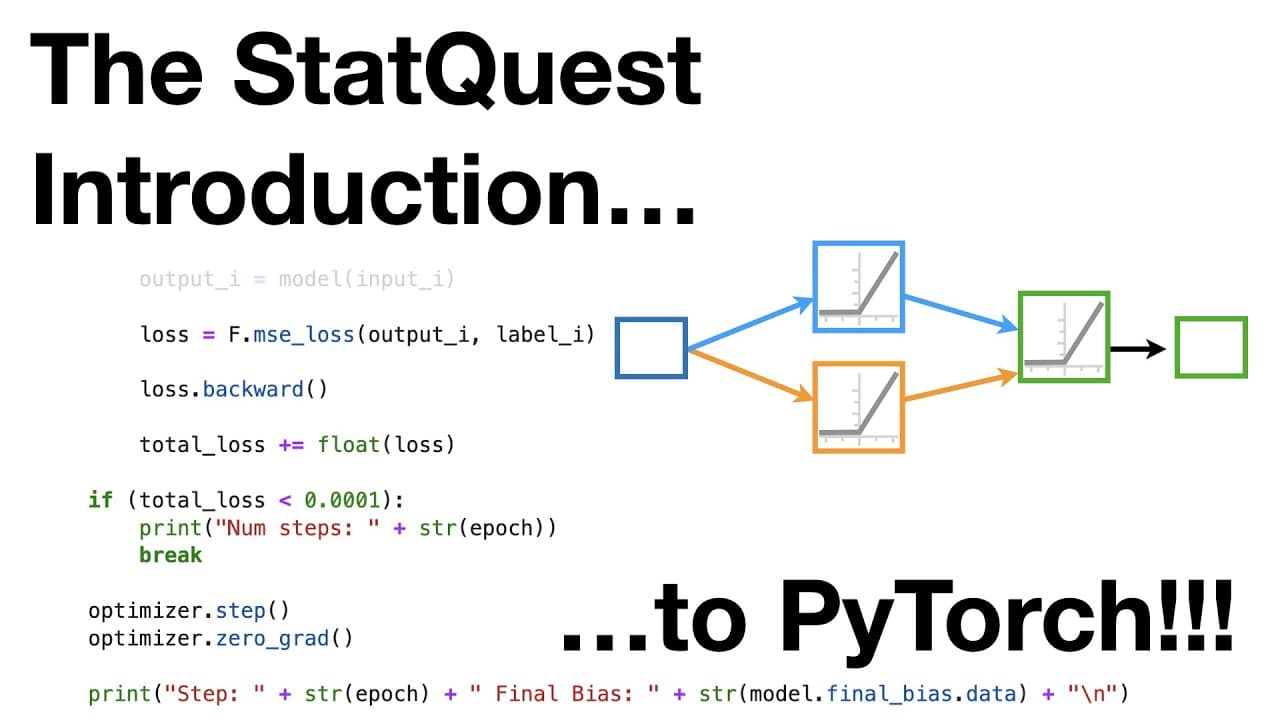
The StatQuest Introduction to PyTorch
TL;DR
Dive into building a neural network with PyTorch basics and optimization using backpropagation.
Transcript
the statquest introduction to pi torch is here statquest hello i'm josh starmer and welcome to statquest today we're going to talk about the stat quest introduction to pi torch this stat quest is sponsored by lightning and grid.ai lightning and grid are awesome you can do cool stuff in the cloud hooray note this stat quest assumes that you already ... Read More
Key Insights
- 👻 PyTorch allows for efficient creation of neural networks with customizable weights, biases, and activation functions.
- 🌸 Backpropagation in PyTorch optimizes neural networks by adjusting parameters to reduce the loss function.
- 🦻 Visualizing the output of the neural network aids in understanding its performance on training data.
- ❓ Gradual optimization through gradient descent ensures convergence to optimal parameter values.
- ❓ Maintaining data integrity and accurate derivatives are crucial for successful optimization in PyTorch.
- ❓ Regularizing the training process with proper techniques enhances neural network performance.
- 🦮 PyTorch study guides and support options provide resources for further learning and exploration.
Install to Summarize YouTube Videos and Get Transcripts
Explore YouTube Video Summarizer or Get YouTube Transcript Extractor
Questions & Answers
Q: What are the main components involved in creating a neural network in PyTorch?
The main components include defining weights, biases, activation functions, and building a forward pass method to connect inputs to outputs using tensors.
Q: How is optimization achieved in PyTorch for neural network training?
Optimization is achieved through backpropagation, where the model calculates gradients, updates the parameters using stochastic gradient descent (SGD), and minimizes the loss function to improve network performance.
Q: Why is it essential to zero out gradients during optimization in PyTorch?
Zeroing out gradients prevents accumulation of gradients from previous iterations, ensuring accurate updates to neural network parameters without interference from previous calculations.
Q: How is the effectiveness of the trained neural network verified in PyTorch?
The effectiveness is verified by plotting predicted output values against input data to visually inspect if the model fits the training data accurately after the optimization process.
Summary & Key Takeaways
-
PyTorch basics introduction and neural network creation with weights, biases, and activation functions explained.
-
Optimization using backpropagation to train the neural network by updating parameters with gradient descent.
-
Verification of network performance with training data visualization and optimization results.
Read in Other Languages (beta)
Share This Summary 📚
Summarize YouTube Videos and Get Video Transcripts with 1-Click
Try YouTube Summary with ChatGPT & Claude or YouTube Transcript Generator
Explore More Summaries from StatQuest with Josh Starmer 📚
Summarize YouTube Videos and Get Video Transcripts with 1-Click
Try YouTube Summary with ChatGPT & Claude or YouTube Transcript Generator