Magnetism (13 of 14) The Lorentz Force, Charged Particles in Magnetic Fields
TL;DR
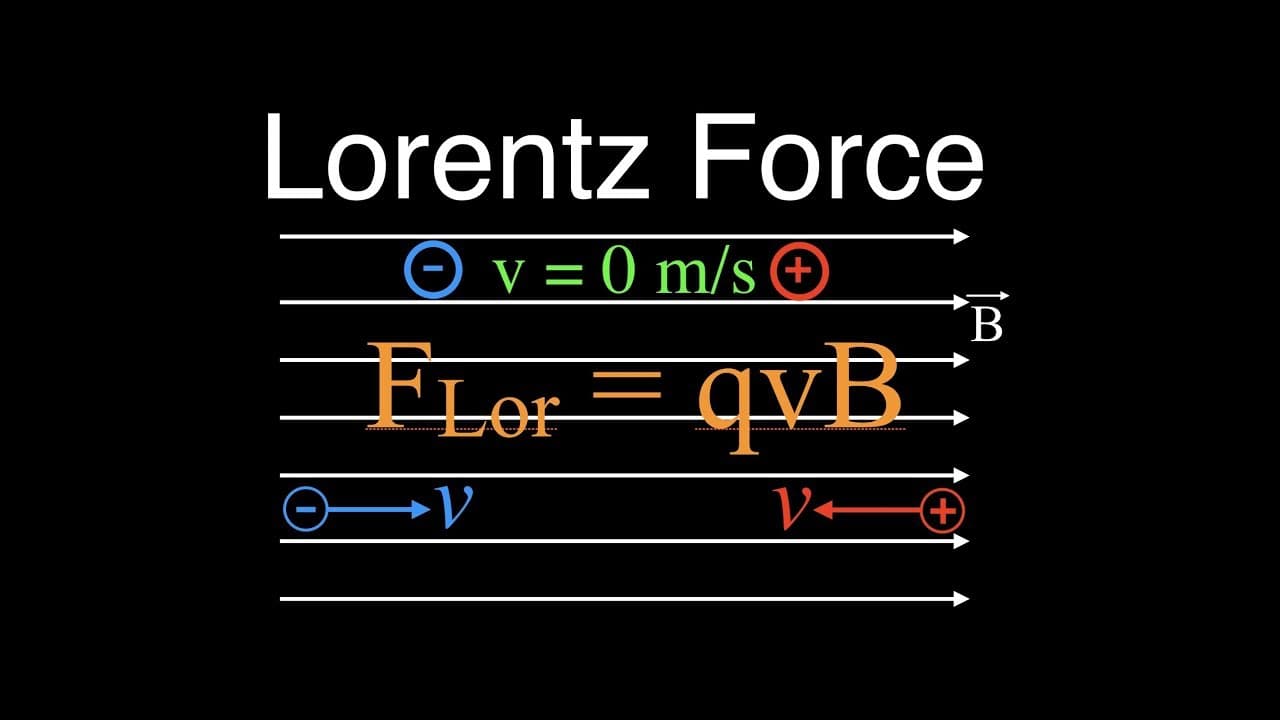
This video discusses the behavior of charged particles in a magnetic field, covering cases where the particle is at rest and when it has an initial velocity.
Transcript
okay in today's video I'm gonna go over hopefully a few last things about the Lorenz force and charges in the magnetic field now if we go on don't forget please don't forget subscribe to my channel get all my excellent physics chemistry and math videos support my channel step-by-step science leave me a comment give me a thumbs up all that good stuf... Read More
Key Insights
- 😣 A charged particle at rest in a magnetic field experiences no force.
- 🧑🏭 If a charged particle has an initial velocity parallel to a magnetic field, no force will act on it.
- 🏑 When a charged particle enters a magnetic field with an initial velocity perpendicular to the field, there will be a force acting on it.
- 🏑 The magnitude and direction of the force can be determined using the equations involving the charge, velocity, and angle between the velocity and magnetic field vectors.
- 🫱 The left or right hand rule can be used to determine the direction of the force.
- 🏑 Negative or positive charges behave similarly in magnetic fields.
- 🙈 Gravitational forces are often ignored in these calculations.
Install to Summarize YouTube Videos and Get Transcripts
Explore YouTube Video Summarizer or Get YouTube Transcript Extractor
Questions & Answers
Q: What happens to a charged particle at rest when placed in a magnetic field?
When a charged particle is at rest in a magnetic field, there is no force exerted on it. It remains stationary.
Q: What determines the force on a charged particle in a magnetic field?
The force on a charged particle in a magnetic field is determined by the charge of the particle, its velocity, and the angle between the velocity vector and the magnetic field vector.
Q: Is there a force on a charged particle if its velocity is parallel to the magnetic field?
No, if a charged particle's velocity is parallel to the magnetic field, there is no force exerted on the particle.
Q: What if the charged particle enters the magnetic field with an initial velocity perpendicular to the field?
In this case, there will be a force exerted on the particle due to the interaction between its velocity, charge, and the magnetic field.
Summary & Key Takeaways
-
The video explores what happens when a charged particle is placed at rest in a magnetic field, concluding that there is no force on the particle in this case.
-
The video also examines the scenario where a charged particle has an initial velocity and enters a magnetic field. If the particle's velocity is parallel to the magnetic field, there is no force on the particle.
-
However, if the particle's velocity is perpendicular to the magnetic field, there will be a force acting on the particle.
Read in Other Languages (beta)
Share This Summary 📚
Summarize YouTube Videos and Get Video Transcripts with 1-Click
Try YouTube Summary with ChatGPT & Claude or YouTube Transcript Generator
Explore More Summaries from Step by Step Science 📚

Summarize YouTube Videos and Get Video Transcripts with 1-Click
Try YouTube Summary with ChatGPT & Claude or YouTube Transcript Generator