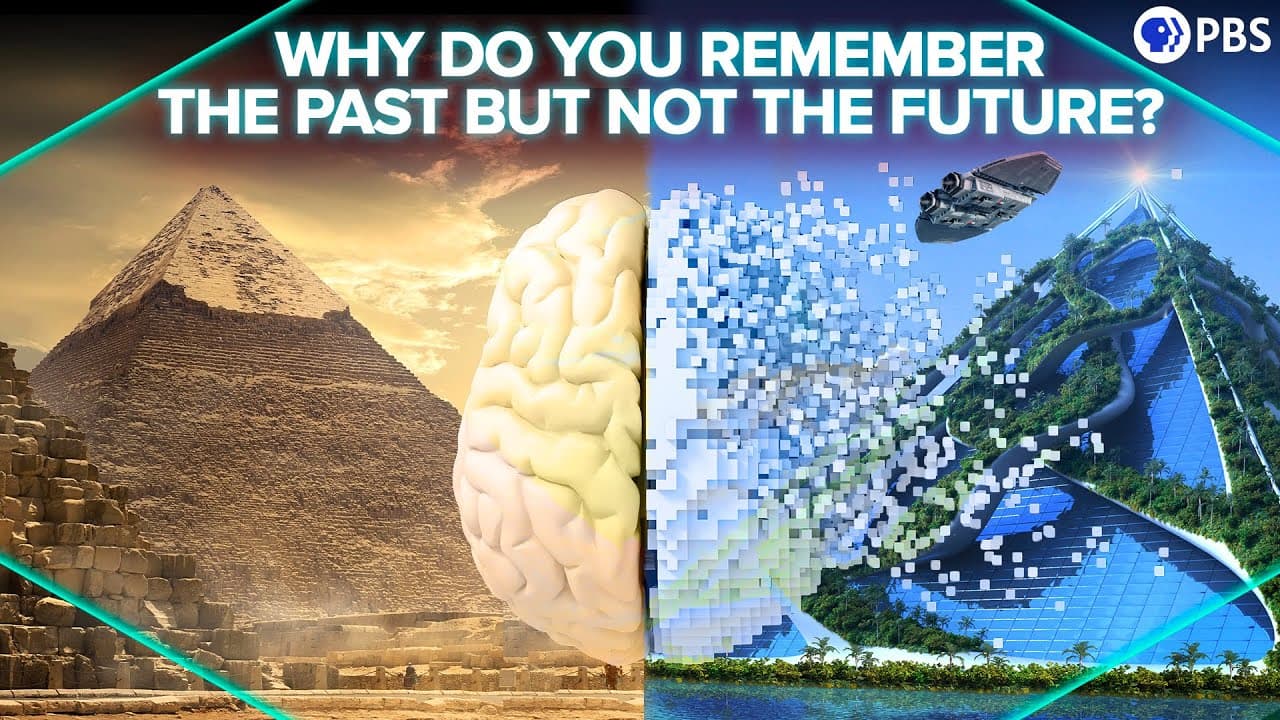
Why Do You Remember The Past But Not The Future?
TL;DR
Our brains perceive time's arrow due to entropy's influence on memory.
Transcript
The laws of physics don’t specify an arrow of time - they don’t distinguish the past from the future. The equations we use to describe how things evolve forward in time also perfectly describe their evolution backwards in time. So the brain is a thing and its ruled by the laws of physics - why does the brain and the conscious experience that emerge... Read More
Key Insights
- The laws of physics do not inherently distinguish between past and future, yet our brains perceive a clear arrow of time due to memory.
- Entropy, as dictated by the second law of thermodynamics, increases over time, creating a gradient that influences our perception of time.
- Memory formation in the brain is linked to the direction of increasing entropy, helping us remember the past but not the future.
- The concept of memory can be extended to inanimate objects, which hold records of their past interactions, though not of future events.
- Time symmetry in physics implies that, theoretically, events could be reconstructed both forward and backward, but entropy breaks this symmetry in practice.
- The early universe's low entropy state allowed for the development of correlations, which laid the groundwork for memory and the arrow of time.
- Quantum mechanics and entropy together help define the arrow of time, with increasing correlations and entanglements over time.
- The mystery of the universe's low initial entropy challenges our understanding of time's directionality and the role of gravitational fields.
Install to Summarize YouTube Videos and Get Transcripts
Explore YouTube Video Summarizer or Get YouTube Transcript Extractor
Questions & Answers
Q: Why do our brains perceive an arrow of time?
Our brains perceive an arrow of time due to the increase in entropy, which aligns with the direction of memory formation. As entropy increases, our brains form memories in the same direction, leading to a perception of time flowing from past to future.
Q: How does entropy influence our perception of time?
Entropy, as described by the second law of thermodynamics, dictates that disorder increases over time. This increase in entropy creates a gradient that influences our perception of time, aligning with the direction in which our brains form memories.
Q: Can inanimate objects have memory?
Inanimate objects can hold records of their past interactions, similar to memory. For example, an asteroid's surface features can reveal its history of collisions and cosmic ray impacts, though these objects do not hold information about future events.
Q: What role does time symmetry play in physics?
Time symmetry in physics suggests that events could theoretically be reconstructed forward and backward in time. However, in practice, entropy breaks this symmetry, as increasing entropy and correlations occur in one direction, influencing our perception of time.
Q: How does the early universe's low entropy state affect time perception?
The early universe's low entropy state allowed for the development of correlations over time. This foundational state is crucial to understanding the arrow of time, as it set the stage for the formation of correlations and memory, influencing our perception of time.
Q: What is the relationship between quantum mechanics and the arrow of time?
Quantum mechanics, together with entropy, helps define the arrow of time. As entropy increases, correlations and entanglements also increase, contributing to the temporal ordering of events and the formation of memories in one direction.
Q: How does the video address the mystery of low initial entropy in the universe?
The video highlights the mystery of the universe's low initial entropy, which challenges our understanding of time's directionality. It suggests that the low entropy state allowed for the development of correlations and memory, with gravitational fields playing a significant role.
Q: What insights does the video provide about the laws of physics and time's arrow?
The video provides insights into how the laws of physics are time-symmetric, yet our perception of time's arrow is influenced by entropy. It explains that the increase in entropy and correlations over time aligns with memory formation, leading to our perception of time flowing from past to future.
Summary & Key Takeaways
-
The video explores why our brains perceive an arrow of time, despite the laws of physics being time-symmetric. It attributes this perception to the increase in entropy, which aligns with our memory formation process.
-
Entropy's role in increasing correlations within the universe helps explain why we remember the past and not the future. This increase in entropy and correlations is mirrored in the brain's memory formation.
-
The discussion extends to the early universe's low entropy state, which allowed for the development of correlations over time. This foundational state is key to understanding the arrow of time and its manifestation in memory.
Read in Other Languages (beta)
Share This Summary 📚
Summarize YouTube Videos and Get Video Transcripts with 1-Click
Try YouTube Summary with ChatGPT & Claude or YouTube Transcript Generator
Explore More Summaries from PBS Space Time 📚




Summarize YouTube Videos and Get Video Transcripts with 1-Click
Try YouTube Summary with ChatGPT & Claude or YouTube Transcript Generator