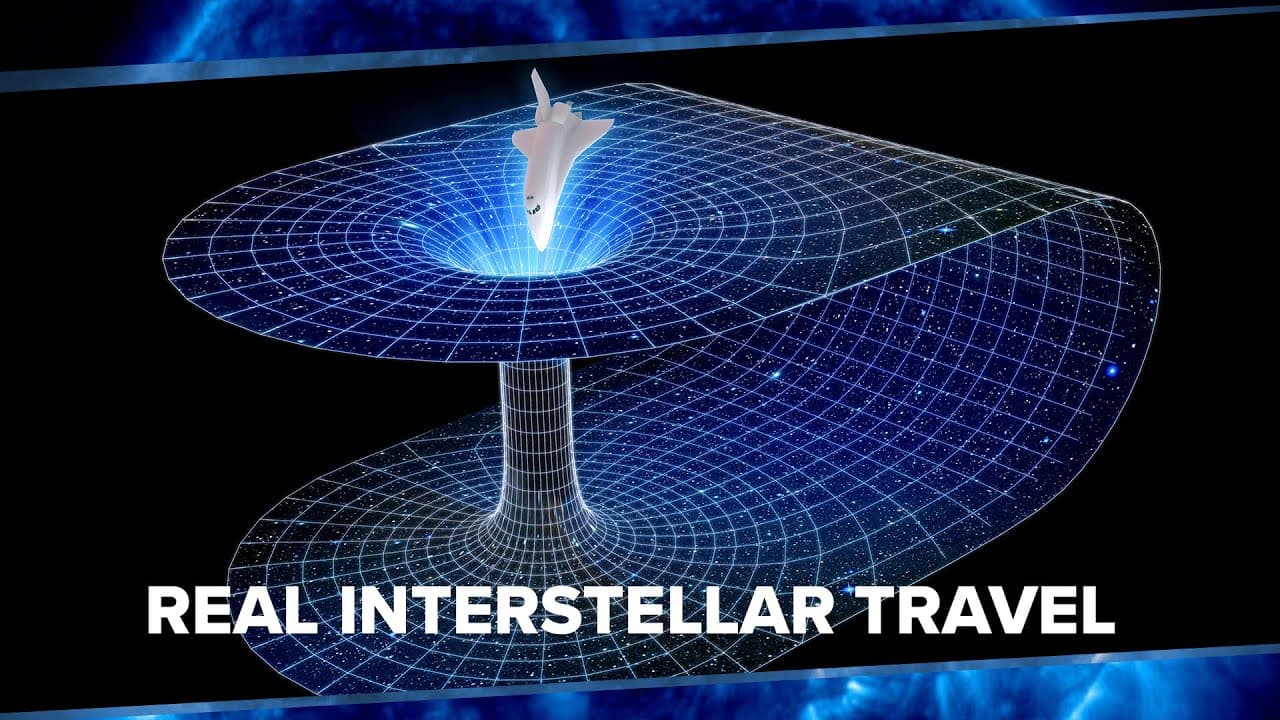
What Are the Real Possibilities for Interstellar Travel?
TL;DR
Interstellar travel could be achievable within our lifetime through realistic technologies. Fusion propulsion and nuclear-driven concepts like the Orion project present the most viable short-term options, while antimatter and light sails offer futuristic promises. However, the challenges of resource allocation and political collaboration are crucial for success.
Transcript
The future of humanity is in the stars. If we wanted it badly enough, interstellar travel could be achievable in our lifetime. So what would it take to build a starship? Why don't we see evidence of galactic empires? Is our galaxy littered with the remains of single planet civilizations as Elon Musk has asked? Is it really so difficult to colonize ... Read More
Key Insights
- Interstellar travel might be achieved within our lifetime using technologies feasible today, focusing on political cooperation and resource allocation.
- Traditional rocket fuel is impractical for interstellar travel, requiring massive fuel tanks due to low energy density.
- Fusion propulsion, such as the Orion project using nuclear explosions, offers a realistic short-term solution for achieving 10% light speed.
- Antimatter drives provide high energy efficiency but face challenges in antimatter production and storage, limiting their current feasibility.
- Light sails, utilizing large sails propelled by powerful lasers, offer a propellant-free method for reaching significant fractions of light speed.
- Blackhole drives, using artificial black holes, promise high speeds but require advanced laser technology beyond current capabilities.
- Fusion engines, although technologically distant, provide a sustainable option for future interstellar travel.
- Manned light sail missions are plausible but far off, with unmanned probes likely to be the first interstellar travelers.
Install to Summarize YouTube Videos and Get Transcripts
Explore YouTube Video Summarizer or Get YouTube Transcript Extractor
Questions & Answers
Q: What is the primary challenge of using traditional rocket fuel for interstellar travel?
The primary challenge of using traditional rocket fuel for interstellar travel is its low energy density, which necessitates an impractically large fuel tank to reach significant speeds. For instance, reaching 10% of the speed of light would require a fuel tank larger than the observable universe, making it an inefficient choice for interstellar missions.
Q: How does the Orion project propose to achieve interstellar travel?
The Orion project proposes achieving interstellar travel by using nuclear explosions to propel a spacecraft. This method involves detonating a series of nuclear bombs behind the spacecraft, using the explosive force to accelerate it to speeds around 10% of the speed of light. Although technically feasible, it requires overcoming political and safety challenges associated with nuclear detonations.
Q: What are the advantages and challenges of using antimatter drives?
Antimatter drives offer the advantage of extremely high energy efficiency, as matter-antimatter annihilation releases most of the rest mass as energy. However, the challenges lie in producing and storing antimatter in sufficient quantities, as current technology only allows for the production of small amounts at great expense. Scaling up production is a significant hurdle for making antimatter drives viable.
Q: How do light sails work, and what are their limitations?
Light sails work by using large, reflective sails propelled by powerful lasers or sunlight to achieve high speeds without carrying propellant. Their limitations include the need for advanced materials to withstand intense laser power and the challenge of slowing down at the destination. Despite these challenges, light sails are considered a feasible option for unmanned interstellar missions.
Q: What is a black hole drive, and why is it not feasible yet?
A black hole drive, specifically a Schwarzschild Kugelblitz, uses an artificial black hole created from concentrated laser light to generate propulsion via Hawking radiation. While it promises high speeds, creating such a black hole requires laser technology far beyond current capabilities, making it an exciting but distant possibility for interstellar travel.
Q: What is the Wait Calculation, and why is it important?
The Wait Calculation is a theoretical framework used to determine the optimal balance between the development time of propulsion technology and the speed of the resulting starship. It ensures that a slower ship launched earlier is not overtaken by a faster ship developed later, optimizing the timeline for interstellar missions. This calculation is crucial for planning effective interstellar travel strategies.
Q: Why are fusion engines considered more sustainable for interstellar travel?
Fusion engines are considered more sustainable for interstellar travel because they use abundant fuel sources like hydrogen and have the potential to provide continuous propulsion over long durations. Although the technology is still developing, fusion offers a cleaner and more efficient alternative to nuclear explosions or antimatter, making it a promising long-term solution for interstellar exploration.
Q: What is the most feasible near-term option for interstellar travel?
The most feasible near-term option for interstellar travel is the use of light sails for unmanned probes. Light sails can achieve significant speeds without carrying propellant, making them an efficient choice for initial exploratory missions. With current technology, it's possible to launch a light sail probe within the next few decades, potentially reaching nearby star systems within a human lifetime.
Summary & Key Takeaways
-
The video explores various methods for achieving interstellar travel, focusing on technologies that could realistically be developed in the near future. It examines propulsion options from traditional rocket fuel to advanced concepts like antimatter and black hole drives.
-
Fusion and antimatter propulsion offer promising avenues for interstellar travel, with fusion being more achievable in the short term. Antimatter drives, while efficient, face significant production challenges.
-
Light sails and black hole drives represent the cutting edge of theoretical propulsion technologies, with light sails being more feasible in the near term for unmanned missions. Black hole drives remain a distant possibility requiring breakthroughs in laser technology.
Read in Other Languages (beta)
Share This Summary 📚
Summarize YouTube Videos and Get Video Transcripts with 1-Click
Try YouTube Summary with ChatGPT & Claude or YouTube Transcript Generator
Explore More Summaries from PBS Space Time 📚



Summarize YouTube Videos and Get Video Transcripts with 1-Click
Try YouTube Summary with ChatGPT & Claude or YouTube Transcript Generator