Two Supermassive Black Holes Orbiting Each Other. Stephen Hawking Was Right!
TL;DR
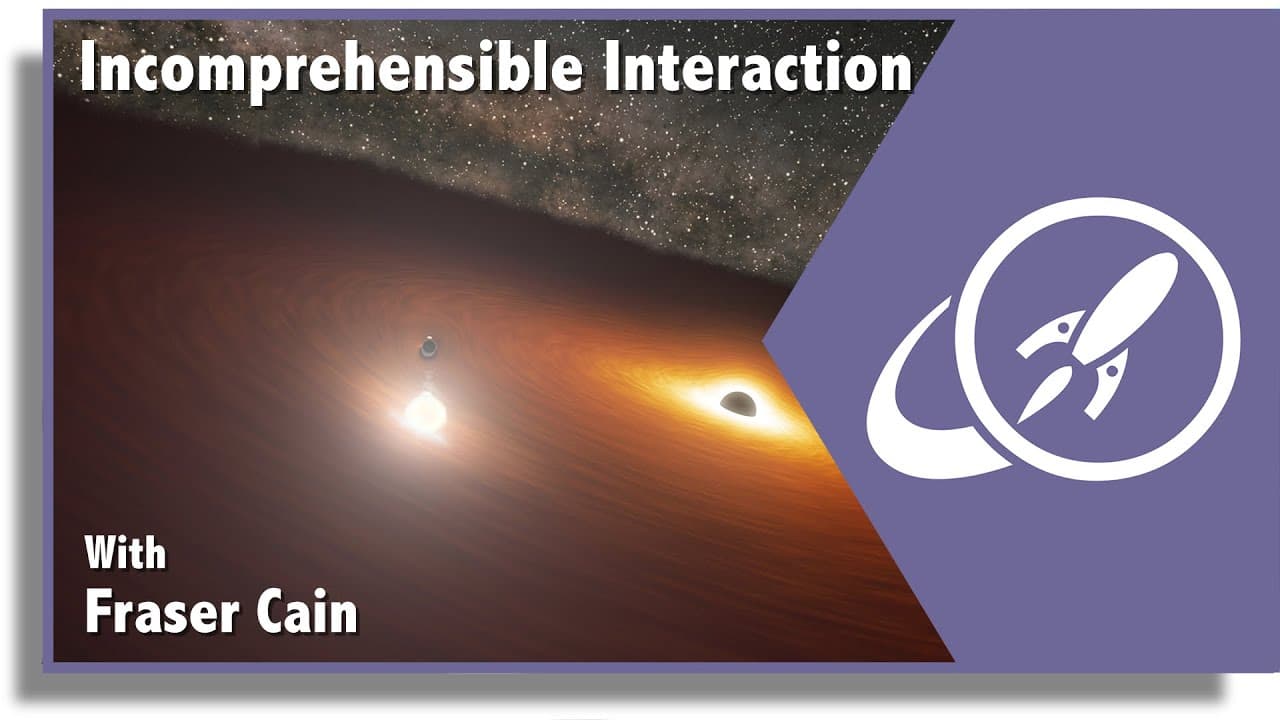
Astronomers have found a system where a supermassive black hole with millions of times the mass of the Sun orbits another black hole with billions of times the mass of the Sun.
Transcript
The Moon orbits around the Earth. The Earth orbits around the Sun. And out in the distant Universe, astronomers have found a system that takes this logical progression to its most extreme. There’s a system where a supermassive black hole with millions of times the mass of the Sun orbits another black hole with billions of times the mass of the Sun.... Read More
Key Insights
- 🖤 OJ 287 is a distant galaxy containing a supermassive black hole 18 billion times the mass of the Sun.
- 🖤 This massive black hole is orbited by another supermassive black hole with 150 million times the mass of the Sun.
- ⬛ The smaller black hole generates bright flashes of light when it passes through the accretion disk of the larger black hole.
- 📸 NASA's Spitzer Space Telescope observed the predicted flash in OJ 287 before its retirement in 2020.
- 🖤 Gravitational wave detections have provided evidence supporting the "no hair" theorem, which suggests that black holes have smooth event horizons.
- 👻 Observations of OJ 287 allowed astronomers to validate theories and models regarding black hole movements and interactions.
- 👋 This discovery highlights the extreme sizes and masses of objects in the universe, as well as the significance of gravitational waves in understanding cosmic phenomena.
Install to Summarize YouTube Videos and Get Transcripts
Explore YouTube Video Summarizer or Get YouTube Transcript Extractor
Questions & Answers
Q: How did astronomers discover the interaction between the two supermassive black holes in OJ 287?
Astronomers observed a flash of light coming from the galactic center of OJ 287 on a semi-regular basis. They realized that the smaller black hole passing through the larger black hole's accretion disk was causing these flashes.
Q: What were the predictions made by scientists regarding the next flare in OJ 287?
A group of scientists accurately predicted when the next flare in OJ 287 would occur, within a couple of weeks of accuracy. They determined that the smaller black hole would pass through the accretion disk of the larger black hole, generating a bright flash of light.
Q: What instrument was used to observe the predicted flare in OJ 287?
NASA's Spitzer Space Telescope, which was on its final years of operation, was directed to observe OJ 287 for the predicted flash. The observations confirmed the accuracy of the predictions.
Q: How did gravitational wave detections contribute to the understanding of black hole movements?
Gravitational waves, detected through instruments like LIGO, allowed physicists to calculate black hole movements with higher accuracy. This information, combined with theories about black hole surfaces and the "no hair" theorem, helped astronomers understand the interactions between black holes in systems like OJ 287.
Summary & Key Takeaways
-
Astronomers have discovered a distant galaxy called OJ 287 that contains a supermassive black hole 18 billion times the mass of the Sun.
-
This black hole is orbited by another supermassive black hole with 150 million times the mass of the Sun.
-
The smaller black hole generates a flash of light brighter than the entire Milky Way each time it passes through the accretion disk of the larger black hole.
Read in Other Languages (beta)
Share This Summary 📚
Summarize YouTube Videos and Get Video Transcripts with 1-Click
Try YouTube Summary with ChatGPT & Claude or YouTube Transcript Generator
Explore More Summaries from Fraser Cain 📚




Summarize YouTube Videos and Get Video Transcripts with 1-Click
Try YouTube Summary with ChatGPT & Claude or YouTube Transcript Generator