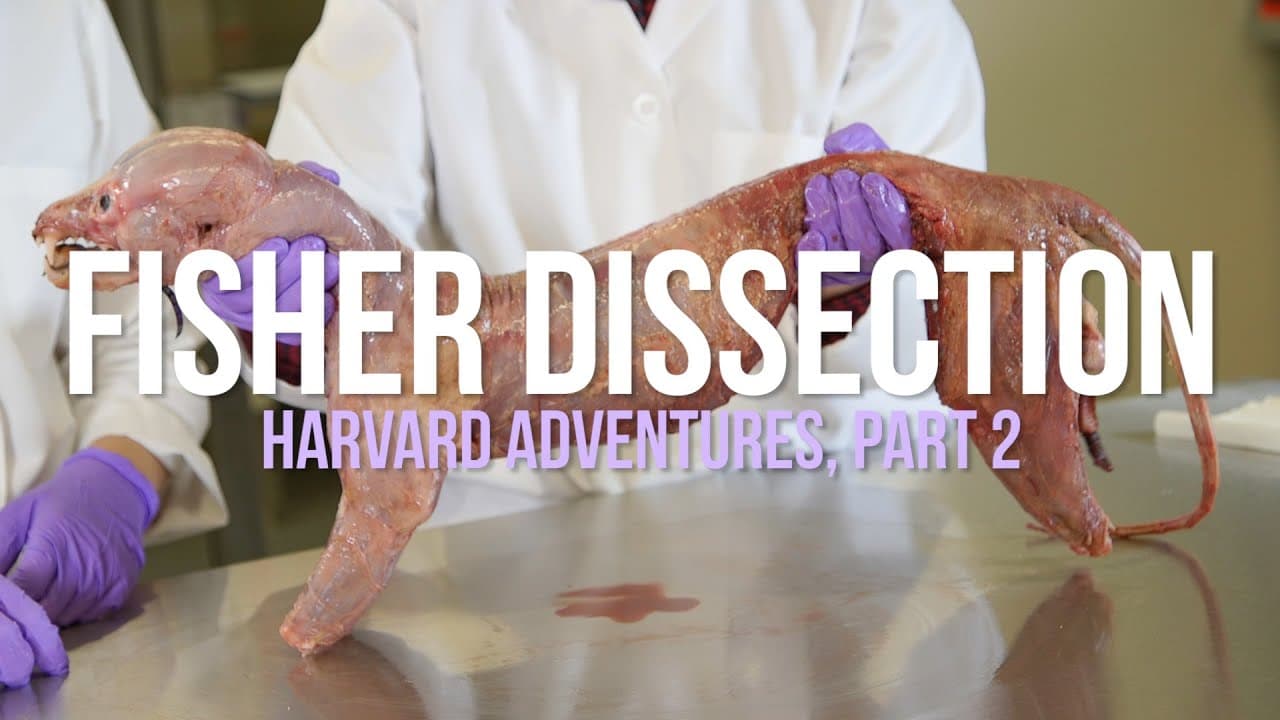
Fisher Dissection: Harvard Adventures, Part 2
TL;DR
Dr. Kenneth Angielczyk and Dr. Katrina Jones dissect fossil mammals to study the evolution of synapsids and their unique vertebral columns.
Transcript
[Warning: This episode contains material that may not be suitable for all audiences. Viewer discretion is advised. Seriously.] [The Brain Scoop Grossometer: EXTREME - some blood, skin removal, visible organs] This series of episodes is brought to you by the Field Museum, the Harvard Museum of Comparative Zoology and the National Science Foundation.... Read More
Key Insights
- 💀 Synapsids are a diverse group of animals that evolved over millions of years, resulting in a wide range of skull and body structures.
- 💀 The synapsid temporal opening is a defining characteristic that all synapsids share, regardless of their skull structure.
- 🫒 The evolution of specialized joints in the vertebral column enabled the flexion, extension, and twisting movements observed in living mammals.
- 😑 The hox genes play a crucial role in region development in the vertebral column, and analyzing these regions in fossil synapsids can provide insights into the expression of these genes in ancient animals.
- 🥳 Dissecting and studying the soft tissues of animals can provide valuable information about the functions and movements of various body parts.
Install to Summarize YouTube Videos and Get Transcripts
Explore YouTube Video Summarizer or Get YouTube Transcript Extractor
Questions & Answers
Q: What is a synapsid and what characteristic defines them?
Synapsids are a group of animals that includes both living mammals and certain fossil forms. They are characterized by having an opening at the back of the skull, just behind the eye socket, where jaw muscles attach.
Q: How do fossil synapsids compare to living mammals in terms of skull structure?
Fossil synapsids, such as Eothyris and Massetognathus, have different skull structures compared to living mammals. However, they still exhibit the synapsid temporal opening, which is a shared characteristic.
Q: What are the researchers studying regarding the backbone of synapsids?
The researchers are interested in understanding the evolution of the backbone in synapsids. They want to investigate how the different regions of the vertebral column in living mammals have evolved and how these regions may have functioned in ancient synapsids.
Q: Why do the researchers dissect the animals and remove soft tissues?
By dissecting animals with soft tissues intact, the researchers can study how the backbone functions in living animals. This information allows them to model how the vertebral columns of fossil synapsids would have worked when their soft tissues were still attached.
Summary & Key Takeaways
-
Synapsids are a group of animals that includes living mammals and various fossil forms, all of which have an opening behind the eye socket where jaw muscles attach.
-
Fossil synapsids, such as Eothyris and Massetognathus, exhibit different skull structures but share the synapsid temporal opening.
-
The researchers are interested in studying the evolution of the backbone in synapsids, particularly in relation to the distinct regions found in the vertebral columns of living mammals.
Read in Other Languages (beta)
Share This Summary 📚
Summarize YouTube Videos and Get Video Transcripts with 1-Click
Try YouTube Summary with ChatGPT & Claude or YouTube Transcript Generator
Explore More Summaries from thebrainscoop 📚


Summarize YouTube Videos and Get Video Transcripts with 1-Click
Try YouTube Summary with ChatGPT & Claude or YouTube Transcript Generator