Products
Features
YouTube Video Summarizer
Summarize YouTube videos
Web & PDF Highlighter
Highlight web pages & PDFs
Chat with PDF
Ask any PDF questions with AI
Ask AI Clone
Chat with your highlights & memories
Audio Transcriber
Transcribe audio files to text
Glasp Reader
Read and highlight articles
Kindle Highlight Export
Export your Kindle highlights
Idea Hatch
Hatch ideas from your highlights
Integrations
Obsidian Plugin
Notion Integration
Pocket Integration
Instapaper Integration
Medium Integration
Readwise Integration
Snipd Integration
Hypothesis Integration
Apps & Extensions
Chrome Extension
Safari Extension
Edge Add-ons
Firefox Add-ons
iOS App
Android App
Discover
Discover
Ideas
Discover new ideas and insights
Articles
Curated articles and insights
Books
Book recommendations by great minds
Posts
Essays and notes from readers
Quotes
Inspiring quotes collection
Videos
Curated videos and summaries
Explore Glasp
Glasp Newsletter
Weekly insights and updates
Glasp Talk
Interview series with great minds
Glasp Blog
Latest news and articles
Glasp Use Cases
Learn how others use Glasp
Build & Support
Glasp API
Access Glasp's API for developers
MCP Connector
Connect Glasp to Claude & ChatGPT
Community
Glasp Reddit Community
Students
Student discount and benefits
FAQs
Frequently Asked Questions
AboutPricing
DashboardLog inSign up

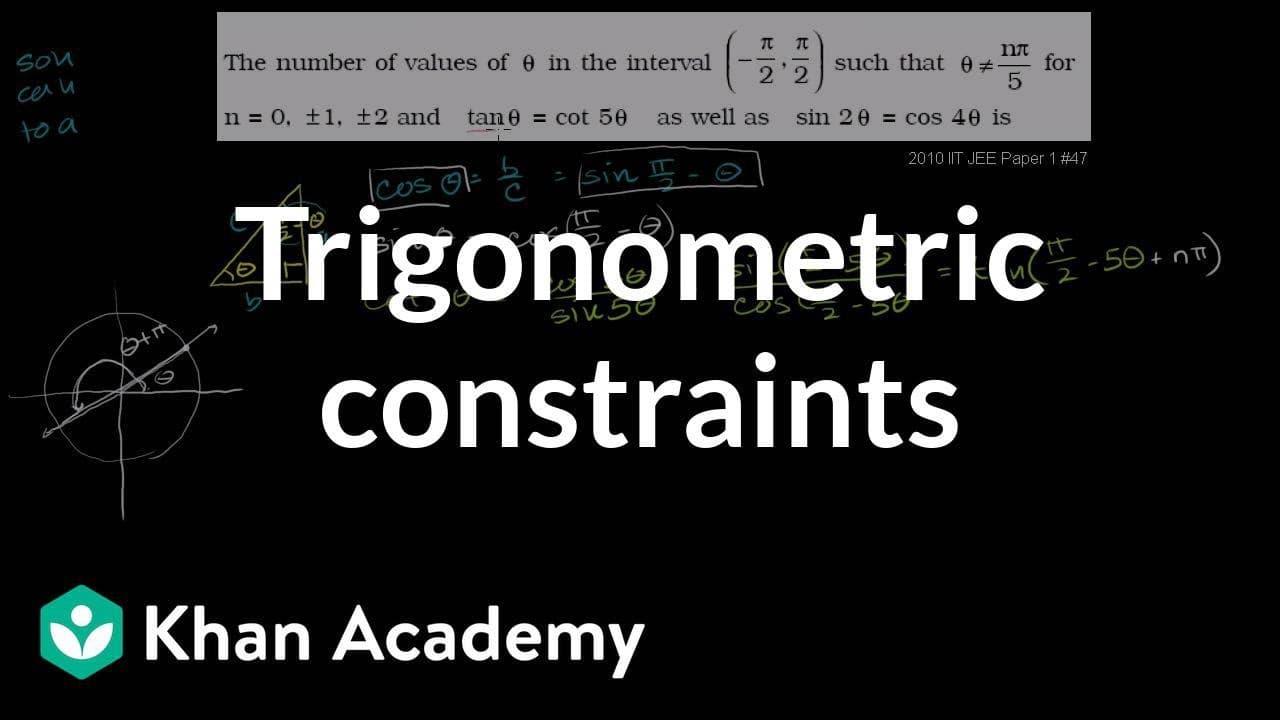
IIT JEE trigonometric constraints | Trig identities and examples | Trigonometry | Khan Academy
December 21, 2010
by
Khan Academy
YouTube video player
IIT JEE trigonometric constraints | Trig identities and examples | Trigonometry | Khan Academy

TL;DR

The video explains how to find the number of values of theta that satisfy specific trigonometric equations.

Transcript

The number of values of theta in the interval from negative pi over 2 to pi over 2-- and it's not including those because we have curly parentheses around it --such that theta does not equal n pi over 5. So it's not a multiple of pi over 5, for n equals 0 plus or minus 1, plus or minus 2. And tangent of theta is equal to cotangent of 5 theta, as we... Read More

Key Insights

  • 🖐️ Trigonometric identities, such as "cosine is adjacent over hypotenuse," play a crucial role in solving trigonometric equations.
  • 🤨 Adding or subtracting multiples of pi accounts for coterminal angles, ensuring all solutions are considered.
  • 💁 Tangent values remain the same when multiples of pi are added to the angle due to their relationship with the slope of the line formed.

Install to Summarize YouTube Videos and Get Transcripts

Explore YouTube Video Summarizer or Get YouTube Transcript Extractor

Questions & Answers

Q: What is the purpose of finding the number of values of theta in this context?

The number of values of theta helps determine the number of possible solutions to the given trigonometric equations, providing insight into the behavior of the functions involved.

Q: How are sine and cosine identities used in solving the equations?

By equating sine and cosine of different angles, the equations can be simplified, allowing for easier solving.

Q: Why does the video mention the addition or subtraction of multiples of pi?

The addition or subtraction of multiples of pi accounts for angles that are coterminal and have the same trigonometric function values, enabling the inclusion of all possible solutions.

Q: How does the use of the unit circle help in solving the equations?

The unit circle provides a visual representation of the angles involved, allowing for a better understanding of their relationships and how trigonometric ratios can be applied.

Summary & Key Takeaways

  • The content discusses finding the number of values of theta within a given interval that satisfy specific trigonometric equations.

  • It introduces the use of trigonometric identities to solve the equations.

  • The video demonstrates the process using examples and provides explanations step by step.


Read in Other Languages (beta)

English

Share This Summary 📚

Summarize YouTube Videos and Get Video Transcripts with 1-Click

Download browser extensions on:

Try YouTube Summary with ChatGPT & Claude or YouTube Transcript Generator

Explore More Summaries from Khan Academy 📚
Common denominators: 3/5 and 7/2  | Math | 4th grade | Khan Academy thumbnail
Common denominators: 3/5 and 7/2 | Math | 4th grade | Khan Academy
Khan Academy
Converting mixed numbers to improper fractions | Fractions | Pre-Algebra | Khan Academy thumbnail
Converting mixed numbers to improper fractions | Fractions | Pre-Algebra | Khan Academy
Khan Academy
How Do Double Number Lines Help Understand Ratios? thumbnail
How Do Double Number Lines Help Understand Ratios?
Khan Academy
Part-to-whole relationships in text structure | Reading | Khan Academy thumbnail
Part-to-whole relationships in text structure | Reading | Khan Academy
Khan Academy
Radical functions differentiation | Derivative rules | AP Calculus AB | Khan Academy thumbnail
Radical functions differentiation | Derivative rules | AP Calculus AB | Khan Academy
Khan Academy
Zeros of polynomials (multiplicity) | Polynomial graphs | Algebra 2 | Khan Academy thumbnail
Zeros of polynomials (multiplicity) | Polynomial graphs | Algebra 2 | Khan Academy
Khan Academy

Summarize YouTube Videos and Get Video Transcripts with 1-Click

Download browser extensions on:

Try YouTube Summary with ChatGPT & Claude or YouTube Transcript Generator

Apps & Extensions

  • Chrome Extension
  • Safari Extension
  • Edge Add-ons
  • Firefox Add-ons
  • iOS App
  • Android App

Key Features

  • YouTube Video Summarizer
  • Web & PDF Summarizer
  • Web & PDF Highlighter
  • Chat with PDF
  • Ask AI Clone
  • Audio Transcriber
  • Glasp Reader
  • Kindle Highlight Export
  • Idea Hatch

Integrations

  • Obsidian Plugin
  • Notion Integration
  • Pocket Integration
  • Instapaper Integration
  • Medium Integration
  • Readwise Integration
  • Snipd Integration
  • Hypothesis Integration

More Features

  • APIs
  • MCP Connector
  • Blog & Post
  • Embed Links
  • Image Highlight
  • Personality Test
  • Quote Shots

Company

  • About us
  • Blog
  • Community
  • FAQs
  • Job Board
  • Newsletter
  • Pricing
Terms

•

Privacy

•

Guidelines

© 2026 Glasp Inc. All rights reserved.