What is Zeno's Dichotomy Paradox? - Colm Kelleher
TL;DR
Zeno's paradox suggests that motion is impossible due to the infinite division of distance and time, but mathematicians have shown that infinite series can still yield a finite answer.
Transcript
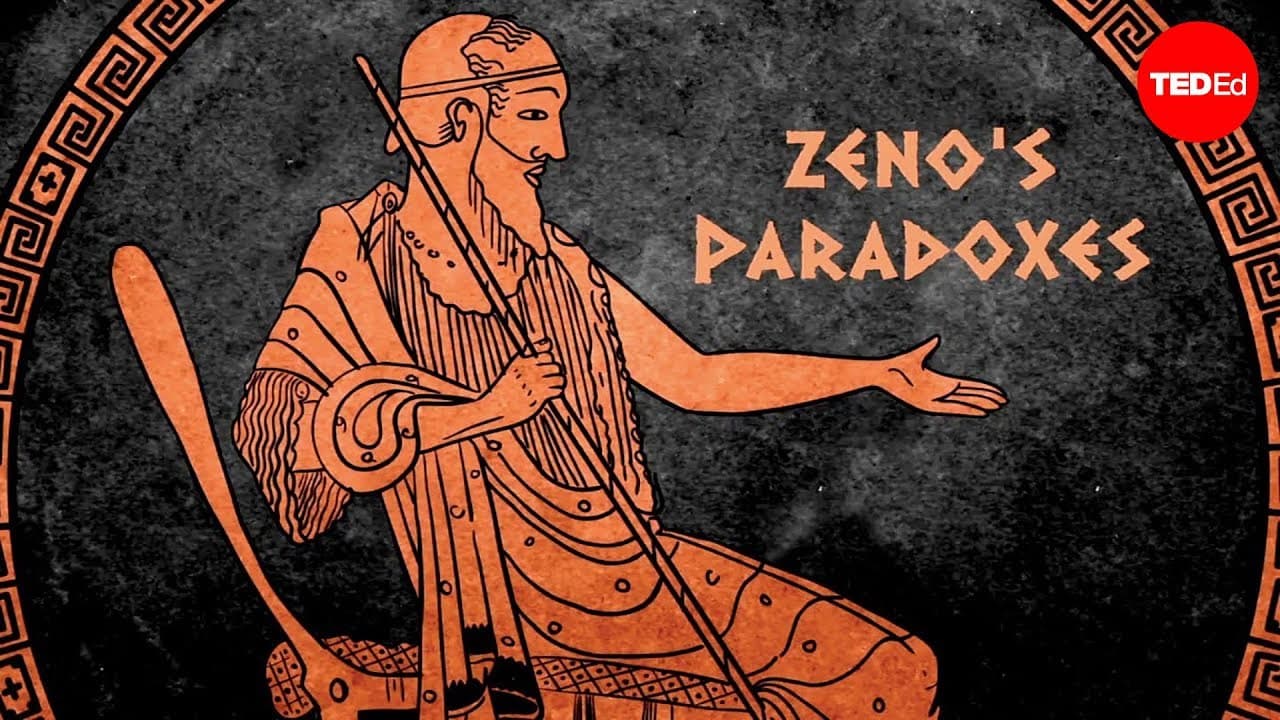
Translator: Andrea McDonough Reviewer: Bedirhan Cinar This is Zeno of Elea, an ancient Greek philosopher famous for inventing a number of paradoxes, arguments that seem logical, but whose conclusion is absurd or contradictory. For more than 2,000 years, Zeno's mind-bending riddles have inspired mathematicians and philosophers to better understand t... Read More
Key Insights
- ♾️ Zeno's paradox has intrigued mathematicians and philosophers for over 2,000 years, inspiring discussions about the nature of infinity and motion.
- 🛩️ The dichotomy paradox in Zeno's paradox challenges the idea of motion by dividing distance and time into infinitely smaller pieces.
- 🛀 Mathematicians have resolved Zeno's paradox by showing that infinite series can converge to finite values, demonstrating that motion is not impossible.
- ⌛ The resolution of Zeno's paradox aligns with common sense notions of time and distance, affirming that motion is possible.
- ♾️ Understanding the counterintuitive nature of infinity and the concept of infinite series is crucial in resolving Zeno's paradox.
- ◾ The example of chopping a square into infinitely smaller pieces demonstrates how an infinite sum can still yield a finite value.
- 🌍 Zeno's paradox showcases the limitations of using logic alone to understand the complexities of the physical world.
Install to Summarize YouTube Videos and Get Transcripts
Explore YouTube Video Summarizer or Get YouTube Transcript Extractor
Questions & Answers
Q: What is Zeno's paradox?
Zeno's paradox is a collection of paradoxes created by Zeno of Elea to challenge the concept of motion and the existence of infinity. One of the most famous is the dichotomy paradox, which involves dividing distance and time infinitely.
Q: How does Zeno's paradox relate to the nature of infinity?
Zeno's paradox uses the idea of infinity to argue that motion is impossible. By infinitely dividing a distance or time, it appears that an infinite number of steps or moments would be required, leading to the conclusion that motion cannot occur.
Q: How do mathematicians resolve Zeno's paradox?
Mathematicians resolve Zeno's paradox by demonstrating that infinite series can still yield a finite answer. By examining the sum of infinitely many finite-sized terms, they show that the sum can converge to a finite value.
Q: What does the resolution of Zeno's paradox tell us about motion?
The resolution of Zeno's paradox reaffirms that motion is possible and that common sense notions of time and distance are accurate. It highlights the limitations of using infinite division to argue against the existence of motion.
Summary & Key Takeaways
-
Zeno of Elea, an ancient Greek philosopher, invented paradoxes to understand infinity.
-
The dichotomy paradox challenges the idea of motion by dividing distance into infinitely smaller pieces.
-
Mathematicians have resolved the paradox by showing that infinite series can still have a finite sum.
Read in Other Languages (beta)
Share This Summary 📚
Summarize YouTube Videos and Get Video Transcripts with 1-Click
Try YouTube Summary with ChatGPT & Claude or YouTube Transcript Generator
Explore More Summaries from TED-Ed 📚


Summarize YouTube Videos and Get Video Transcripts with 1-Click
Try YouTube Summary with ChatGPT & Claude or YouTube Transcript Generator