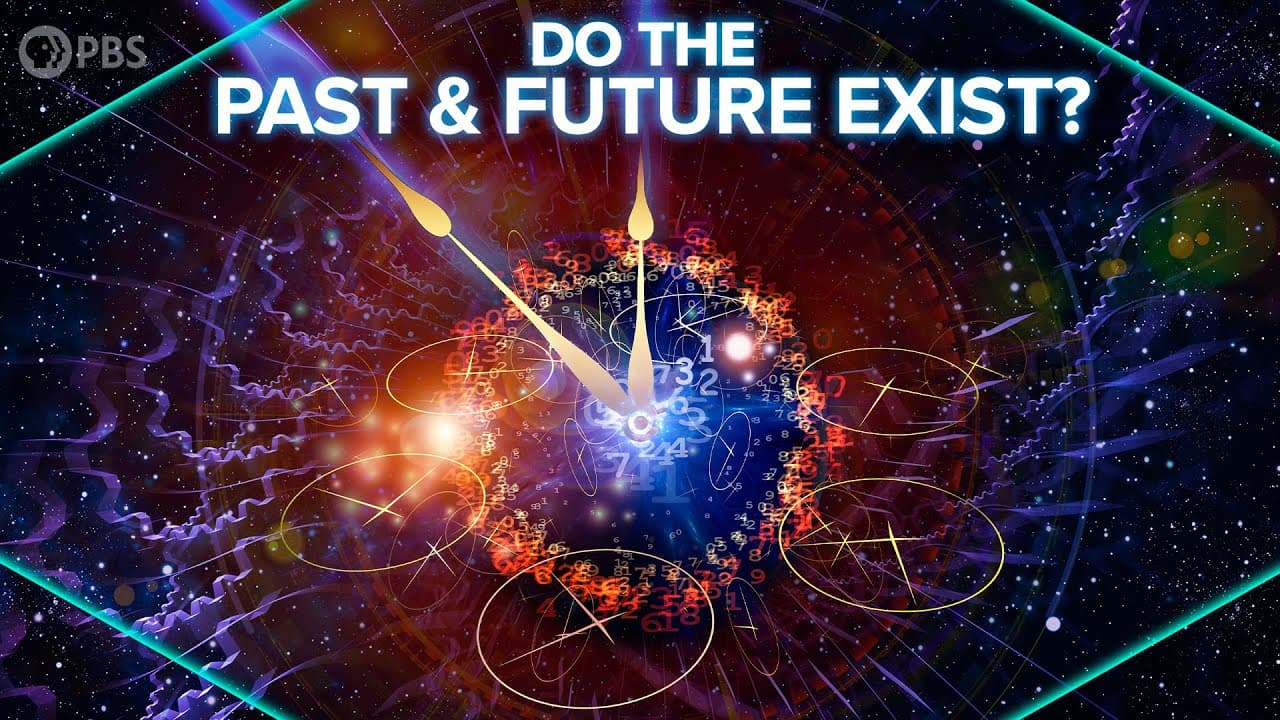
Do the Past and Future Exist?
TL;DR
The nature of time challenges our perception of past, present, and future.
Transcript
Is all that exists just whatever exists right now? Is the past erased and the future a void yet to be filled? Well the answer lies in between the past and the future - in the elusive, ever-moving eye-blink that we call the present. Today we’re starting a deep dive into the nature of time - and down that rabbit hole we’ll encounter the physical orig... Read More
Key Insights
- The concept of time challenges our perception of reality, questioning whether the past and future truly exist or if only the present is real.
- Newton’s deterministic universe suggests that knowing the current state of particles allows prediction of all past and future states.
- Einstein’s theory of relativity introduced the idea that time is not absolute, and the present is relative to the observer's motion.
- The block universe theory proposes that all of time exists as a four-dimensional structure, with no true present, past, or future.
- Eternalism suggests that past, present, and future all exist simultaneously, while presentism posits only the current moment is real.
- Quantum mechanics introduces indeterminacy to the universe, suggesting that unobserved events exist in multiple potential states.
- Different interpretations of quantum mechanics, such as Many Worlds, imply all possible realities exist and persist into the future.
- The concept of light cones in relativity shows that our perception of the present is limited by the speed of light and our position in space-time.
Install to Summarize YouTube Videos and Get Transcripts
Explore YouTube Video Summarizer or Get YouTube Transcript Extractor
Questions & Answers
Q: What is the block universe theory?
The block universe theory posits that all of time exists as a four-dimensional structure, where the past, present, and future are equally real. In this view, time is like a spatial dimension, and the flow of time is an illusion created by our perception. The theory challenges the traditional notion of a linear timeline.
Q: How does Einstein's relativity affect our understanding of time?
Einstein's theory of relativity shows that time is not an absolute entity but is relative to the observer's motion. It introduces the idea that the present is not a universal concept, as different observers may perceive different slices of time depending on their relative velocities. This challenges the notion of a single, shared present.
Q: What is eternalism in the context of time?
Eternalism is the philosophical viewpoint that all points in time—past, present, and future—exist simultaneously. It contrasts with presentism, which holds that only the current moment is real. Eternalism aligns with the block universe theory, suggesting that time is a dimension like space, and all moments are equally real and existent.
Q: How does quantum mechanics challenge determinism?
Quantum mechanics introduces indeterminacy, suggesting that particles do not have definite states until observed. This challenges the deterministic view that the future is entirely predictable based on the present. Instead, quantum mechanics implies that multiple potential outcomes exist, leading to interpretations like the Many Worlds theory, where all possible realities coexist.
Q: What is the role of light cones in relativity?
Light cones are a concept in relativity that define the region of space-time from which signals can reach an observer. The past light cone includes events that can currently be observed, while the future light cone encompasses events that can be influenced. Light cones illustrate the limitations of perceiving the present, as distant events may not be observable until their light reaches us.
Q: How does the concept of presentism differ from eternalism?
Presentism is the belief that only the present moment is real, and the past and future do not exist in any meaningful way. In contrast, eternalism posits that all points in time are equally real and existent. While presentism sees time as a flowing river, eternalism views it as a static landscape, where all moments are laid out simultaneously.
Q: What implications does the block universe have on free will?
In the block universe model, all moments in time exist simultaneously, suggesting that the future is already determined. This raises questions about free will, as it implies that our choices are predetermined within the block structure. However, interpretations vary, and some argue that quantum mechanics allows for multiple potential outcomes, preserving the notion of free will.
Q: How might quantum mechanics support the idea of a block multiverse?
Quantum mechanics, particularly the Many Worlds interpretation, suggests that all possible outcomes of quantum events exist simultaneously in a multiverse. This aligns with the block universe concept, where all moments and realities are equally real. In a block multiverse, different timelines and outcomes coexist, offering a framework where both determinism and indeterminacy are reconciled.
Summary & Key Takeaways
-
The nature of time is explored through concepts like the block universe, where all moments exist simultaneously, challenging our perception of a linear past, present, and future.
-
Einstein's relativity suggests that time is not absolute, with the present being a relative concept influenced by an observer's motion, contrasting with Newton's deterministic universe.
-
Quantum mechanics introduces the idea of indeterminacy, where unobserved events exist in multiple states, potentially supporting the notion of a block multiverse where all realities coexist.
Read in Other Languages (beta)
Share This Summary 📚
Summarize YouTube Videos and Get Video Transcripts with 1-Click
Try YouTube Summary with ChatGPT & Claude or YouTube Transcript Generator
Explore More Summaries from PBS Space Time 📚
Summarize YouTube Videos and Get Video Transcripts with 1-Click
Try YouTube Summary with ChatGPT & Claude or YouTube Transcript Generator