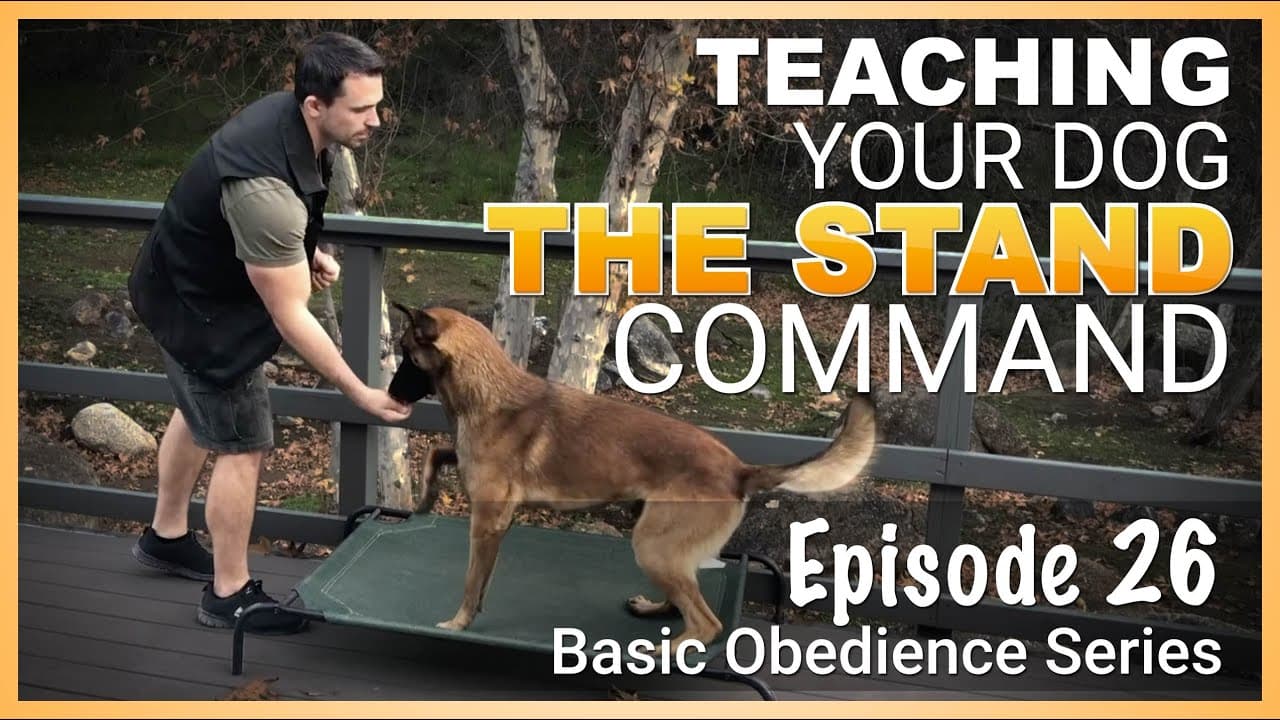
How to Teach Your Dog to STAND on Command. Episode 26
TL;DR
Learn how to teach your dog to stand on command.
Transcript
for the stand I like to use the climb bit so I'm gonna guide my little puppy up on the climb here and then place them into a sit and remember the hand is gonna go from being upwards to inwards and towards the chest okay so he's flopping down what you're gonna see what some dogs we want to bring them back up and I can even help a little bit with the... Read More
Key Insights
- Using a climb bit can help guide a dog into a standing position, starting from a sit, and using hand movements towards the chest.
- Leash pressure can assist in encouraging the dog to move into a stand, with gradual pressure to guide the behavior.
- Rewarding the dog with treats when they successfully perform the stand reinforces positive behavior and helps them learn the command.
- Naming the command should only be done once the dog consistently performs the behavior with physical cues, ensuring they understand the action.
- Repetition is key, especially for young puppies, as the stand command is more challenging and requires practice to master.
- Using a combination of verbal cues and hand signals helps the dog associate the action with the command, improving their response over time.
- The stand command can be useful for service dogs, as it aids in tasks like counterbalance and support.
- Switching command words can prevent confusion with similar sounding commands, ensuring the dog clearly understands each action.
Install to Summarize YouTube Videos and Get Transcripts
Explore YouTube Video Summarizer or Get YouTube Transcript Extractor
Questions & Answers
Q: How does the instructor guide the dog into a standing position?
The instructor uses a combination of hand movements towards the chest and leash pressure to guide the dog into a standing position. By rotating the hand inwards and guiding the dog's legs back, the dog is encouraged to stand, with positive reinforcement through treats when successful.
Q: What role does leash pressure play in the training?
Leash pressure is used to provide gentle guidance to the dog, encouraging them to move into a standing position. The pressure is applied forward, helping the dog understand the desired movement. This method is combined with verbal cues and rewards to reinforce the behavior.
Q: When should the command be named during training?
The command should be named only after the dog consistently performs the stand behavior with physical cues. This ensures that the dog understands the action associated with the command, allowing for a clear association between the verbal cue and the behavior.
Q: Why is repetition important in teaching the stand command?
Repetition is crucial because the stand command is more challenging than other basic commands. Consistent practice helps the dog understand and remember the behavior, especially for young puppies who are still learning and developing their understanding of commands.
Q: How can the stand command benefit service dogs?
The stand command is beneficial for service dogs as it can be used for tasks like counterbalance and counter support. Teaching a service dog to stand on command allows them to assist their handler in maintaining balance and providing support when needed.
Q: What is the significance of switching command words?
Switching command words is important if the dog confuses similar sounding commands. This helps ensure that the dog clearly understands each command and reduces the likelihood of confusion, improving their response to the correct action.
Q: How does the instructor use rewards in the training process?
The instructor uses treats as a reward to reinforce positive behavior when the dog successfully performs the stand command. Each time the dog completes the action correctly, they receive a treat, which encourages them to repeat the behavior and strengthens their understanding of the command.
Q: What is the purpose of combining verbal cues with hand signals?
Combining verbal cues with hand signals helps the dog associate the action with the command more effectively. The use of both verbal and physical cues enhances the dog's learning process, making it easier for them to understand and respond to the command consistently.
Summary & Key Takeaways
-
This video explains how to teach your dog to stand on command using a combination of hand signals, leash pressure, and rewards. The training involves guiding the dog into a stand from a sit or down position, with repetition being key to mastering the command.
-
The instructor demonstrates the use of verbal cues alongside physical guidance to help the dog associate the command with the action. The video highlights the importance of rewarding the dog consistently to reinforce positive behavior.
-
The stand command is particularly useful for service dogs and requires patience and practice. The video suggests switching command words if the dog confuses similar actions and emphasizes the gradual introduction of the verbal cue once the dog reliably performs the stand.
Read in Other Languages (beta)
Share This Summary 📚
Summarize YouTube Videos and Get Video Transcripts with 1-Click
Try YouTube Summary with ChatGPT & Claude or YouTube Transcript Generator
Explore More Summaries from Nate Schoemer 📚


Summarize YouTube Videos and Get Video Transcripts with 1-Click
Try YouTube Summary with ChatGPT & Claude or YouTube Transcript Generator