Products
Features
YouTube Video Summarizer
Summarize YouTube videos
Web & PDF Highlighter
Highlight web pages & PDFs
Chat with PDF
Ask any PDF questions with AI
Ask AI Clone
Chat with your highlights & memories
Audio Transcriber
Transcribe audio files to text
Glasp Reader
Read and highlight articles
Kindle Highlight Export
Export your Kindle highlights
Idea Hatch
Hatch ideas from your highlights
Integrations
Obsidian Plugin
Notion Integration
Pocket Integration
Instapaper Integration
Medium Integration
Readwise Integration
Snipd Integration
Hypothesis Integration
Apps & Extensions
Chrome Extension
Safari Extension
Edge Add-ons
Firefox Add-ons
iOS App
Android App
Discover
Discover
Ideas
Discover new ideas and insights
Articles
Curated articles and insights
Books
Book recommendations by great minds
Posts
Essays and notes from readers
Quotes
Inspiring quotes collection
Videos
Curated videos and summaries
Explore Glasp
Glasp Newsletter
Weekly insights and updates
Glasp Talk
Interview series with great minds
Glasp Blog
Latest news and articles
Glasp Use Cases
Learn how others use Glasp
Build & Support
Glasp API
Access Glasp's API for developers
MCP Connector
Connect Glasp to Claude & ChatGPT
Community
Glasp Reddit Community
Students
Student discount and benefits
FAQs
Frequently Asked Questions
AboutPricing
DashboardLog inSign up

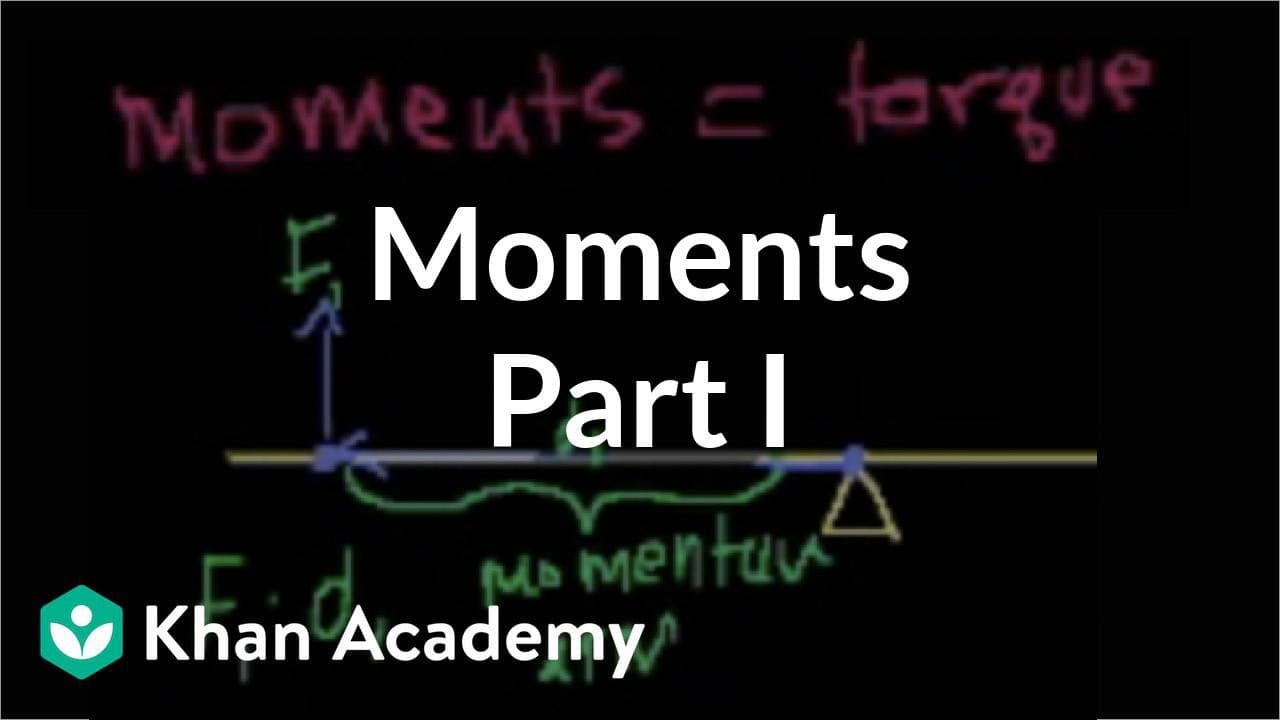
Moments | Moments, torque, and angular momentum | Physics | Khan Academy
May 23, 2008
by
Khan Academy
YouTube video player
Moments | Moments, torque, and angular momentum | Physics | Khan Academy

TL;DR

Moments of force, also known as torque, are created when a force is applied at a distance from the axis of rotation.

Transcript

Welcome to the presentation on moments. So just if you were wondering, I have already covered moments. You just may not have recognized it, because I covered it in mechanical advantage and torque. But I do realize that when I covered it in mechanical advantage and torque, I think I maybe over-complicated it. And if anything, I didn't cover some of ... Read More

Key Insights

  • ❓ Moments of force, also known as torque, determine an object's ability to rotate.
  • ✖️ The formula for calculating moments of force is force multiplied by the distance from the axis of rotation.
  • ❓ Balanced moments of force result in equilibrium, while unbalanced moments cause rotation.
  • 🍹 The Law of Moments states that the sum of clockwise moments must be equal to the sum of counterclockwise moments for equilibrium.
  • 🖐️ Moments of force play a vital role in various fields, including engineering and architecture.
  • 🦾 Lever arms and moment arm distances are interchangeable terms referring to the distance from the axis of rotation.
  • 🦾 Moments of force calculations are used to design stable structures and mechanical systems.

Install to Summarize YouTube Videos and Get Transcripts

Explore YouTube Video Summarizer or Get YouTube Transcript Extractor

Questions & Answers

Q: What is a moment of force?

A moment of force, also known as torque, is the product of a force and the distance between the axis of rotation and the point where the force is applied. It determines an object's ability to rotate.

Q: How are moments of force calculated?

Moments of force can be calculated by multiplying the perpendicular force with the distance from the axis of rotation. The formula is moment = force x distance.

Q: How do moments of force affect equilibrium?

In order for an object to be in equilibrium, the sum of clockwise moments must be equal to the sum of counterclockwise moments. If the moments are unbalanced, the object will rotate.

Q: How can moments of force be used practically?

Understanding moments of force is crucial in designing structures and mechanical systems. Engineers and architects use torque calculations to ensure stability and balance in various applications, such as bridges and buildings.

Summary & Key Takeaways

  • Moments of force, or torque, are calculated by multiplying the perpendicular force with the distance from the axis of rotation.

  • If the moment of force is unbalanced, it will cause an object to rotate.

  • The Law of Moments states that the sum of clockwise moments must be equal to the sum of counterclockwise moments for an object to be in equilibrium.


Read in Other Languages (beta)

English

Share This Summary 📚

Summarize YouTube Videos and Get Video Transcripts with 1-Click

Download browser extensions on:

Try YouTube Summary with ChatGPT & Claude or YouTube Transcript Generator

Explore More Summaries from Khan Academy 📚
Khan Academy Ed Talks with Ned Johnson - February 2, 2022 thumbnail
Khan Academy Ed Talks with Ned Johnson - February 2, 2022
Khan Academy
Subset, strict subset, and superset | Probability and Statistics | Khan Academy thumbnail
Subset, strict subset, and superset | Probability and Statistics | Khan Academy
Khan Academy
What Are the Sn2 and E2 Reactions of Bromocyclopentane? thumbnail
What Are the Sn2 and E2 Reactions of Bromocyclopentane?
Khan Academy
Sums and products of irrational numbers thumbnail
Sums and products of irrational numbers
Khan Academy
U03_L2_T1_we2 Representing Functions as Graphs thumbnail
U03_L2_T1_we2 Representing Functions as Graphs
Khan Academy
Derivative of sin(ln(x_)) | Advanced derivatives | AP Calculus AB | Khan Academy thumbnail
Derivative of sin(ln(x_)) | Advanced derivatives | AP Calculus AB | Khan Academy
Khan Academy

Summarize YouTube Videos and Get Video Transcripts with 1-Click

Download browser extensions on:

Try YouTube Summary with ChatGPT & Claude or YouTube Transcript Generator

Apps & Extensions

  • Chrome Extension
  • Safari Extension
  • Edge Add-ons
  • Firefox Add-ons
  • iOS App
  • Android App

Key Features

  • YouTube Video Summarizer
  • Web & PDF Summarizer
  • Web & PDF Highlighter
  • Chat with PDF
  • Ask AI Clone
  • Audio Transcriber
  • Glasp Reader
  • Kindle Highlight Export
  • Idea Hatch

Integrations

  • Obsidian Plugin
  • Notion Integration
  • Pocket Integration
  • Instapaper Integration
  • Medium Integration
  • Readwise Integration
  • Snipd Integration
  • Hypothesis Integration

More Features

  • APIs
  • MCP Connector
  • Blog & Post
  • Embed Links
  • Image Highlight
  • Personality Test
  • Quote Shots

Company

  • About us
  • Blog
  • Community
  • FAQs
  • Job Board
  • Newsletter
  • Pricing
Terms

•

Privacy

•

Guidelines

© 2026 Glasp Inc. All rights reserved.