Why Do Stars Become Red Giants as They Age?
TL;DR
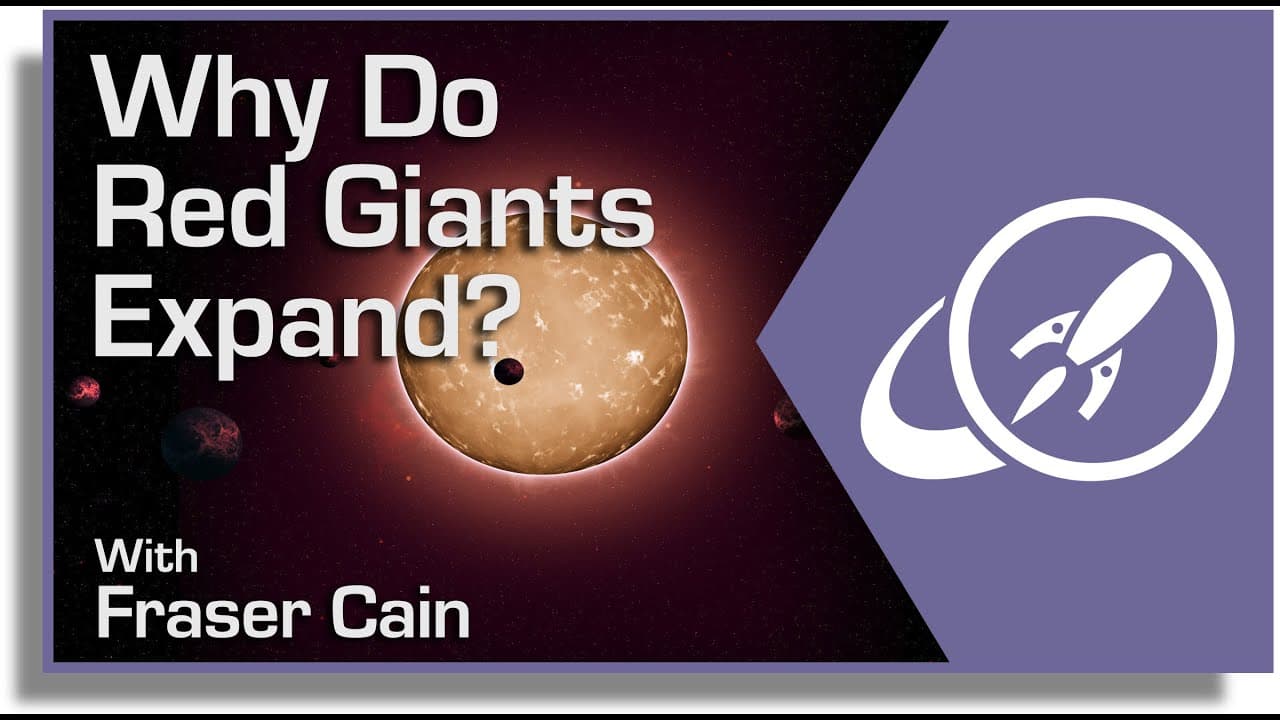
Stars become red giants as they exhaust hydrogen fuel in their cores, leading to periods of contraction and then renewed fusion in outer layers. This process causes them to swell significantly, and when a star like the Sun runs out of fuel entirely, it ultimately transforms into a red giant, potentially engulfing nearby planets before shedding its outer layers and leaving behind a white dwarf.
Transcript
one of the handy things about the universe apart from the fact that it exists is that it lets us see crazy different configurations of everything including planets stars and galaxies we see stars like our Sun and dramatically unlike our Sun tiny cool red dwarf stars with a fraction of the mass of our own sippin away of their hydrogen juice boxes fo... Read More
Key Insights
- 🌟 The universe consists of various configurations of planets, stars, and galaxies, including stars that are vastly different from our sun, such as red dwarf stars and massive stars that eventually explode as supernovae.
- 🔥 The Sun is a main-sequence star that converts hydrogen into helium through nuclear fusion at its core, a process that releases a significant amount of gamma radiation.
- 🌋 The core of the Sun, which makes up only 1% of its volume, is incredibly dense and experiences temperatures exceeding 15 million degrees Celsius.
- 💥 Eventually, the fusion in the core slows down due to the accumulation of helium, causing the core to contract and heat up again, leading to fusion in the outer layer of the Sun and an increase in energy release. ⏰ This cycle of fusion and contraction can occur multiple times, causing the Sun to expand and contract, turn into a red giant, and potentially engulf nearby planets like Earth.
- 🌌 Once the Sun runs out of usable hydrogen and switches to fusing helium, it generates carbon and oxygen as byproducts, but this phase is short-lived.
- 👋 When the Sun exhausts its helium fuel, it swells to hundreds of times its size, releasing thousands of times more energy and becoming a red giant before eventually shedding its outer atmosphere in a beautiful planetary nebula. ⏳ The remaining core of the Sun becomes a white dwarf, cooling down over billions of years until it reaches the background temperature of the universe, marking the end of its life cycle.
Install to Summarize YouTube Videos and Get Transcripts
Explore YouTube Video Summarizer or Get YouTube Transcript Extractor
Questions & Answers
Q: How does the process of nuclear fusion happen in the Sun's core?
The Sun's core, which is a small fraction of its entire volume, is incredibly dense and hot, allowing for the fusion of hydrogen atoms into helium and the release of gamma radiation.
Q: What happens when the core of the Sun becomes filled with helium?
Once the core is choked with helium, the fusion process shuts down, causing the core to contract and heat up, allowing a layer of hydrogen around it to begin fusion again, giving the Sun a second chance at life.
Q: What happens when the Sun runs out of usable hydrogen?
The Sun can switch to using helium as fuel, generating carbon and oxygen as byproducts. However, this phase is short-lived, and the Sun eventually swells into a red giant, possibly engulfing nearby planets like Earth.
Q: What is the final stage of a star's life?
After the red giant phase, the remaining atmosphere of the Sun is puffed out into space, creating a planetary nebula. The Sun's core becomes a white dwarf, cooling down over billions of years until it reaches the background temperature of the universe.
Summary & Key Takeaways
-
Stars come in different configurations, from red dwarfs to supernovas, depending on their mass and age.
-
The Sun is a main-sequence star that converts hydrogen into helium at its core through nuclear fusion.
-
As the Sun ages, it will expand and contract multiple times, eventually becoming a red giant and then a white dwarf.
Read in Other Languages (beta)
Share This Summary 📚
Summarize YouTube Videos and Get Video Transcripts with 1-Click
Try YouTube Summary with ChatGPT & Claude or YouTube Transcript Generator
Explore More Summaries from Fraser Cain 📚
Summarize YouTube Videos and Get Video Transcripts with 1-Click
Try YouTube Summary with ChatGPT & Claude or YouTube Transcript Generator