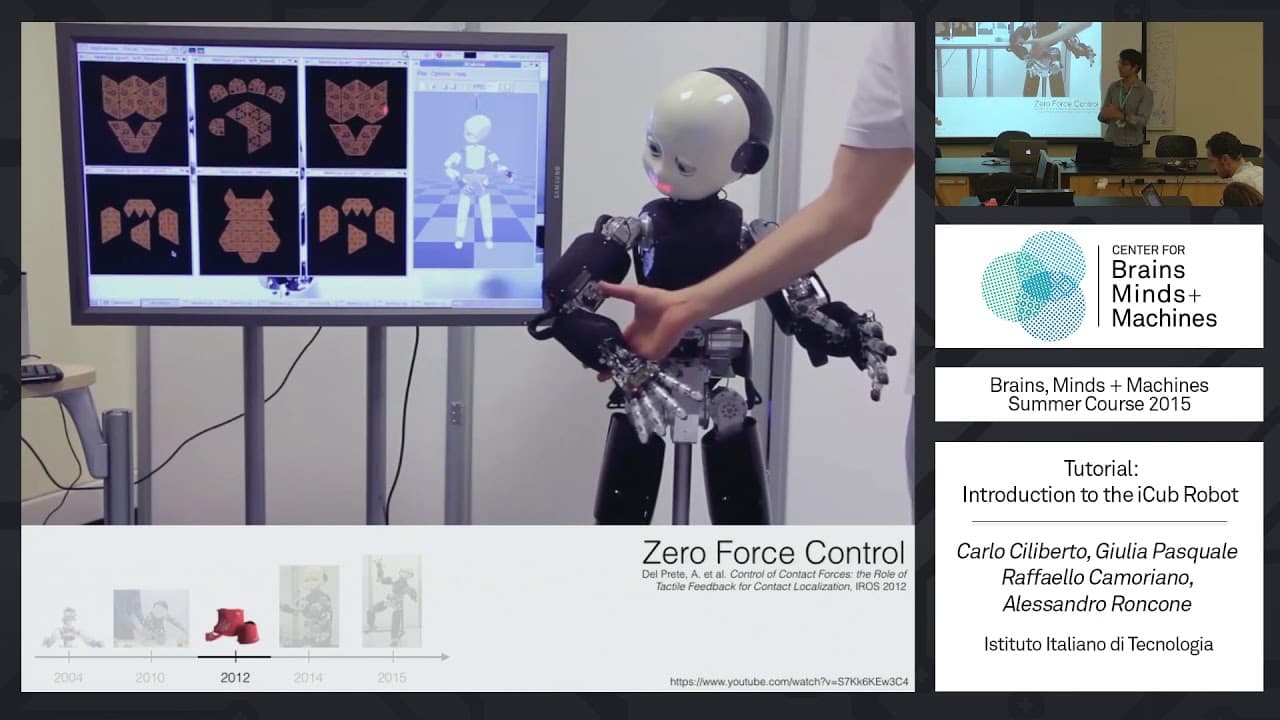
Lecture 8.6: iCub Team - Overview of Research on the iCub Robot
TL;DR
The iCub robot is a child humanoid robot designed to study artificial intelligence and cognition. Visual recognition methods, such as deep learning, have shown promise in object identification, but challenges still remain for implementing them in real-world robotic applications.
Transcript
The following content is provided under a Creative Commons license. Your support will help MIT OpenCourseWare continue to offer high quality educational resources for free. To make a donation or view additional materials from hundreds of MIT courses, visit MIT OpenCourseWare at ocw.mit.edu. CARLO CILIBERTO: Good morning. So today, there is a bit if... Read More
Key Insights
- 🤖 The iCub robot was designed to study artificial intelligence and cognition in embodied systems, with the goal of understanding how intelligence emerges in robots.
- 🌍 Visual recognition methods, such as deep learning, have shown high performance in large-scale image classification, but challenges remain in implementing them in real-world robotics scenarios.
- 🤳 Important requirements for robust visual recognition in robotics include self-supervision, robustness to environmental and appearance variations, exploitation of contextual information, and the ability to learn incrementally.
- 🕖 The iCubWork28 dataset, which includes 28 objects divided into seven categories, was created to evaluate visual recognition performance and address these requirements.
- 💁 Exploiting temporal contextual information, such as using a temporal window of predictions, can significantly improve object identification accuracy.
Install to Summarize YouTube Videos and Get Transcripts
Explore YouTube Video Summarizer or Get YouTube Transcript Extractor
Questions & Answers
Q: What are some of the capabilities of the iCub robot?
The iCub robot has many sensors, including accelerometers, cameras, and force/torque sensors. These sensors allow it to interact with and learn from its environment. It can also perform complex actions and has the ability to balance on one foot.
Q: What is the main motivation behind the creation of the iCub robot?
The main motivation behind creating the iCub robot is to study how intelligence and cognition emerge in artificial embodied systems. Researchers want to understand how robots can learn from and interact with their environment in a way that resembles human intelligence.
Q: How have visual recognition methods, such as deep learning, performed in object identification tasks?
Visual recognition methods based on deep learning, such as convolutional neural networks, have achieved high performance in large-scale image classification tasks. They have also shown promise in object identification tasks, but challenges still exist in applying these methods to real-world robotic applications.
Q: What are some of the challenges in implementing visual recognition methods in robotics?
One of the challenges is the need for self-supervision, where the robot can focus its attention on the object of interest and isolate it from the visual field. Another challenge is the robustness to variations in the environment and object appearance. Additionally, the ability to exploit contextual information, such as temporal correlations in video frames, is also important. Finally, incremental learning is needed to continuously build richer models of objects over time.
Summary & Key Takeaways
-
The iCub robot was developed in 2004 to study how intelligence and cognition emerge in artificial systems.
-
It has many sensors, including accelerometers, cameras, and force/torque sensors, to interact with and learn from its environment.
-
Visual recognition methods, based on deep learning, have achieved high performance in large-scale image classification, but challenges exist in applying them to real-world robotics.
Read in Other Languages (beta)
Share This Summary 📚
Summarize YouTube Videos and Get Video Transcripts with 1-Click
Try YouTube Summary with ChatGPT & Claude or YouTube Transcript Generator
Explore More Summaries from MIT OpenCourseWare 📚


Summarize YouTube Videos and Get Video Transcripts with 1-Click
Try YouTube Summary with ChatGPT & Claude or YouTube Transcript Generator