What Is the Cook-Levin Theorem About NP-Completeness?
TL;DR
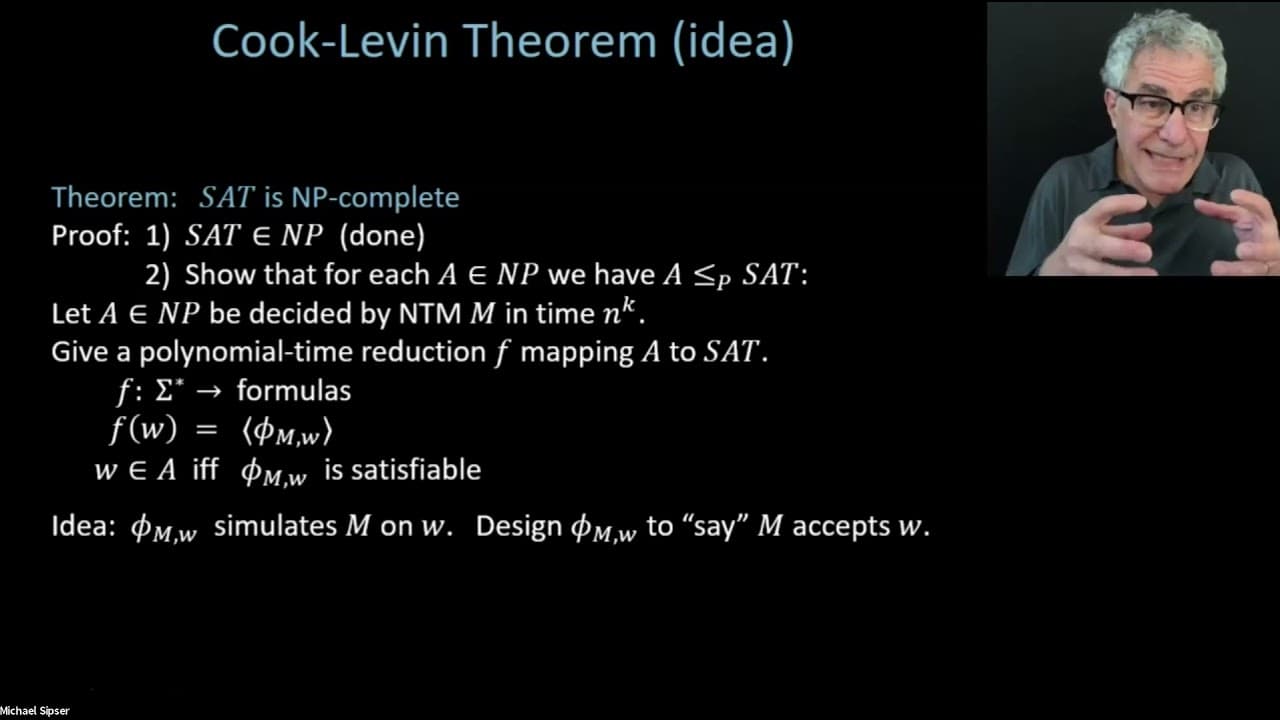
The Cook-Levin Theorem establishes that SAT is NP-complete, meaning it serves as a fundamental problem in the NP class. This proof involves showing polynomial time reductions from SAT to 3SAT and emphasizes the significance of NP-completeness in computational theory. Understanding the intricacies of these reductions is crucial for recognizing the complexity of computational problems.
Transcript
[SQUEAKING] [RUSTLING] [CLICKING] MICHAEL SIPSER: OK, everybody. Let's begin. Welcome back. Good to see you all here on Zoom. So we're going to pick up with what we had been discussing last week, which was an introduction to NP-completeness. So we're following on our description of time complexity. We started talking about the time complexity class... Read More
Key Insights
- 🤗 The process of proving NP-completeness involves reducing a known NP-complete problem to the problem at hand.
- 👷 The reduction process requires constructing a formula that captures the essence of the problem and preserves the problem's complexity.
- ⌛ The reduction must be done in polynomial time to maintain the efficiency of the algorithm.
Install to Summarize YouTube Videos and Get Transcripts
Explore YouTube Video Summarizer or Get YouTube Transcript Extractor
Questions & Answers
Q: Can you explain the difference between NP and NP-complete?
NP (nondeterministic polynomial time) is the class of decision problems for which a proposed solution can be verified in polynomial time. NP-complete problems are the hardest problems in NP, meaning that if any NP-complete problem can be solved efficiently, then all problems in NP can also be solved efficiently.
Q: How do you prove a problem to be NP-complete?
To prove a problem to be NP-complete, you need to show two things: that the problem is in NP and that it is as hard as the hardest problems in NP by reducing a known NP-complete problem to the problem at hand.
Q: What is the purpose of the reduction process in proving NP-completeness?
The reduction process is used to prove the NP-completeness of a problem by reducing a known NP-complete problem to the problem you are trying to prove. This shows that the problem is at least as hard as the known NP-complete problem and therefore belongs to the NP-complete class.
Q: Why is it important to prove that a problem is NP-complete?
Proving a problem to be NP-complete is important because it helps categorize the problem's complexity and provides evidence that there is likely no efficient algorithm to solve it. NP-complete problems are the hardest problems in NP, and if any NP-complete problem can be solved in polynomial time, then all problems in NP can also be solved in polynomial time.
Summary & Key Takeaways
-
The content begins by providing an overview of NP-completeness, including the classes P, NP, and NP-complete.
-
The concept of NP-completeness is further explored through the discussion of NP-complete problems and the importance of proving a problem to be NP-complete.
-
The reduction process is explained, which involves reducing a known NP-complete problem to the problem at hand to prove its NP-completeness.
-
The content then delves into the specific reduction of SAT to 3SAT, discussing the construction of a 3SAT formula that preserves satisfiability.
-
The formula is divided into four components: phi sub cell, phi sub start, phi sub accept, and phi sub move.
-
The details of each component are provided, explaining how they contribute to the construction of the 3SAT formula.
-
The content concludes by emphasizing the importance of the size and complexity of the reduction in polynomial time.
Read in Other Languages (beta)
Share This Summary 📚
Summarize YouTube Videos and Get Video Transcripts with 1-Click
Try YouTube Summary with ChatGPT & Claude or YouTube Transcript Generator
Explore More Summaries from MIT OpenCourseWare 📚


Summarize YouTube Videos and Get Video Transcripts with 1-Click
Try YouTube Summary with ChatGPT & Claude or YouTube Transcript Generator