Physics 1 Formulas and Equations - Kinematics, Projectile Motion, Force, Work, Energy, Power, Moment
TL;DR
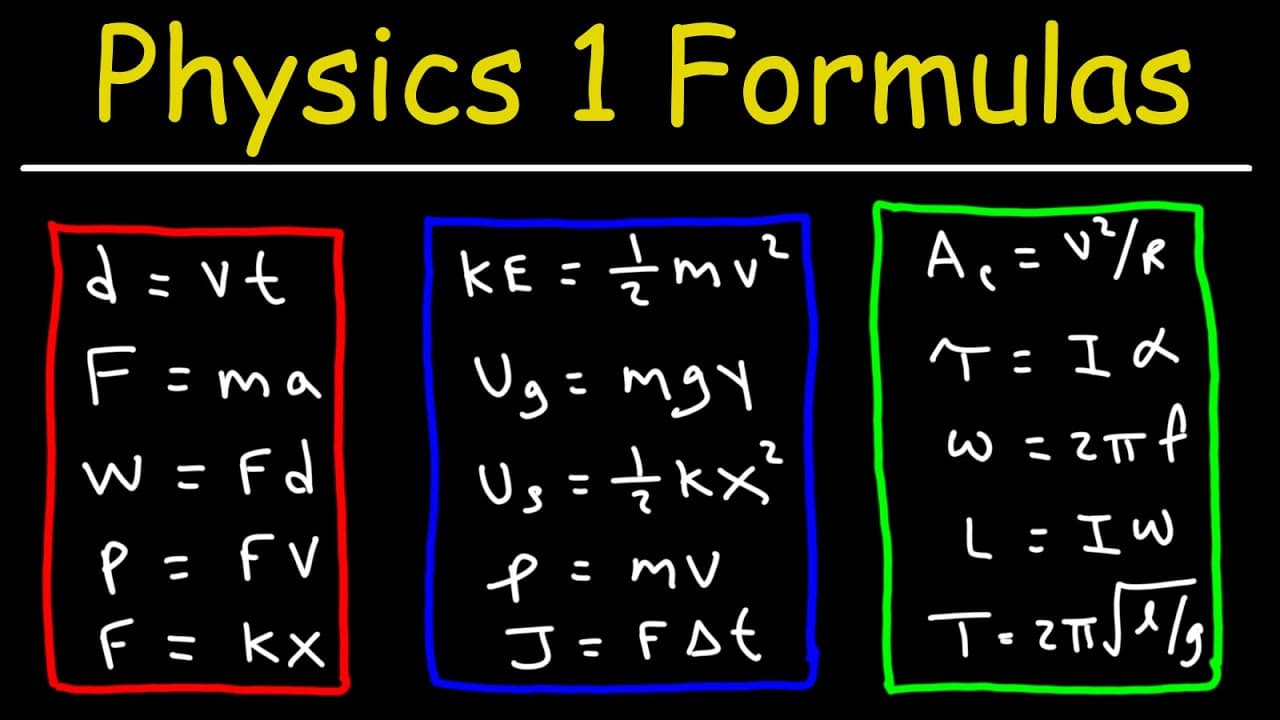
This video discusses key formulas in physics, including kinematics, projectile motion, relative velocity, vectors, forces, uniform circular motion, work energy and power, momentum and impulse, rotational motion, gravity, and simple harmonic motion.
Transcript
in this video I'm going to review some of the most common formulas that you're going to encounter in a typical physics one class so whether if you're studying for physics now or if you're preparing for your final exam this video is going to be very helpful to you so the first Formula you want to know has to do with motion with constant speed and th... Read More
Key Insights
- 💦 The video covers formulas for various topics in physics, including kinematics, projectile motion, relative velocity, vectors, forces, uniform circular motion, work energy and power, momentum and impulse, rotational motion, gravity, and simple harmonic motion.
- ❓ Understanding the difference between scalar and vector quantities is crucial in physics and affects the interpretation of formulas.
- 🐎 The application of kinematic formulas can help solve problems related to motion with constant speed or acceleration.
- 😒 Projectile motion involves the use of specific formulas to calculate maximum height and range based on launch angle and initial velocity.
- 🖼️ Relative velocity formulas are important for understanding motion in relation to different frames of reference.
- 🖐️ Vectors play a significant role in physics, with formulas for magnitude, direction, and calculations involving vectors.
- 💁 Newton's laws of motion form the basis for understanding forces and their role in physics, along with formulas for centripetal force and acceleration.
- 💦 Formulas for work, energy, and power are essential for understanding the transfer and calculation of energy in various systems.
- ⌛ Momentum and impulse formulas involve understanding the change in momentum and the force applied over a specific time period.
- 🏋️ Gravity formulas help calculate the gravitational force and potential energy between objects, and the concepts of weight and friction are also covered.
- 💆 Simple harmonic motion formulas are explained, including period and frequency, for mass-spring systems and pendulums.
Install to Summarize YouTube Videos and Get Transcripts
Explore YouTube Video Summarizer or Get YouTube Transcript Extractor
Questions & Answers
Q: What are the main differences between displacement, velocity, and time in physics?
Displacement refers to the change in position of an object and is measured as a vector quantity. Velocity is the rate at which an object changes its displacement and is also a vector quantity. Time is a scalar quantity that represents the duration of an event or the interval between two events.
Q: How can we calculate the maximum height and range of a projectile?
The maximum height can be calculated using the formula: V_initial^2 * sin^2(Theta) / (2 * g), where V_initial is the initial velocity of the projectile, Theta is the launch angle, and g is the acceleration due to gravity. The range can be calculated using the formula: V_initial^2 * sin(2*Theta) / g.
Q: How do we calculate centripetal acceleration and force?
Centripetal acceleration can be calculated using the formula: V^2 / R, where V is the velocity of the object and R is the radius of the circular path. Centripetal force can be calculated using the formula: m * (V^2 / R), where m is the mass of the object.
Q: What is the relationship between linear and angular quantities in rotational motion?
Linear quantities, such as displacement, velocity, and acceleration, have rotational equivalents in angular displacement, angular velocity, and angular acceleration. The relationship between linear and angular quantities is defined by the radius of the circular path or object.
Summary & Key Takeaways
-
The video covers common formulas used in physics, such as equations for constant speed and constant acceleration, displacement, velocity, and time. It also discusses formulas for projectile motion, including maximum height and range.
-
Other topics include relative velocity, vectors, forces, including Newton's laws, and formulas for uniform circular motion, such as centripetal acceleration and force. The video also covers work, energy, and power formulas, as well as momentum, impulse, gravitational force, and simple harmonic motion formulas.
-
The video provides formulas for various objects, such as springs, and discusses the relationship between linear and angular quantities in rotational motion. It also explains formulas for gravity, including gravitational force and potential energy, and formulas for simple harmonic motion in mass-spring systems and pendulums.
Read in Other Languages (beta)
Share This Summary 📚
Summarize YouTube Videos and Get Video Transcripts with 1-Click
Try YouTube Summary with ChatGPT & Claude or YouTube Transcript Generator
Explore More Summaries from The Organic Chemistry Tutor 📚




Summarize YouTube Videos and Get Video Transcripts with 1-Click
Try YouTube Summary with ChatGPT & Claude or YouTube Transcript Generator