How to Calculate Internal Energy Change Using Heat and Work
TL;DR
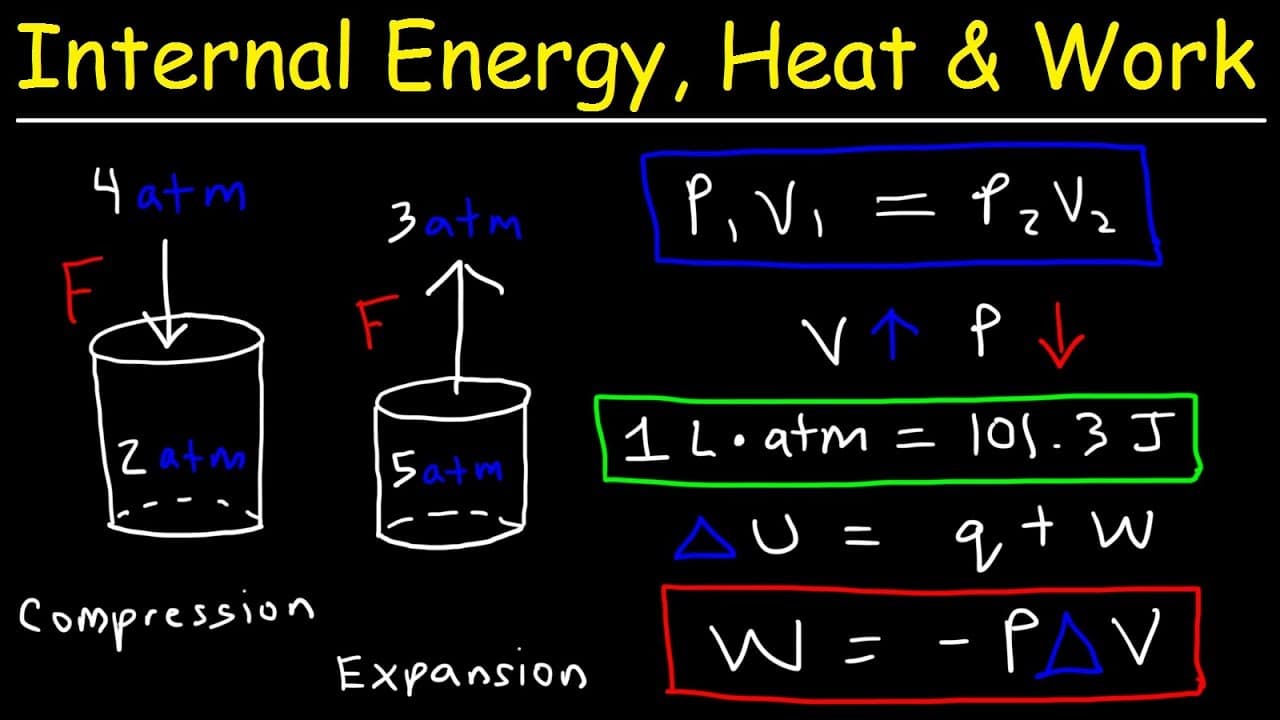
To calculate the change in internal energy (ΔU) of a system, use the formula ΔU = q + w, where q is the heat absorbed by the system and w is the work done on or by the system. Heat is positive when absorbed and negative when released; work is positive when done on the system and negative when done by the system.
Transcript
in this video we're going to focus on chemistry problems related to internal energy heat and work so let's start with this one calculate the change in the internal energy of a system if 300 joules of heat energy is absorbed by the system and if 400 joules of work is done on the system now i don't know if you saw a previous video that i created on t... Read More
Key Insights
- 😝 Internal energy change is calculated using the equation delta u = q + w, where q is heat and w is work.
- 💦 Heat is positive for system absorption and negative for release, while work is positive for work done on the system and negative for work done by the system.
- ❎ The change in internal energy can be positive or negative depending on the values of q and w.
- ❓ The transfer of energy between the system and surroundings affects the internal energy.
- 🫢 Compressing a gas requires positive work, while expanding a gas requires negative work.
- 🫢 The volume and pressure changes in a gas affect the transfer of energy and work done.
Install to Summarize YouTube Videos and Get Transcripts
Explore YouTube Video Summarizer or Get YouTube Transcript Extractor
Questions & Answers
Q: How is the change in internal energy of a system calculated?
The change in internal energy (delta u) is calculated using the equation delta u = q + w, where q is the heat energy absorbed/released and w is the work done on/by the system.
Q: What are the signs of heat and work in relation to the system?
Heat is positive when absorbed by the system (endothermic) and negative when released (exothermic). Work is positive when done on the system and negative when done by the system.
Q: How can the change in internal energy be determined in a system with specific heat and work values?
By substituting the given values for heat (q) and work (w) into the equation delta u = q + w, the change in internal energy can be calculated.
Q: How does the transfer of energy between the system and surroundings affect internal energy?
Energy transfer from the surroundings to the system increases the internal energy, while energy transfer from the system to the surroundings decreases the internal energy.
Summary & Key Takeaways
-
Internal energy change in a system is calculated using the equation delta u = q + w, where q is heat energy absorbed/released and w is work done on/by the system.
-
Heat is positive when absorbed by the system (endothermic) and negative when released (exothermic). Work is positive when done on the system and negative when done by the system.
-
In a system absorbing 300 joules of heat energy and 400 joules of work, the change in internal energy is 700 joules.
-
In a system releasing 700 joules of heat energy and doing 300 joules of work, the change in internal energy is -1,000 joules.
-
In a system where the surroundings gain 250 joules of heat energy and 470 joules of work are performed by the surroundings, the change in internal energy is 220 joules.
-
In a system where the surroundings release 300 joules of heat energy and the system does 550 joules of work on the surroundings, the change in internal energy is -250 joules.
Read in Other Languages (beta)
Share This Summary 📚
Summarize YouTube Videos and Get Video Transcripts with 1-Click
Try YouTube Summary with ChatGPT & Claude or YouTube Transcript Generator
Explore More Summaries from The Organic Chemistry Tutor 📚




Summarize YouTube Videos and Get Video Transcripts with 1-Click
Try YouTube Summary with ChatGPT & Claude or YouTube Transcript Generator