How Many Different Types of Forces Are There In Physics?
TL;DR
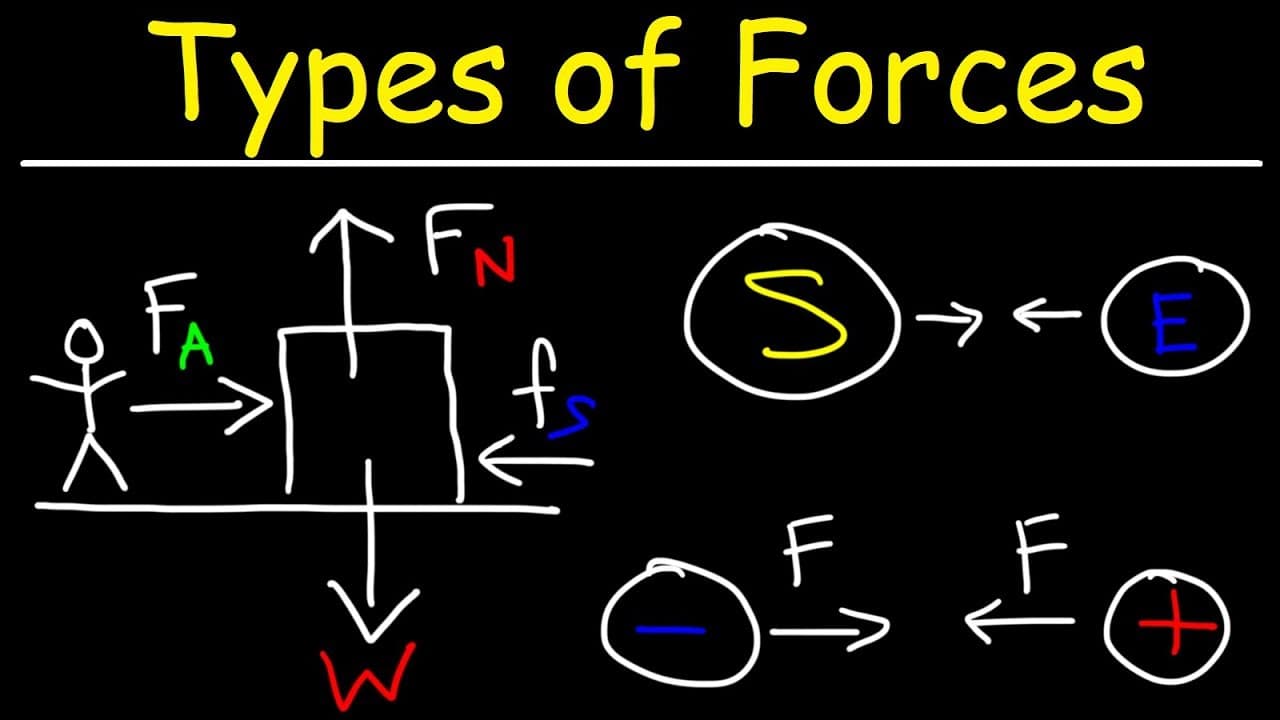
This video discusses different types of forces in physics, including applied force, tension force, weight force, normal force, static friction, kinetic friction, spring force, centripetal force, magnetic force, and gravitational force.
Transcript
so how many different types of forces are there in physics now i'm not going to go over all of them because there are some that we haven't discovered yet but i'm going to go over the most common ones that are taught in a typical physics course and the first type of force we're going to talk about is an applied force so let's say if you have a perso... Read More
Key Insights
- 🏋️ There are various types of forces in physics, including applied force, tension force, weight force, normal force, static friction, kinetic friction, spring force, centripetal force, magnetic force, and gravitational force.
- 🫷 Forces can take different forms, such as pushing, pulling, or twisting, and can act through ropes or between objects in contact.
- ❓ Centripetal force is not a force itself but is provided by other forces to keep an object moving in a circular path.
- 🛰️ Gravity provides the centripetal force for objects in orbit, while tension and magnetism can also provide the centripetal force in specific situations.
- ❓ Friction forces, both static and kinetic, depend on the surfaces in contact and the normal force.
- 🧘 Springs provide a restoring force that brings an object back to its equilibrium position when stretched or compressed.
- 🧑🏭 Magnetic forces can act on moving charged particles in a magnetic field, causing them to move in a circular path.
Install to Summarize YouTube Videos and Get Transcripts
Explore YouTube Video Summarizer or Get YouTube Transcript Extractor
Questions & Answers
Q: What is an applied force and can it take different forms?
An applied force is when a person or object exerts a force on another object. It can take different forms, such as pushing, pulling, twisting, or hitting.
Q: What is the difference between static friction and kinetic friction?
Static friction occurs when two surfaces are not sliding past each other, and there is an applied force that does not exceed the maximum static frictional force. Kinetic friction occurs when two surfaces are sliding past each other. Static friction can vary, while kinetic friction is a fixed value.
Q: How does gravity provide the centripetal force for an object in orbit?
Gravity provides the centripetal force for an object in orbit by constantly pulling it towards the center of the orbit. The balance between the object's velocity and the gravitational force keeps it moving in a circular path.
Q: How does magnetism affect charged particles in a magnetic field?
Moving charged particles in a magnetic field experience a magnetic force. The force acts perpendicular to both the magnetic field and the particle's velocity. It can cause the particle to move in a circular path, with the magnetic field providing the centripetal force.
Summary & Key Takeaways
-
The video introduces various types of forces in physics, including applied force, tension force, weight force, normal force, static friction, kinetic friction, spring force, centripetal force, magnetic force, and gravitational force.
-
It explains how each force works and provides examples of their applications, such as pushing a box, pulling an object with a rope, objects resting on a surface, friction on different surfaces, springs, circular motion, and interactions between charged particles.
-
The video emphasizes that the centripetal force, which keeps an object moving in a circle, is not a force itself but is provided by other forces such as tension, gravity, or magnetism.
Read in Other Languages (beta)
Share This Summary 📚
Summarize YouTube Videos and Get Video Transcripts with 1-Click
Try YouTube Summary with ChatGPT & Claude or YouTube Transcript Generator
Explore More Summaries from The Organic Chemistry Tutor 📚

Summarize YouTube Videos and Get Video Transcripts with 1-Click
Try YouTube Summary with ChatGPT & Claude or YouTube Transcript Generator