Levels of Measurement Scale: Nominal | Ordinal | Interval | Ratio Scales | Examples | Questions
TL;DR
Levels of measurement scale determine the precision and statistical tests applied in data analysis.
Transcript
hello everybody and welcome back to lesson 15 levels of measurement scale before moving to the main discussion let's define what measurement mean measurement is a process of assigning numbers to objects for specific set of attributes and it is used to transform the equality of attributes into numbers let's take a simple example if we want to measur... Read More
Key Insights
- ⚾ Measurement is the process of assigning numbers to objects based on their attributes.
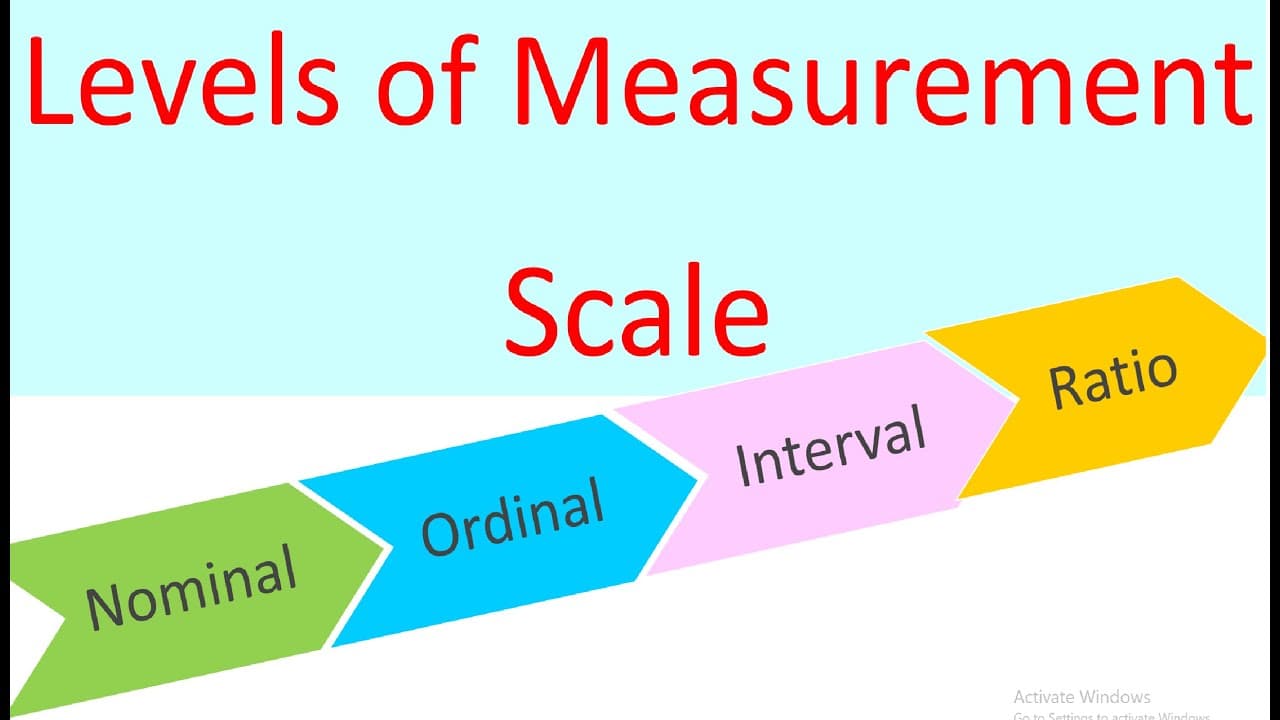
- 🥳 There are four levels of measurement: nominal, ordinal, interval, and ratio.
- ⚖️ Nominal scale is qualitative, ordinal scale introduces ranking, interval scale allows for meaningful comparisons but lacks a natural zero point, and ratio scale includes a true zero point.
- 🏆 Descriptive statistics and non-parametric tests are suitable for nominal and ordinal scale data analysis.
- 🥳 Parametric tests are more powerful and appropriate for interval and ratio scale data analysis.
- 🏆 Different statistical tests can be applied based on the level of measurement.
- 📈 Nominal and ordinal scale data can be represented using bar graphs and pie charts.
Install to Summarize YouTube Videos and Get Transcripts
Explore YouTube Video Summarizer or Get YouTube Transcript Extractor
Questions & Answers
Q: What is measurement and why is it important in data analysis?
Measurement is the process of assigning numbers to objects based on their attributes. It is important in data analysis as it allows for comparison and statistical testing.
Q: What are the four types of levels of measurement and how do they differ?
The four types of levels of measurement are nominal, ordinal, interval, and ratio. Nominal scale is qualitative, ordinal scale includes ranking, interval scale allows for meaningful comparisons but lacks a natural zero point, and ratio scale includes a true zero point.
Q: How is data analyzed for the nominal scale?
Descriptive statistics such as frequency and mode can be applied to analyze nominal scale data. Non-parametric tests, like the chi-square test of independence, are suitable for this type of data.
Q: What statistical tests can be applied to interval scale data?
Descriptive statistics such as frequency, mode, median, and range can be used to analyze interval scale data. Parametric tests like t-tests, linear regression, ANOVA, and Pearson correlation are appropriate for interval scale data analysis.
Summary & Key Takeaways
-
Measurement is the process of assigning numbers to objects based on their attributes.
-
There are four types of levels of measurement: nominal, ordinal, interval, and ratio.
-
Nominal scale is qualitative and used for labeling categories, while ordinal scale introduces ranking.
-
Interval scale allows for meaningful comparisons, but lacks a natural zero point, and ratio scale includes a true zero point.
Read in Other Languages (beta)
Share This Summary 📚
Summarize YouTube Videos and Get Video Transcripts with 1-Click
Try YouTube Summary with ChatGPT & Claude or YouTube Transcript Generator
Explore More Summaries from Solomon Getachew 📚


Summarize YouTube Videos and Get Video Transcripts with 1-Click
Try YouTube Summary with ChatGPT & Claude or YouTube Transcript Generator