What Is the Coefficient of Restitution in Collisions?
TL;DR
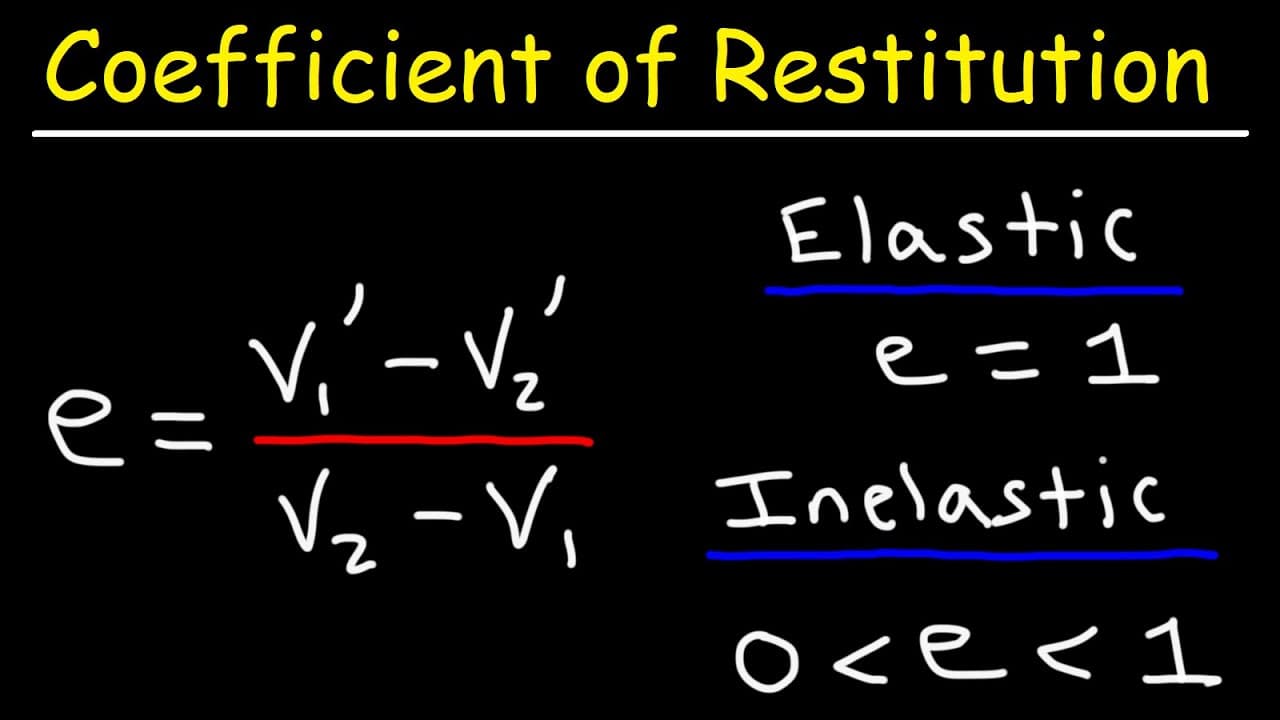
The coefficient of restitution quantifies the type of collision, ranging from perfectly elastic (e = 1) to completely inelastic (e = 0). It is calculated as the ratio of the difference in final velocities to the difference in initial velocities. This value helps determine if kinetic energy is conserved during the collision.
Transcript
let's talk about the coefficient of restitution the coefficient of restitution is represented by the symbol e and it's equal to the ratio of the difference of the final velocities after the Collision to the initial velocities before the Collision so it's equal to V1 Prime minus V2 Prime divided by V2 minus V1 now the coefficient of restitution it's... Read More
Key Insights
- 💥 The coefficient of restitution determines if a collision is elastic or inelastic and to what degree it is inelastic.
- 💥 In an elastic collision, both momentum and kinetic energy are conserved.
- 💥 In a completely inelastic collision, there is a loss of kinetic energy.
- 💥 The coefficient of restitution can be calculated using the difference in velocities before and after the collision.
- 💥 As the coefficient of restitution increases from 0 to 1, the loss of kinetic energy in the collision decreases.
- 💥 The coefficient of restitution can be used to determine the nature of a collision and if kinetic energy is conserved.
- 🥰 The kinetic energy in a collision can be calculated using the formula KE = 1/2mv^2, where m is the mass and v is the velocity.
Install to Summarize YouTube Videos and Get Transcripts
Explore YouTube Video Summarizer or Get YouTube Transcript Extractor
Questions & Answers
Q: What does the coefficient of restitution tell us about a collision?
The coefficient of restitution tells us if a collision is elastic or inelastic and to what degree it is inelastic. It is a measure of how much kinetic energy is conserved in the collision.
Q: How is the coefficient of restitution calculated?
The coefficient of restitution (e) is calculated using the formula e = (V1' - V2') / (V2 - V1), where V1' and V2' are the final velocities of the objects and V1 and V2 are the initial velocities.
Q: What happens in a perfectly elastic collision?
In a perfectly elastic collision, both momentum and kinetic energy are conserved. There is no loss of kinetic energy, and the objects bounce off each other with their original velocities.
Q: How is a completely inelastic collision different from an elastic collision?
In a completely inelastic collision, momentum is conserved, but kinetic energy is not conserved. The objects stick together after the collision, and there is a loss of kinetic energy.
Summary & Key Takeaways
-
The coefficient of restitution (e) is the ratio of the difference in final velocities to the difference in initial velocities in a collision.
-
A coefficient of restitution of 1 indicates a perfectly elastic collision, where both momentum and kinetic energy are conserved.
-
A coefficient of restitution of 0 indicates a completely inelastic collision, where momentum is conserved but kinetic energy is not conserved.
Read in Other Languages (beta)
Share This Summary 📚
Summarize YouTube Videos and Get Video Transcripts with 1-Click
Try YouTube Summary with ChatGPT & Claude or YouTube Transcript Generator
Explore More Summaries from The Organic Chemistry Tutor 📚


Summarize YouTube Videos and Get Video Transcripts with 1-Click
Try YouTube Summary with ChatGPT & Claude or YouTube Transcript Generator