What Are Common Business Analyst Interview Questions?
TL;DR
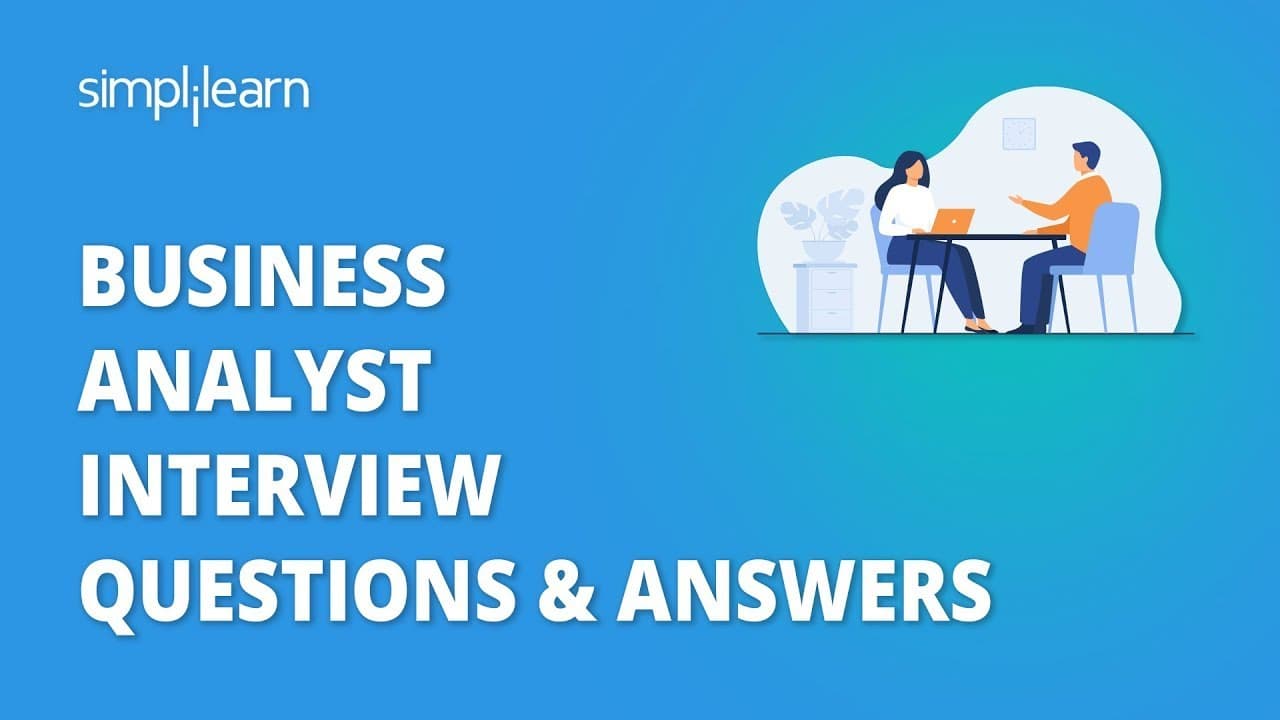
Common business analyst interview questions cover topics such as the differences between risks and issues, essential tools like Excel and SQL, and project stages including initiation and closure. Additionally, questions may address feasibility studies, business model analysis, and requirements prioritization techniques like the Moscow method, helping candidates prepare effectively for interviews.
Transcript
business analyst interview questions my name is richard kirschner with the simply learn team get certified get ahead we'll go over some beginner intermediate and advanced level questions to expect in interviews when you're looking at business analytics let's start with the differentiation between a risk and an issue and this should be a very fundam... Read More
Key Insights
- 🔍 Risk refers to potential problems, while an issue is a problem that is already happening. Risk can be predicted and a proactive response plan can be formulated, while issues are reacted to.
- 🔧 Various tools used by business analysts include Excel, Python, SQL, Tableau, and Balsamiq. Proficiency in specific tools may vary depending on the company's requirements, and certification may be offered by some companies.
- 📈 The stages of a business project include initiation, planning, execution, control and monitoring, and closure. It is important to have a detailed understanding of each stage to effectively manage a project.
- 🔎 A feasibility study helps assess the success rate of a proposed business solution and discover new opportunities. It is a central question in most business plans.
- 💼 Business model analysis helps determine if a business is financially, economically, and socially viable. It is crucial in analyzing the potential success of a business venture or product.
- 🧩 Requirements are targeted solutions to achieve business objectives, while needs represent high-level representations of goals and strategic directions. Requirements are necessary to succeed, while needs are the broader context.
- 📚 Excel is a foundational tool in business analysis and should be familiar to all analysts. It is often used for data manipulation and analysis.
- 📊 Analytical reporting provides data analysis, information, and recommendations for decision-making. It is important to comprehend business analysis, display analysis skills, think critically, and reduce complex information to actionable insights.
- 📅 The V model follows a sequential execution process, while the Fish model involves multiple verification teams for each stage. The V model is less time-consuming, while the Fish model provides additional verification.
- 📋 Requirement prioritization techniques include the Moscow technique, ranking method, top 10 requirements, and more. These techniques help allocate requirements based on urgency and importance.
- 🐠 The Fish model includes multiple verification teams for each stage, leading to higher costs and time consumption compared to the V model.
Install to Summarize YouTube Videos and Get Transcripts
Explore YouTube Video Summarizer or Get YouTube Transcript Extractor
Questions & Answers
Q: What is the difference between risks and issues in a business context?
In business, risk refers to a potential problem that can be predicted, while an issue is a risk that is occurring or about to happen. Risk can be addressed with a proactive response plan, while issues require reactive responses.
Q: What are some commonly used tools for business analysts?
Some common tools used by business analysts include Excel for data analysis, SQL for database querying, Tableau for visualization, Python for data manipulation and analysis, and various other platforms depending on the company's requirements.
Q: What are the stages of a business project?
The stages of a business project include initiation (defining project scope and objectives), planning (creating a detailed project plan), execution (implementing the plan), control and monitoring (tracking project progress), and closure (officially concluding the project).
Q: What is the purpose of a feasibility study in business analysis?
A feasibility study helps assess the likelihood of success for a proposed business solution. It allows business analysts to identify potential opportunities and understand the viability of a business venture before undertaking it.
Q: How does business model analysis contribute to decision-making?
Business model analysis evaluates whether a business is financially, economically, and socially viable. It helps analysts determine if a business is sustainable and provides insights into areas that require improvement or course correction.
Q: How do requirements differ from needs in a business context?
Requirements refer to targeted solutions necessary to achieve business objectives, while needs represent the high-level representation of the business's goals and strategic direction. Needs provide the context for defining and articulating requirements to achieve business goals.
Q: How can Excel be used to find information from a list of zip codes?
In Excel, you can select the zip code data and use the "Data" tab to convert it into geographical information. By selecting "geography" as the data type, you can readily find the corresponding city and state names.
Q: How do you calculate the total revenue generated for specific items in India using Excel?
With Excel, you can use the SUMIF function to calculate the total revenue generated for specific items in India. By specifying the criteria as India, you can sum the revenue column to find the total. Additionally, you can use filters to isolate the data for India and use the subtotal function to calculate the total revenue.
Q: How can Tableau be used to visualize revenue generated from offline and online sales?
In Tableau, you can create a highlight table to visualize revenue generated from offline and online sales. By dragging the region, sales channel, item type, total revenue, and total profit columns to different cards, you can create a clear visualization that highlights the revenue generated from offline and online sales for different items across regions.
Q: What is the difference between the agile and waterfall models in software development?
The agile model is adaptable to requirement changes and follows an incremental approach, allowing testing in each phase. In contrast, the waterfall model is a structured methodology with sequential phases and limited flexibility for changes. Testing in the waterfall model is typically performed in the final phase.
Q: What are some common analytical techniques used by business analysts?
Some common analytical techniques used by business analysts include MOSCOW analysis (prioritization technique), SWOT analysis (identifying strengths, weaknesses, opportunities, and threats), benchmarking (evaluating against standard criteria), and various requirements prioritization methods (e.g., ranking, 100 method, top 10 requirements).
Q: How can you approach working with difficult stakeholders as a business analyst?
When working with difficult stakeholders, it is important to listen patiently, respond politely and diplomatically, have one-on-one discussions, comprehend their worries, and maintain transparency. Continuous engagement and addressing concerns are key to managing difficult stakeholders effectively.
Q: What are some popular agile methodologies used in software development?
Some popular agile methodologies include Scrum, Kanban, Extreme Programming (XP), Feature Driven Development (FDD), Crystal, and Dynamic Systems Development Method (DSDM).
Q: What is gap analysis, and how is it used in business analysis?
Gap analysis involves analyzing the differences between existing system functionalities and desired outcomes. It helps identify areas of improvement and establishes an action plan to bridge the gap between the current and desired states.
Q: How do you import a text file into MS Excel?
To import a text file into MS Excel, you can go to the "Data" tab, select the "Get Data" option, choose "From File," and select the text file location. Then, click on "Import" and load the data into Excel.
Q: How do you create a dual axes chart in Tableau?
In Tableau, you can create a dual axes chart by dragging the desired data fields onto the columns and rows, synchronizing the right axis, selecting the appropriate mark type (e.g., bar and line), and adjusting the size and color for better visualization.
Q: What is the purpose of benchmarking in business analysis?
Benchmarking helps evaluate an organization's measures, such as quality of policies and programs, against standard criteria. It provides insights into performance, identifies areas of improvement, and allows analysis of how other companies achieve their objectives.
Q: How can you effectively work with stakeholders during business analysis?
Effective stakeholder management involves listening to their point of view, responding politely, having one-on-one discussions for clarity, comprehending their concerns, and maintaining transparency. Continuous engagement and keeping stakeholders involved in the process contribute to successful business analysis.
Q: What are the critical components of strategy analysis for developing a strategic plan?
The critical components of strategy analysis are vision (the desired future state), objectives (specific goals to achieve the vision), mission (the overall purpose of the organization), strategies (approaches to achieve objectives), action plan (implementation steps), and assessing performance.
Summary & Key Takeaways
-
Differentiate between risks and issues: Risk is a potential problem that can be predicted, while an issue is a risk that is occurring or about to happen.
-
Understand the tools used by a business analyst: Company-specific tools may vary, but some commonly used ones include Excel, SQL, Tableau, Python, and more.
-
Know the stages of a business project: Project initiation, planning, execution, control and monitoring, and closure are key stages that should be understood in detail.
Read in Other Languages (beta)
Share This Summary 📚
Summarize YouTube Videos and Get Video Transcripts with 1-Click
Try YouTube Summary with ChatGPT & Claude or YouTube Transcript Generator
Explore More Summaries from Simplilearn 📚





Summarize YouTube Videos and Get Video Transcripts with 1-Click
Try YouTube Summary with ChatGPT & Claude or YouTube Transcript Generator