What Are the Transient Response Specifications in Control Systems?
TL;DR
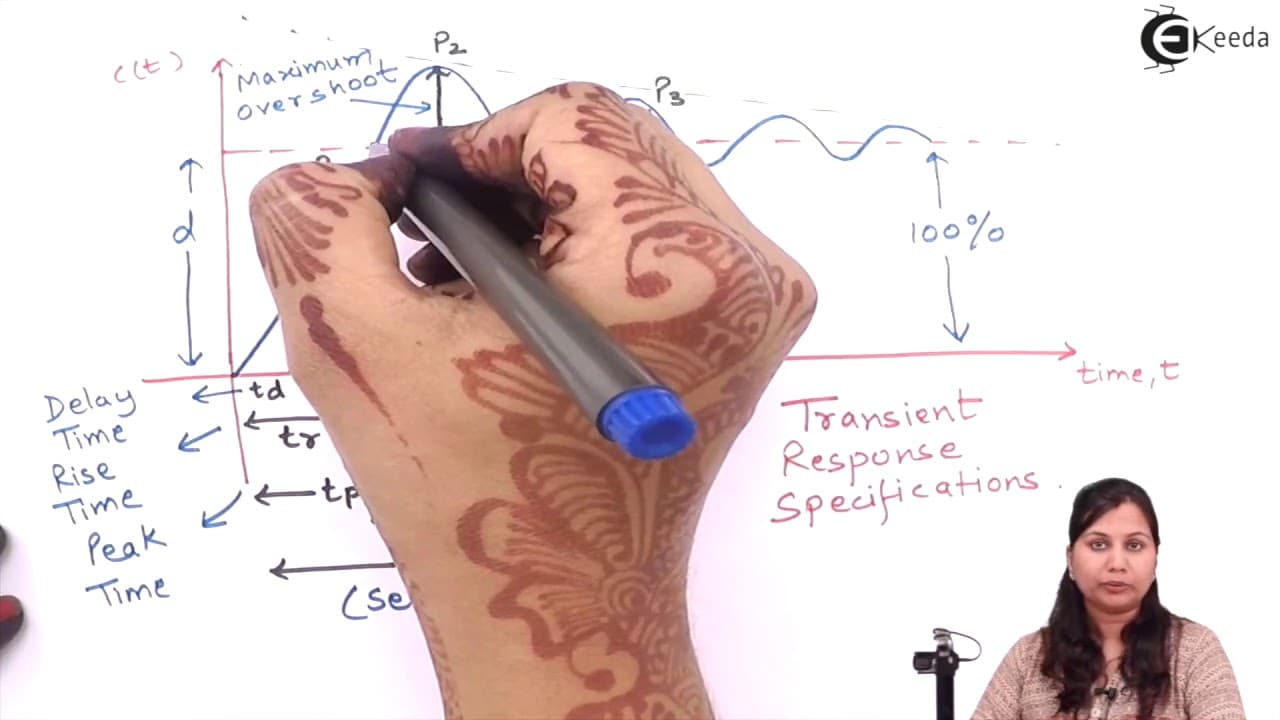
Transient response specifications, including delay time, rise time, peak time, maximum overshoot, and settling time, characterize the behavior of underdamped second order control systems. Delay time measures when the system reaches 50% of its final value, rise time is when output first meets input, peak time is when maximum overshoot occurs, and settling time defines how long it takes to remain within a tolerance band of the final value.
Transcript
hello friends in this video we are going to study about the transient response specifications as we know that the second order for the second order control system we have studied the time response when the input is a unit step function and we have studied four cases for that that depending upon the value of del the system can be under damped critic... Read More
Key Insights
- 🥳 The transient response of a second order control system depends on the damping ratio and natural frequency.
- ⌛ Delay time represents the time for the response to reach 50% of its final value.
- ⌛ Rise time is the time for the output to become equal to the input for the first time.
- 🙊 Peak time indicates when the output reaches its maximum overshoot.
- 🙊 Maximum overshoot is the percentage of the peak value above the desired output.
- ⌛ Settling time is the time for the output to reach and remain within a tolerance band of its final value.
- ⌛ Formulas are provided to calculate delay time, rise time, peak time, and maximum overshoot.
Install to Summarize YouTube Videos and Get Transcripts
Explore YouTube Video Summarizer or Get YouTube Transcript Extractor
Questions & Answers
Q: What is delay time in the context of transient response specifications for control systems?
Delay time is the time it takes for the system's response to reach 50% of its final value. It represents how long it takes for the output to reach half of its desired value.
Q: How can rise time be calculated for an underdamped second order control system?
Rise time is the time it takes for the output to become equal to the input for the first time. It can be calculated using formulas such as pi minus phi upon omega n or pi minus tan inverse of sqrt(1 - del^2) / del.
Q: What is the significance of peak time in transient response specifications?
Peak time is the time required to reach the peak value of the step response. It indicates when the output reaches its maximum overshoot and helps understand the system's behavior.
Q: How can maximum overshoot be calculated for a control system?
Maximum overshoot is calculated as a percentage of the peak value above the desired output. The formula is given as (Ctp - 1) / 1 * 100, where Ctp is the output response at the peak time.
Q: What is settling time and how is it approximated for second order control systems?
Settling time is the time taken for the output to reach and remain within a tolerance band of its final value. For a two percent tolerance band, it is approximately four times the time constant, which is 1 / (del * omega_n).
Summary & Key Takeaways
-
The video introduces the concept of transient response and explains that it depends on the values of the damping ratio and natural frequency for underdamped systems.
-
It describes the four specifications of transient response: delay time, rise time, peak time, and settling time.
-
The calculations for each specification are derived, including formulas for delay time, rise time, peak time, and maximum overshoot.
Read in Other Languages (beta)
Share This Summary 📚
Summarize YouTube Videos and Get Video Transcripts with 1-Click
Try YouTube Summary with ChatGPT & Claude or YouTube Transcript Generator
Explore More Summaries from Ekeeda 📚



Summarize YouTube Videos and Get Video Transcripts with 1-Click
Try YouTube Summary with ChatGPT & Claude or YouTube Transcript Generator