How To Convert Hexadecimal to Binary
TL;DR
Learn how to convert hexadecimal numbers into binary numbers using a simple step-by-step process.
Transcript
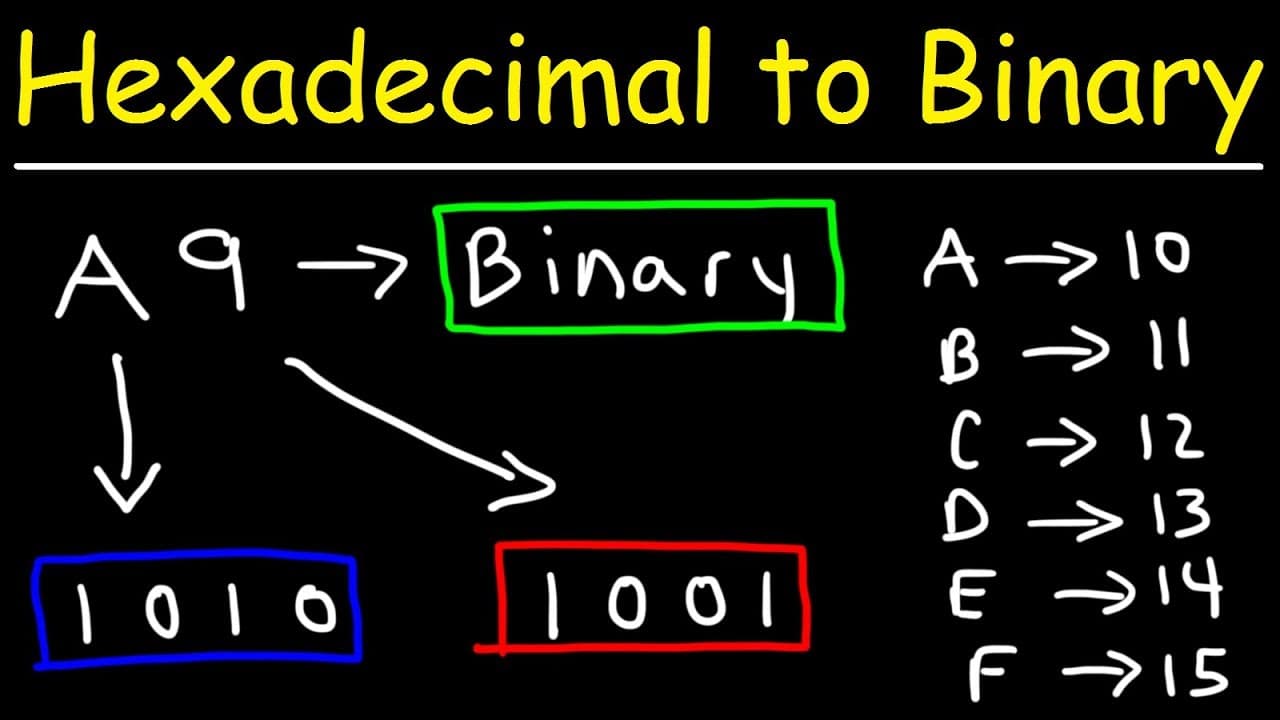
in this video we're gonna talk about how to convert hexadecimal numbers into binary numbers so let's start with this example a 9 how can we convert that into a binary number well the first thing we needs to do is convert the a into a number or a decimal value in the hexadecimal system a corresponds to 10 in the decimal system B corresponds to 11 C ... Read More
Key Insights
- ❓ Converting hexadecimal to binary involves replacing each digit with its binary representation.
- ❓ Decimal values are used as an intermediary step to convert hexadecimal digits to binary.
- 😫 Grouping binary digits in sets of four aligns with the hexadecimal system.
- ❓ Verifying the conversion by converting binary back to decimal ensures accuracy.
- #️⃣ The process can be applied to any hexadecimal number.
- 🆓 Hexadecimal digits A to F represent decimal values 10 to 15.
- ✊ Binary can be represented using powers of 2.
Install to Summarize YouTube Videos and Get Transcripts
Explore YouTube Video Summarizer or Get YouTube Transcript Extractor
Questions & Answers
Q: How do you convert a hexadecimal number to a binary number?
To convert a hexadecimal number to binary, replace each digit with its binary representation. Then, group the binary digits in sets of four to represent the entire hexadecimal number in binary form.
Q: Why do we need to convert each digit to a decimal value first?
Converting each digit to a decimal value allows us to use the powers of 2 to convert to binary. Each digit represents a specific value, and by converting to decimal, we can easily determine the binary representation.
Q: What is the significance of grouping binary digits in sets of four?
Grouping binary digits in sets of four aligns with the hexadecimal system, where each digit represents four bits. This simplifies the conversion process and ensures accuracy.
Q: Can you explain the conversion process with an example?
Sure! Let's take the hexadecimal number 1D29. The digit 1 corresponds to binary 0001, D corresponds to binary 1101, 2 corresponds to binary 0010, and 9 corresponds to binary 1001. Combining these binary digits, we get 1110100101001 as the binary representation of 1D29.
Summary & Key Takeaways
-
Hexadecimal numbers can be converted to binary numbers by replacing each digit with its binary representation.
-
Each digit in the hexadecimal system corresponds to a decimal value, which can then be converted to binary using the powers of 2.
-
By grouping the binary digits in sets of four, the entire hexadecimal number can be represented in binary form.
Read in Other Languages (beta)
Share This Summary 📚
Summarize YouTube Videos and Get Video Transcripts with 1-Click
Try YouTube Summary with ChatGPT & Claude or YouTube Transcript Generator
Explore More Summaries from The Organic Chemistry Tutor 📚





Summarize YouTube Videos and Get Video Transcripts with 1-Click
Try YouTube Summary with ChatGPT & Claude or YouTube Transcript Generator