Cosmological Horizons. The Past, Present and Future Limits of Astronomy with Dr. Paul Sutter
TL;DR
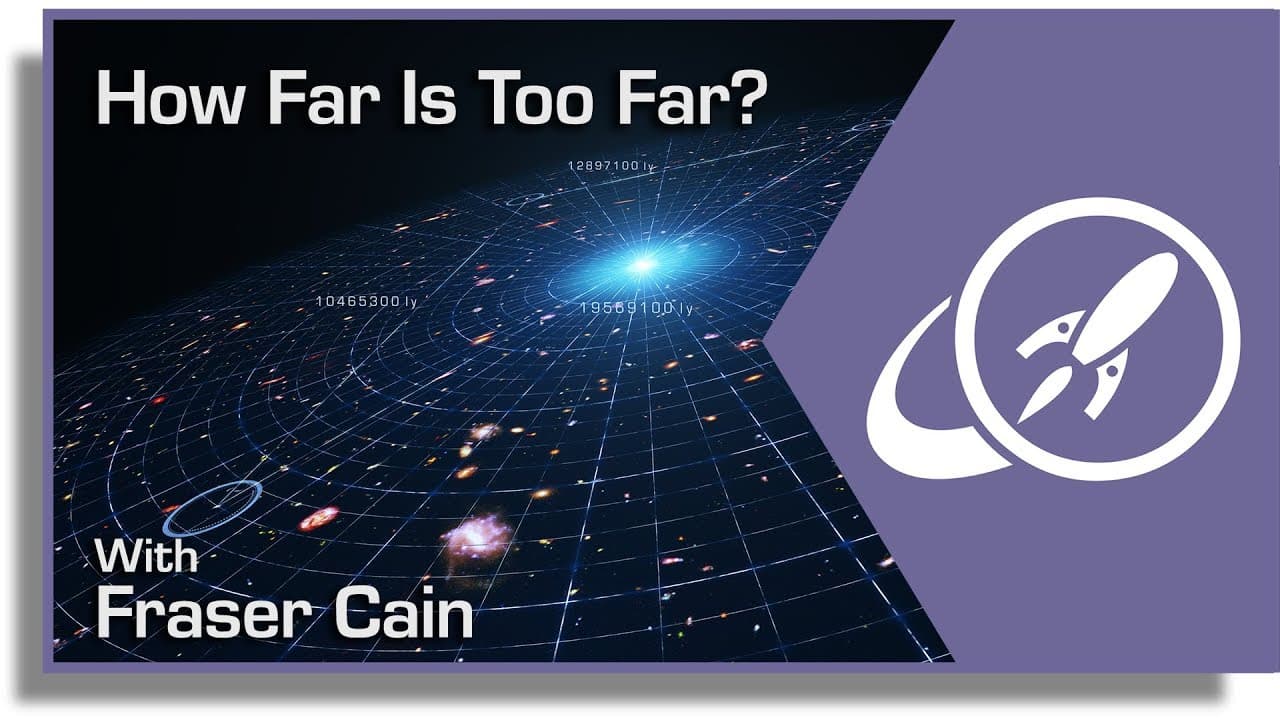
Cosmological horizons define what humanity can observe, reach, or influence across an expanding universe. Dr. Paul Sutter explains that the observable cosmological horizon is around 47 billion light-years away, while the Hubble horizon is 13.8 billion light-years away and the event horizon is shrinking as expansion accelerates due to dark energy. Read on to understand why visible galaxies may still remain forever unreachable.
Transcript
our view to the universe is a time machine the farther we look out into space the further we're looking back in time in fact our most sensitive telescopes like plunk and W map have taken this to the cosmic microwave background radiation a time when the universe had cooled down just enough for light to be able to escape into space just 300,000 years... Read More
Key Insights
- 🚥 The cosmological horizon represents the limit of our ability to directly observe events in the universe due to the finite speed of light and the expansion of the universe.
- 🚥 The Hubble horizon marks the point where objects appear to recede from us faster than the speed of light, indicating the accelerating expansion of the universe.
- 🚥 Our event horizon, within which we can affect or communicate with objects, is shrinking over time due to the expansion of the universe driven by dark energy.
- 🚥 The gap between the Hubble horizon and the cosmological horizon allows us to see objects that appear to be receding faster than the speed of light, but this gap is shrinking.
- 💨 In the future, only gravitationally bound structures within our local group, like the Milky Way and Andromeda galaxies, will remain within our event horizon, while all other galaxies will be ripped away from us.
- 👽 The ability to receive messages from alien civilizations beyond our event horizon without being able to reply or visit them highlights our limitations in exploration and communication.
- ⚖️ The true scale of the universe is vast but not infinite, and as the expansion continues, much of it will become inaccessible to us.
Install to Summarize YouTube Videos and Get Transcripts
Explore YouTube Video Summarizer or Get YouTube Transcript Extractor
Questions & Answers
Q: What is the cosmological horizon?
The cosmological horizon, also called the particle horizon, is the limit of the observable universe. It marks the most distant regions whose light has had enough time to reach us during the universe’s roughly 13.8-billion-year history.
Q: How far away is the cosmological horizon?
The current cosmological horizon is around 47 billion light-years away. Although the light has traveled for about 13.8 billion years, the regions that emitted it are now much farther away because the universe expanded during its journey.
Q: Why does looking farther into space mean looking further back in time?
Light takes time to travel, so telescopes receive distant objects’ light as it appeared in the past. Telescopes such as Planck and WMAP have observed cosmic microwave background radiation from about 300,000 years after the Big Bang.
Q: What is the Hubble horizon?
The Hubble horizon is the distance at which objects appear to recede from us at the speed of light because of cosmic expansion. It is about 13.8 billion light-years away, and objects beyond it appear to recede faster than light.
Q: Can galaxies appear to move away faster than the speed of light?
Yes. Galaxies beyond the Hubble horizon appear to recede faster than light because the universe itself is expanding. The cosmological horizon appears to be receding at 3.2 times the speed of light.
Q: What is the universe’s event horizon?
The event horizon is the limit of where signals, spacecraft, or other influences launched today can eventually reach. It describes the boundary of causality in our present-day region of the universe and is distinct from a black hole’s event horizon.
Q: Can we reach every galaxy that we can currently see?
No. Some galaxies are visible because their light began traveling toward us in the past, yet a signal sent today would never reach them. Even traveling at 99.9 percent of the speed of light would not overcome their continued recession caused by cosmic expansion.
Q: How will cosmic expansion change these horizons?
The cosmological horizon continues to grow as light from more distant galaxies reaches our observable region. The event horizon is shrinking because the universe’s expansion is accelerating due to dark energy, reducing the region that we can affect or communicate with.
Summary & Key Takeaways
-
Our telescopes, like Plank and WMAP, enable us to observe the cosmic microwave background radiation, which occurred 300,000 years after the Big Bang.
-
The cosmological horizon is the limit of our observable universe, determined by the distance light has been able to travel to us since the universe's age is 13.8 billion years.
-
There are other cosmological horizons, such as the Hubble horizon, which marks the point where objects appear to recede from us faster than the speed of light.
Read in Other Languages (beta)
Share This Summary 📚
Summarize YouTube Videos and Get Video Transcripts with 1-Click
Try YouTube Summary with ChatGPT & Claude or YouTube Transcript Generator
Explore More Summaries from Fraser Cain 📚


Summarize YouTube Videos and Get Video Transcripts with 1-Click
Try YouTube Summary with ChatGPT & Claude or YouTube Transcript Generator