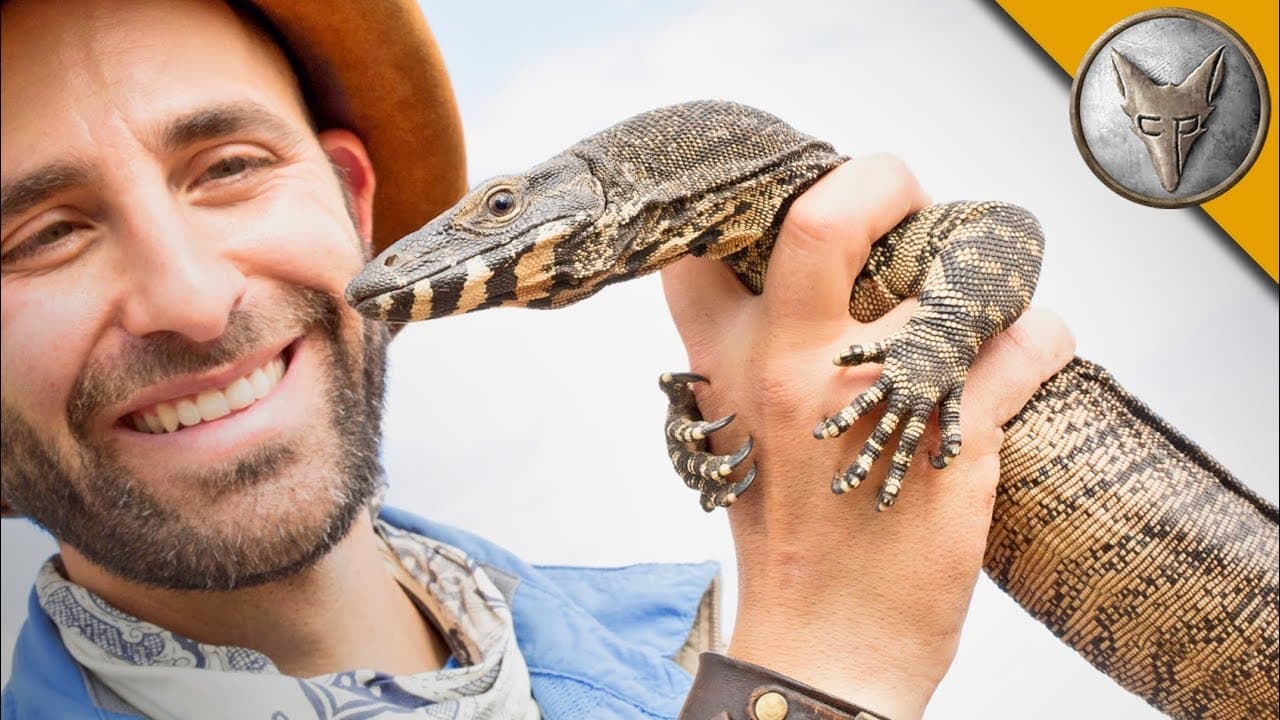
Did I just catch a DINOSAUR?!
TL;DR
Brave Wilderness team takes on the challenge of catching a lace monitor, an elusive lizard species in the Australian Outback, by climbing trees and risk getting bitten.
Transcript
- All right, guys, I'm climbing. (dramatic music) - [Man] Careful. - Whoa, whoa, whoa, boy, he's coming right at me, hold on. Oh, this is a bad situation to be in. (growling) (snarling) As you travel across the rugged landscape of the Australian Outback, it's pretty obvious that this environment is the perfect place for reptiles. Today is our last ... Read More
Key Insights
- 💯 The Australian Outback is a perfect environment for reptiles, including the elusive lace monitor.
- 😤 Climbing trees to catch the lace monitor was one of the most daring and dangerous catches for the Brave Wilderness team.
- 🥇 The lace monitor is a formidable predator with sharp claws and potentially venomous saliva.
- 🥇 Monitoring reptiles like the lace monitor is important for conservation efforts and to understand their behavior and habitat.
- 🥇 The lace monitor demonstrates intelligence, problem-solving abilities, and unique parenting behaviors.
- 🫡 Catching the lace monitor required patience, skill, and a deep respect for the reptile's power and beauty.
- 😤 The Brave Wilderness team looks forward to future adventures in the Australian Outback and further wildlife encounters.
Install to Summarize YouTube Videos and Get Transcripts
Explore YouTube Video Summarizer or Get YouTube Transcript Extractor
Questions & Answers
Q: How did the team capture the lace monitor?
The team climbed trees to get closer to the lace monitor, which had retreated to higher branches as a defense mechanism. One team member managed to grab its backside and gain control to prevent being bitten while others helped with the capture.
Q: What are the risks of being bitten by a lace monitor?
The bite from a lace monitor is painful and can result in infections due to the bacteria in their saliva. There is debate in the scientific community on whether they are venomous like Komodo dragons, but getting bitten by one is highly undesirable.
Q: What makes the lace monitor unique compared to other monitor species?
The lace monitor is more arboreal, meaning it spends more time in trees, compared to other monitor species. It can grow larger and stockier and exhibits problem-solving intelligence. Females lay their eggs in termite mounds and remember the location to dig them up as the babies hatch.
Q: How difficult was it to catch the lace monitor?
Catching the lace monitor was challenging due to its speed and tendency to stay near burrows or retreat up trees. The team had to maneuver through branches, risking being clawed, and carefully control the lizard to avoid getting bitten.
Summary & Key Takeaways
-
The Brave Wilderness team explores the Australian Outback and successfully captures and releases several reptile species, including the bearded dragon, blue-tongue skink, and sand monitor.
-
On their last day of exploration, they encounter the lace monitor, one of the Outback's most elusive lizards.
-
Climbing trees, the team manages to catch the lace monitor, facing challenges and risks along the way.
Read in Other Languages (beta)
Share This Summary 📚
Summarize YouTube Videos and Get Video Transcripts with 1-Click
Try YouTube Summary with ChatGPT & Claude or YouTube Transcript Generator
Explore More Summaries from Brave Wilderness 📚



Summarize YouTube Videos and Get Video Transcripts with 1-Click
Try YouTube Summary with ChatGPT & Claude or YouTube Transcript Generator