How to Calculate Torque When Force Isn't Perpendicular
TL;DR
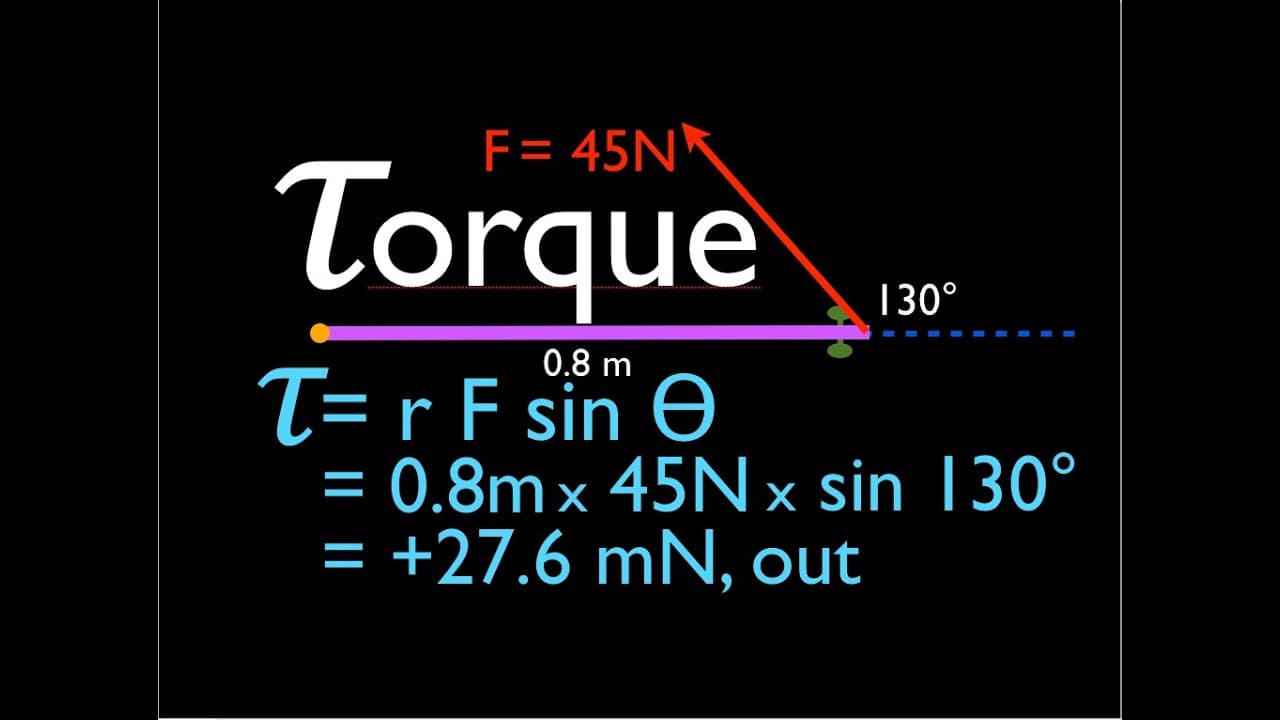
To calculate torque when force is not at a right angle, use the equation τ = R × F × sin(θ), where R is the distance from the axis of rotation to the force application point, F is the applied force, and θ is the angle between the radial vector and the force. The torque vector indicates rotation direction, with counterclockwise defined as positive torque.
Transcript
okay in this video I'm going to show you how to calculate torque and in this video the force the applied force and the radial Vector will not be at right angles to each other in the previous video I showed you how to calculate torque which you can link to that video right here I showed you how to calculate the torque when the force vector and the r... Read More
Key Insights
- 🔺 Torque is calculated using the equation RF sin θ, where R is the distance from the axis of rotation to the point of application of force, F is the applied force, and θ is the angle between the radial vector and the force vector.
- 😥 The torque vector points out of the page or screen and is always perpendicular to the plane created by the radial vector and the force vector.
- 🔄 Counterclockwise rotation is defined as positive torque.
- 🔺 The choice of angle (θ) in the torque equation does not affect the calculation as long as the sine of the angle is the same.
- ❤️🩹 Torque can still be calculated even if the force is not applied at the end of the object.
- 😀 Accurate measurement of the distance (R) is crucial for calculating torque correctly.
- ❓ The torque vector has both magnitude and direction, indicating the direction of rotation.
Install to Summarize YouTube Videos and Get Transcripts
Explore YouTube Video Summarizer or Get YouTube Transcript Extractor
Questions & Answers
Q: How is torque calculated for objects that do not have the applied force and radial vector at right angles to each other?
Torque can still be calculated using the equation RF sin θ, where θ is the angle between the radial vector and the force vector. The torque vector will have a magnitude and direction, indicating the direction of rotation.
Q: Can the torque equation be used if the force is not applied at the end of the object?
Yes, the torque equation can still be used. The distance from the axis of rotation to the point of application of force (R) should be measured accurately, even if the force is not applied at the end of the object.
Q: Does the choice of angle (θ) in the torque equation affect the calculation?
Technically, the angle θ is defined as the angle between the radial vector and the force vector. However, since the sine of 130° is the same as the sine of 50°, you can use either angle in the calculation and still obtain the correct answer.
Q: What does the direction of the torque vector indicate?
The direction of the torque vector indicates the direction of rotation. If the object rotates counterclockwise, the torque vector points out of the page or screen (positive torque).
Summary & Key Takeaways
-
Torque is calculated using the equation RF sin θ, where R is the distance from the axis of rotation to the point of application of force, F is the applied force, and θ is the angle between the radial vector and the force vector.
-
The torque vector points out of the page or screen and is always perpendicular to the plane created by the radial vector and the force vector.
-
The direction of the torque vector indicates the direction of rotation, with counterclockwise rotation being defined as positive torque.
Read in Other Languages (beta)
Share This Summary 📚
Summarize YouTube Videos and Get Video Transcripts with 1-Click
Try YouTube Summary with ChatGPT & Claude or YouTube Transcript Generator
Explore More Summaries from Step by Step Science 📚


Summarize YouTube Videos and Get Video Transcripts with 1-Click
Try YouTube Summary with ChatGPT & Claude or YouTube Transcript Generator