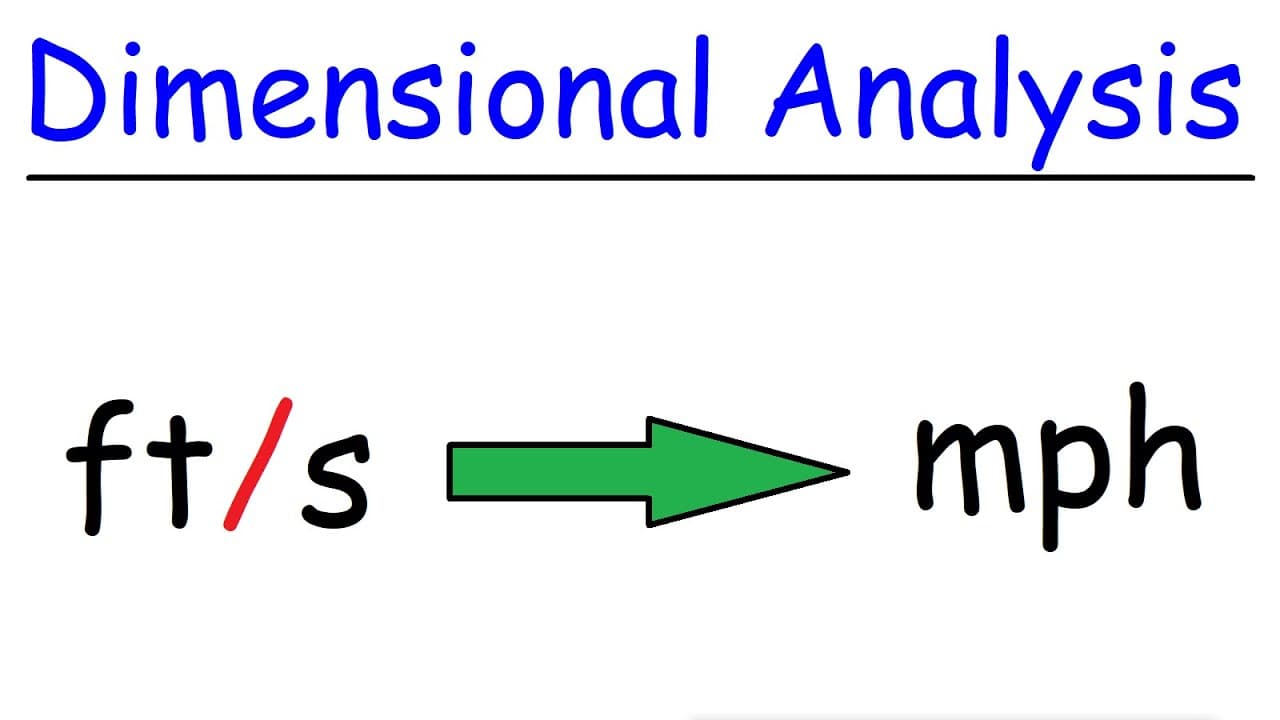
Dimensional Analysis
TL;DR
Learn how to convert units using dimensional analysis, with examples including converting seconds in a year and feet per second to miles per hour.
Transcript
in this video we're going to focus on dimensional analysis how to convert from one unit into another so let's start with this problem how many seconds are there in a year so how do we do this well it's always good to start with what you're given in this case one year now what we want to do is we want to convert years into days and then days into ho... Read More
Key Insights
- 🥳 Dimensional analysis is a valuable tool for converting units and solving ratio problems.
- 🇦🇪 The technique involves setting up unit ratios and canceling out units to arrive at the desired unit.
- 🧑🏭 Conversion factors are used to convert from one unit to another.
- 🥳 Dimensional analysis can be used to solve problems related to time, distance, ratios, and more.
- 😫 Understanding how the units cancel out and setting up the problem correctly is crucial for dimensional analysis.
- 🇦🇪 It is helpful to start with the given unit and convert it step-by-step to the desired unit.
- ❓ Dimensional analysis simplifies complex conversion problems and ensures accuracy.
Install to Summarize YouTube Videos and Get Transcripts
Explore YouTube Video Summarizer or Get YouTube Transcript Extractor
Questions & Answers
Q: What is dimensional analysis?
Dimensional analysis is a problem-solving technique used to convert units by setting up unit ratios and canceling out units to arrive at the desired unit.
Q: How do you convert seconds in a year using dimensional analysis?
Start with the given unit, which is one year, and convert it to days, hours, minutes, and finally seconds using established conversion factors. Multiply all the numbers to obtain the final answer of 31,536,000 seconds.
Q: How do you convert feet per second to miles per hour using dimensional analysis?
Begin with the given unit, 30 feet per second, and convert it to miles by using the conversion factor of 5280 feet per mile. Then, convert seconds to minutes and minutes to hours using the appropriate conversion factors. The final answer is 20.45 miles per hour.
Q: How can dimensional analysis be used to determine the number of girls in a classroom based on a given number of boys?
Use the given number of boys and the ratio of boys to girls to set up a conversion factor. Divide the number of boys by the numerator of the ratio, and then multiply the result by the denominator to find the number of girls. In the example given, there are 45 girls.
Summary & Key Takeaways
-
The video explains how to convert units using dimensional analysis.
-
It covers examples such as converting seconds in a year, feet per second to miles per hour, and determining the number of girls in a classroom based on a ratio.
-
Dimensional analysis is a useful tool for solving conversion and ratio problems.
Read in Other Languages (beta)
Share This Summary 📚
Summarize YouTube Videos and Get Video Transcripts with 1-Click
Try YouTube Summary with ChatGPT & Claude or YouTube Transcript Generator
Explore More Summaries from The Organic Chemistry Tutor 📚



Summarize YouTube Videos and Get Video Transcripts with 1-Click
Try YouTube Summary with ChatGPT & Claude or YouTube Transcript Generator