The Dark Ages of the Cosmos | Crash Course Pods: The Universe #3
TL;DR
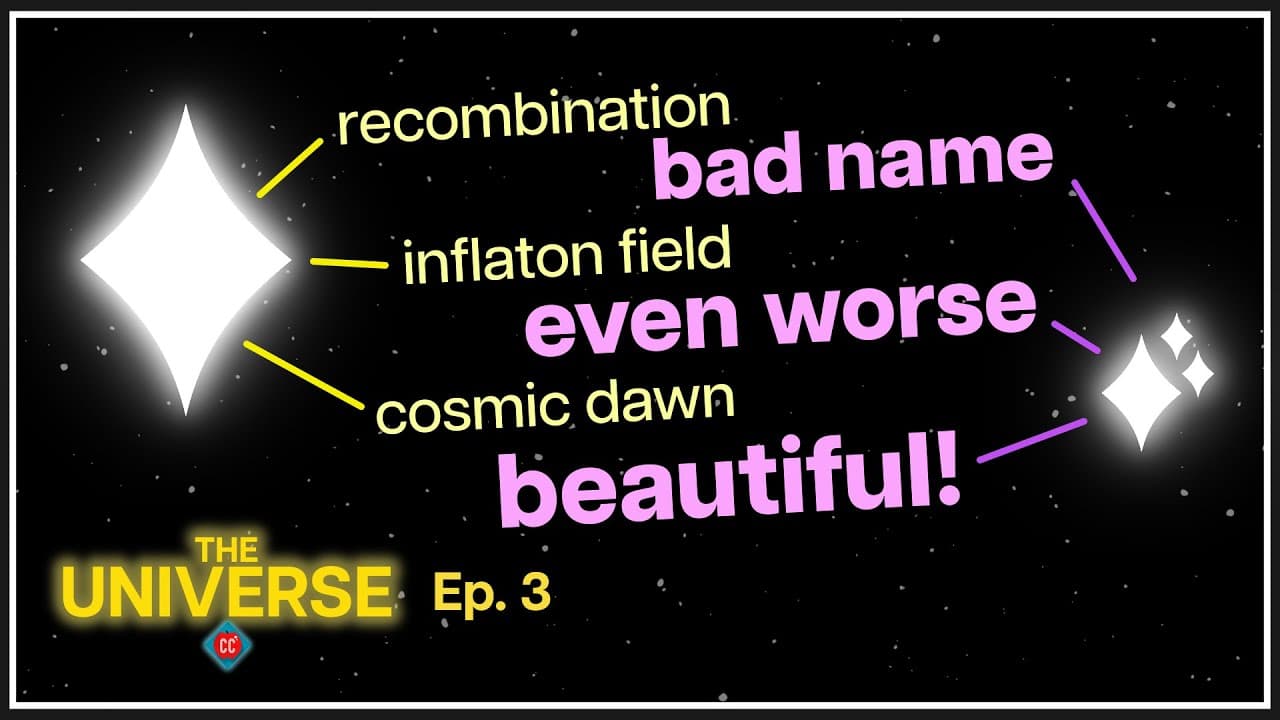
Exploration of the universe's formation from the Big Bang to the cosmic dawn.
Transcript
all right Katie so we've learned so far that the Universe was in a very hot very dense State and then it began to expand we've learned a lot about what happened in the first second we've learned that the rules of the universe were different and are different when things are very hot and very dense and we've learned that over the first couple minute... Read More
Key Insights
- The universe began in a hot, dense state and expanded, resulting in the laws of physics we know today, including gravity and electromagnetism.
- Cosmic Microwave Background (CMB) reveals the universe's early non-uniformity, which led to the formation of galaxies through gravitational clumping.
- The concept of a multiverse arises from cosmic inflation, suggesting our universe is a small part of a much larger cosmos.
- Quantum fluctuations during cosmic inflation led to density variations in the universe, which seeded galaxy formation.
- The Cosmic Web describes the large-scale structure of the universe, formed from initial small density variations amplified by gravity.
- The universe's Dark Ages followed recombination, a period without stars, where gas cooled and clumped due to dark matter's gravitational influence.
- Dark matter, which doesn't interact with light, played a crucial role in forming the first cosmic structures by creating gravitational wells.
- Cosmic Dawn marks the end of the Dark Ages with the formation of the first stars and galaxies, initiating the creation of heavier elements.
Install to Summarize YouTube Videos and Get Transcripts
Explore YouTube Video Summarizer or Get YouTube Transcript Extractor
Questions & Answers
Q: What is the cosmic microwave background (CMB)?
The cosmic microwave background (CMB) is the afterglow of the Big Bang, a faint cosmic background radiation filling the universe. It represents the universe's state when it was a hot plasma, and its slight non-uniformities provide insights into the early universe's density variations that eventually led to galaxy formation.
Q: How does the concept of a multiverse relate to cosmic inflation?
Cosmic inflation, a theory proposing a rapid expansion of the universe in its earliest moments, suggests the existence of a multiverse. This inflation implies that our observable universe is just a small part of a much larger cosmos, potentially containing other 'pocket' universes, each with its own unique properties and laws of physics.
Q: What role did quantum fluctuations play in the universe's formation?
Quantum fluctuations during the cosmic inflation phase caused small variations in the density of the universe. These fluctuations acted as seeds for the gravitational clumping that led to the formation of galaxies and large-scale structures. Essentially, these tiny initial variations were amplified over time by gravity, shaping the universe's structure.
Q: What is the significance of the cosmic web?
The cosmic web describes the large-scale structure of the universe, a vast network of interconnected filaments and voids formed from initial density variations. It illustrates how galaxies and galaxy clusters are distributed throughout the universe, with gravity playing a key role in its development over billions of years.
Q: What occurred during the universe's Dark Ages?
The Dark Ages were a period following recombination when the universe was filled with neutral hydrogen gas and no stars existed. During this time, the universe continued to expand and cool, and dark matter's gravitational influence began to pull gas clouds together, setting the stage for the formation of the first stars and galaxies.
Q: How did dark matter influence cosmic structure formation?
Dark matter, which does not interact with light, influenced cosmic structure formation through its gravitational pull. It created gravitational wells into which regular matter, primarily hydrogen gas, could fall and clump together. This process was crucial for the formation of the first stars and galaxies, marking the transition from the Dark Ages to the Cosmic Dawn.
Q: What marked the Cosmic Dawn in the universe's timeline?
The Cosmic Dawn marked the end of the Dark Ages and the beginning of star formation. As gas clouds clumped under gravity, aided by dark matter, they became dense enough to ignite nuclear reactions, forming the first stars. These stars began producing heavier elements, laying the foundation for subsequent cosmic evolution, including planet formation.
Q: How do modern observations support our understanding of the early universe?
Modern observations, such as those from the James Webb Space Telescope, allow us to see early galaxies and their evolution. By comparing these early structures to more recent ones, astronomers can trace the universe's development, confirming theories about cosmic inflation, the role of dark matter, and the processes leading to galaxy formation, providing a coherent picture of cosmic history.
Summary & Key Takeaways
-
The universe's evolution began with a hot, dense state, expanding to give rise to the physical laws we observe today. Early non-uniformities in the cosmic microwave background led to the formation of galaxies through gravitational interactions.
-
Cosmic inflation theory suggests our universe is part of a larger multiverse. Quantum fluctuations during this inflation caused density variations, which seeded the formation of the cosmic web, the large-scale structure of the universe.
-
Following the recombination era, the universe entered the Dark Ages, a time without stars. Dark matter's gravitational influence helped gas clouds clump together, leading to the Cosmic Dawn, where the first stars and galaxies formed, producing heavier elements.
Read in Other Languages (beta)
Share This Summary 📚
Summarize YouTube Videos and Get Video Transcripts with 1-Click
Try YouTube Summary with ChatGPT & Claude or YouTube Transcript Generator
Explore More Summaries from CrashCourse 📚





Summarize YouTube Videos and Get Video Transcripts with 1-Click
Try YouTube Summary with ChatGPT & Claude or YouTube Transcript Generator