Products
Features
YouTube Video Summarizer
Summarize YouTube videos
Web & PDF Highlighter
Highlight web pages & PDFs
Chat with PDF
Ask any PDF questions with AI
Ask AI Clone
Chat with your highlights & memories
Audio Transcriber
Transcribe audio files to text
Glasp Reader
Read and highlight articles
Kindle Highlight Export
Export your Kindle highlights
Idea Hatch
Hatch ideas from your highlights
Integrations
Obsidian Plugin
Notion Integration
Pocket Integration
Instapaper Integration
Medium Integration
Readwise Integration
Snipd Integration
Hypothesis Integration
Apps & Extensions
Chrome Extension
Safari Extension
Edge Add-ons
Firefox Add-ons
iOS App
Android App
Discover
Discover
Ideas
Discover new ideas and insights
Articles
Curated articles and insights
Books
Book recommendations by great minds
Posts
Essays and notes from readers
Quotes
Inspiring quotes collection
Videos
Curated videos and summaries
Explore Glasp
Glasp Newsletter
Weekly insights and updates
Glasp Talk
Interview series with great minds
Glasp Blog
Latest news and articles
Glasp Use Cases
Learn how others use Glasp
Build & Support
Glasp API
Access Glasp's API for developers
MCP Connector
Connect Glasp to Claude & ChatGPT
Community
Glasp Reddit Community
Students
Student discount and benefits
FAQs
Frequently Asked Questions
AboutPricing
DashboardLog inSign up

Numerical based on Nuclear Binding Energy and Mass Defect 02 - Nuclear Chemistry
3.9K views
•
May 23, 2023
by
Ekeeda
YouTube video player
Numerical based on Nuclear Binding Energy and Mass Defect 02 - Nuclear Chemistry

TL;DR

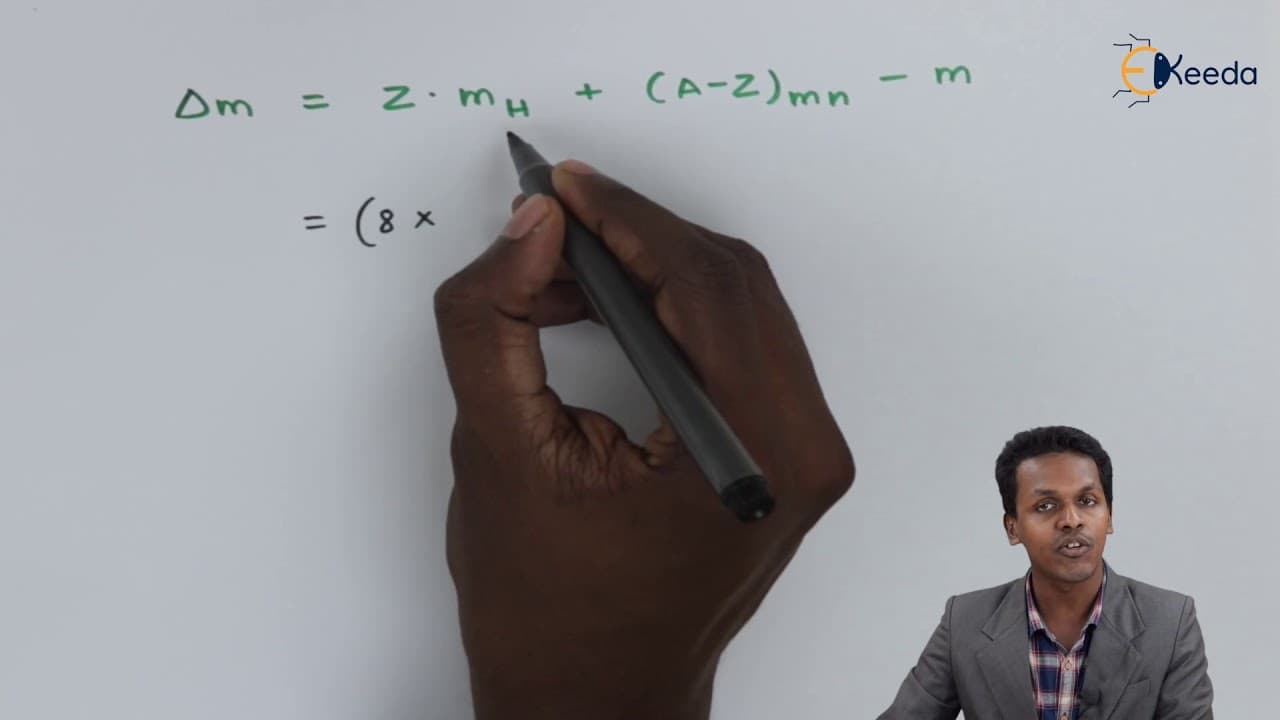
Calculate the binding energy per nucleon for the formation of an oxygen nucleus with atomic number 8 and atomic mass number 16.

Transcript

click the bell icon to get latest videos from akira reference in the Prius topic we have discussed about in the numerical based on the binding energy and the mass defect problem number one and now here we see we are going to talk about the problem number two based on that is binding energy and the mass defect so let us see what is the cushion and l... Read More

Key Insights

  • 🎮 The video provides a step-by-step explanation of calculating the binding energy per nucleon for an oxygen nucleus.
  • 💆 Understanding the mass defect helps in determining the binding energy and stability of a nucleus.
  • 💆 The formula for mass defect takes into account the atomic number, atomic mass number, and mass of hydrogen and neutron.

Install to Summarize YouTube Videos and Get Transcripts

Explore YouTube Video Summarizer or Get YouTube Transcript Extractor

Questions & Answers

Q: What is the purpose of calculating the binding energy per nucleon for an oxygen nucleus?

Calculating the binding energy helps in understanding the stability and energy release during the formation of the oxygen nucleus.

Q: How is the mass defect of the oxygen nucleus calculated?

The mass defect is calculated using the formula Delta M = Z(Mass of Hydrogen) + (A-Z)(Mass of Neutron) - M, where Z is the atomic number, A is the atomic mass number, and M is the observed mass of the oxygen atom.

Q: What is the significance of the mass defect in nuclear physics?

The mass defect represents the difference in mass between the sum of individual nucleon masses and the mass of the nucleus. It is related to the binding energy and stability of the nucleus.

Q: How is the binding energy per nucleon calculated?

The binding energy per nucleon is calculated by dividing the binding energy by the atomic mass number. It represents the average energy required to remove a nucleon from the nucleus.

Summary & Key Takeaways

  • The video discusses the calculation of the binding energy per nucleon for the formation of an oxygen nucleus.

  • The necessary data for the calculation, such as atomic number, atomic mass number, and mass of hydrogen and neutron, is provided.

  • Using the formula for mass defect, the mass defect of the oxygen nucleus is calculated, which is then used to determine the binding energy per nucleon.


Read in Other Languages (beta)

English

Share This Summary 📚

Summarize YouTube Videos and Get Video Transcripts with 1-Click

Download browser extensions on:

Try YouTube Summary with ChatGPT & Claude or YouTube Transcript Generator

Explore More Summaries from Ekeeda 📚
Amines & its Classifications - Compounds Containing Nitrogen - Chemistry Class 12 thumbnail
Amines & its Classifications - Compounds Containing Nitrogen - Chemistry Class 12
Ekeeda
Basic Operation And Characteristics Of TRIAC thumbnail
Basic Operation And Characteristics Of TRIAC
Ekeeda
Hartnell Governor - Flywheel and Governors - Theory of Machine thumbnail
Hartnell Governor - Flywheel and Governors - Theory of Machine
Ekeeda
Problem No.10 Based on Value of Function - Functions - Diploma Maths - II thumbnail
Problem No.10 Based on Value of Function - Functions - Diploma Maths - II
Ekeeda
Expression For the Radius of Curvature For a Polar Curve - Polar Curve - Engineering Mathematics - 2 thumbnail
Expression For the Radius of Curvature For a Polar Curve - Polar Curve - Engineering Mathematics - 2
Ekeeda
FIR Adaptive Filters - Adaptive Filters - Advanced Digital Signal Processing thumbnail
FIR Adaptive Filters - Adaptive Filters - Advanced Digital Signal Processing
Ekeeda

Summarize YouTube Videos and Get Video Transcripts with 1-Click

Download browser extensions on:

Try YouTube Summary with ChatGPT & Claude or YouTube Transcript Generator

Apps & Extensions

  • Chrome Extension
  • Safari Extension
  • Edge Add-ons
  • Firefox Add-ons
  • iOS App
  • Android App

Key Features

  • YouTube Video Summarizer
  • Web & PDF Summarizer
  • Web & PDF Highlighter
  • Chat with PDF
  • Ask AI Clone
  • Audio Transcriber
  • Glasp Reader
  • Kindle Highlight Export
  • Idea Hatch

Integrations

  • Obsidian Plugin
  • Notion Integration
  • Pocket Integration
  • Instapaper Integration
  • Medium Integration
  • Readwise Integration
  • Snipd Integration
  • Hypothesis Integration

More Features

  • APIs
  • MCP Connector
  • Blog & Post
  • Embed Links
  • Image Highlight
  • Personality Test
  • Quote Shots

Company

  • About us
  • Blog
  • Community
  • FAQs
  • Job Board
  • Newsletter
  • Pricing
Terms

•

Privacy

•

Guidelines

© 2026 Glasp Inc. All rights reserved.