Microscopy: Disassembling a Nikon Ti Eclipse (Stephen Ross)
TL;DR
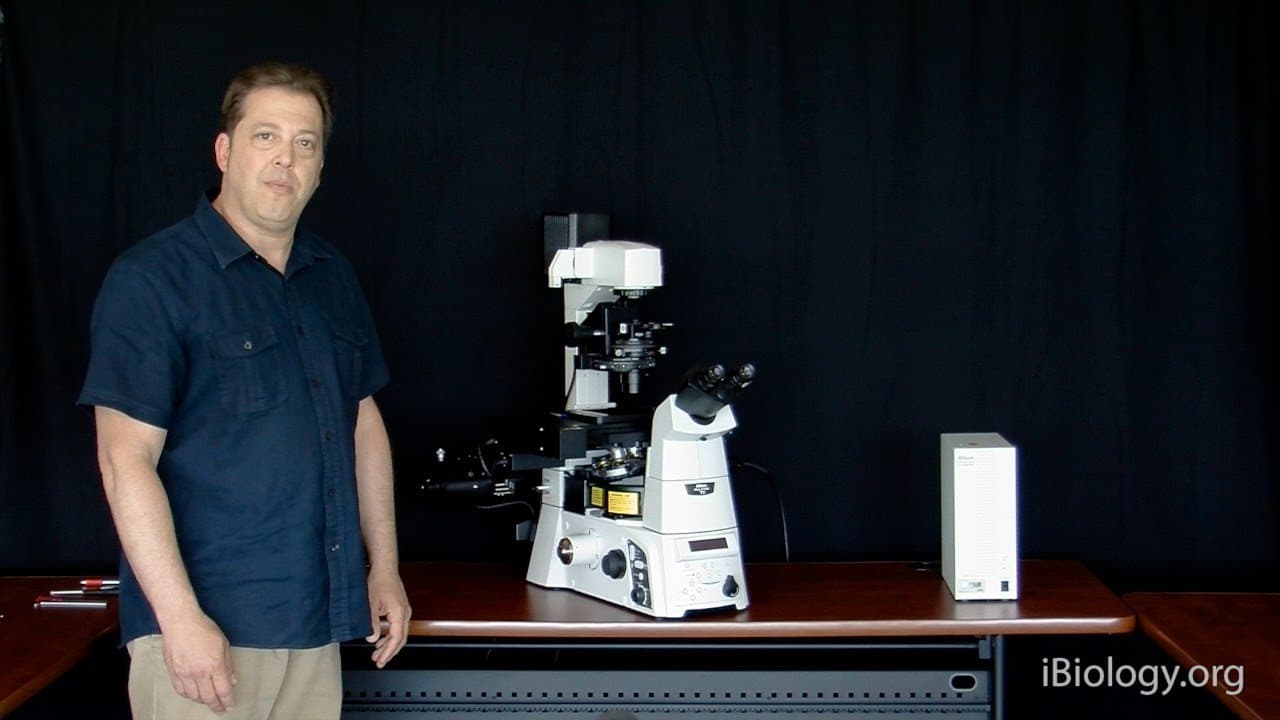
Comprehensive breakdown of Nikon Ti Eclipse microscope components.
Transcript
Hello, my name is Steven Ross. I'm the general manager of products and marketing at Nikon. And we're going to continue on in the microscopy courses with a run through of the research microscope. And what I want to talk about is all of the components of the microscope and sort of how we integrate it. And how you can take advantage of the components ... Read More
Key Insights
- The Nikon Ti Eclipse microscope's transmitted light path starts with a halogen lamp house, featuring a collector lens to magnify the filament image, which is the first aperture plane.
- Diffusers and fly eye lenses are used to soften the harsh edges of the filament, providing even illumination across the field of view.
- The microscope includes various filters, such as neutral color balancing and green interference filters, to enhance image contrast and resolution.
- The universal condenser allows for multiple condenser lenses, balancing working distance and resolution, with options like high NA oil and dry lenses.
- The eyepiece reticle offers an accessible field plane for adding scale bars or filters, accommodating users with or without glasses through independently focusable high eye point eyepieces.
- The epi illuminator supports laser illumination for techniques like total internal reflection fluorescence and includes mechanisms for magnifying the laser beam for increased intensity.
- The hub controller manages motorized components, enabling high-speed imaging sequences by storing experimental recipes and controlling electronics locally.
- The microscope's tube lens system allows for magnification changes without adding more glass, using 200mm and 300mm tube lenses for 1X and 1.5X magnification, respectively.
Install to Summarize YouTube Videos and Get Transcripts
Explore YouTube Video Summarizer or Get YouTube Transcript Extractor
Questions & Answers
Q: How is the halogen lamp house integrated into the microscope?
The halogen lamp house is the initial component of the transmitted light path in the Nikon Ti Eclipse microscope. It features a collector lens that magnifies the filament image, serving as the first aperture plane. The lamp house is secured with a screw and includes safety measures to prevent bulb explosions, such as a heavily shielded cover.
Q: What role do diffusers and fly eye lenses play in the microscope?
Diffusers and fly eye lenses are crucial for softening the harsh edges of the filament in the halogen bulb, providing even illumination across the field of view. A diffuser is typically a frosted piece of glass or plastic, while a fly eye lens creates multiple images of the filament, ensuring uniform light distribution.
Q: How does the universal condenser function in the microscope?
The universal condenser in the Nikon Ti Eclipse microscope supports multiple condenser lenses, allowing users to balance working distance and resolution. Options include high NA oil and dry lenses, each offering different numerical apertures. The condenser also contains prisms and phase rings for differential interference contrast and phase contrast techniques.
Q: What is the purpose of the eyepiece reticle?
The eyepiece reticle provides an accessible field plane for adding scale bars or filters, such as an IR cut filter for laser safety. The eyepieces are independently focusable, allowing users to adjust the focus for each eye, accommodating individuals with or without glasses through high eye point eyepieces.
Q: How does the epi illuminator support laser illumination?
The epi illuminator in the Nikon Ti Eclipse microscope is designed for laser illumination techniques like total internal reflection fluorescence. It includes a fiber coupler and mechanisms to magnify the laser beam, increasing its intensity. The illuminator also features neutral density filters and an aperture diaphragm to control light levels.
Q: What is the function of the hub controller?
The hub controller acts as the brain of the Nikon Ti Eclipse microscope, managing motorized components and synchronizing them for high-speed imaging sequences. It stores experimental recipes in onboard memory, allowing the microscope to operate locally without constant communication with a computer, enhancing efficiency and speed.
Q: How does the tube lens system affect magnification?
The tube lens system in the Nikon Ti Eclipse microscope allows for magnification adjustments without adding extra glass elements. It includes two tube lenses: a 200mm lens for 1X magnification and a 300mm lens for 1.5X magnification. This design maintains optical efficiency while providing flexibility in magnification.
Q: What is the significance of the imaging port?
The imaging port in the Nikon Ti Eclipse microscope features a turret of prisms that direct emission light from the specimen to cameras, eyepieces, or other detectors. It includes an ISO C-mount, adhering to international standards, ensuring compatibility with various camera systems by maintaining a precise distance to the detector.
Summary & Key Takeaways
-
The Nikon Ti Eclipse microscope features a transmitted light path with a halogen lamp house, collector lens, and various filters to enhance image quality. The universal condenser supports multiple lenses, balancing working distance and resolution. The eyepiece reticle offers an accessible field plane for scale bars or filters.
-
The epi illuminator accommodates laser illumination for techniques like total internal reflection fluorescence, with mechanisms to magnify the laser beam for increased intensity. The hub controller synchronizes motorized components, enabling high-speed imaging sequences by storing experimental recipes and controlling electronics locally.
-
The microscope's tube lens system allows for magnification adjustments without adding more glass, using 200mm and 300mm tube lenses. The base unit includes aperture space for filters, while the imaging port features a turret of prisms to direct emission light to cameras or eyepieces.
Read in Other Languages (beta)
Share This Summary 📚
Summarize YouTube Videos and Get Video Transcripts with 1-Click
Try YouTube Summary with ChatGPT & Claude or YouTube Transcript Generator
Explore More Summaries from iBiology Techniques 📚
Summarize YouTube Videos and Get Video Transcripts with 1-Click
Try YouTube Summary with ChatGPT & Claude or YouTube Transcript Generator