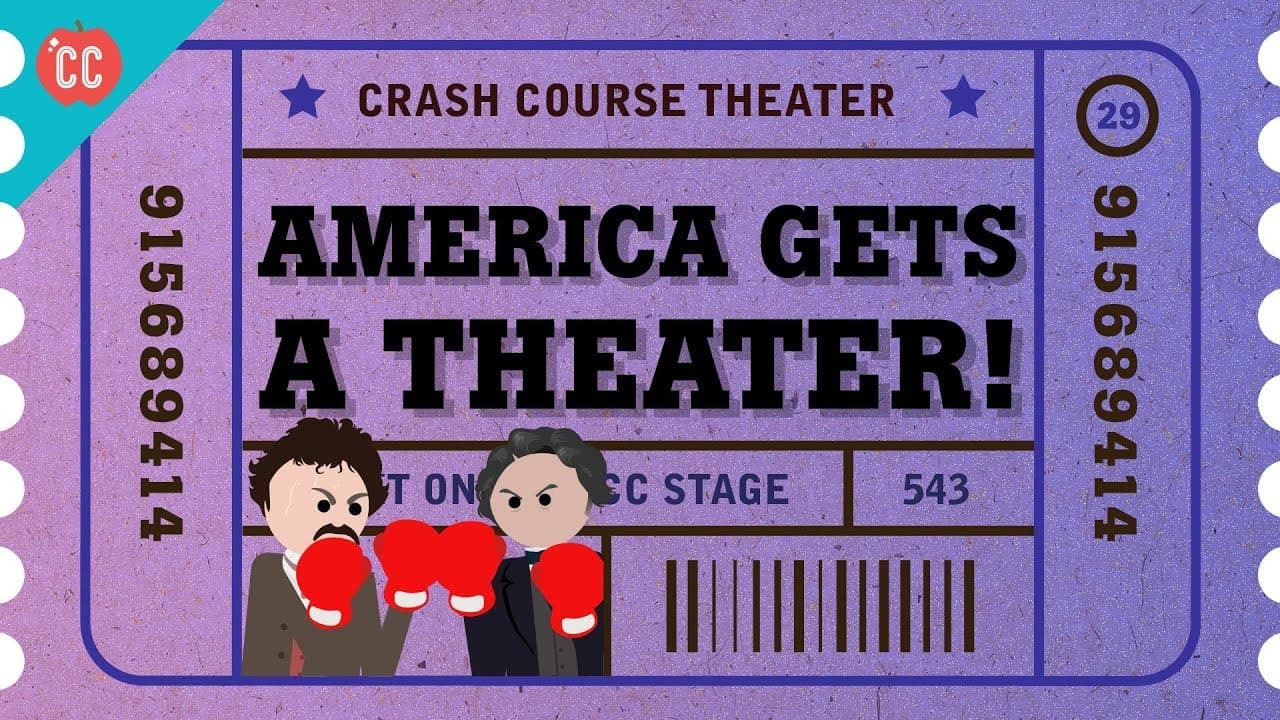
North America Gets a Theater...Riot: Crash Course Theater #29
TL;DR
Explores American theater history and the Astor Place Riot.
Transcript
hey there I'm Mike Rugnetta this is crash course theater and today we're going to the land of the free and the home of the showboat that's right it's America he's loving it we'll look at pre-colonial performance post-colonial performance some attempts to exotic eyes indigenous cultures and a theater related riot lights up as you remember from our e... Read More
Key Insights
- Indigenous communities in North America had rich performance traditions involving song, dance, and storytelling, which were suppressed by colonizers but eventually influenced colonial theater.
- The first scripted play in North America, 'The Theatre of Neptune,' was performed in Canada in 1606, highlighting early cultural exchanges between settlers and indigenous peoples.
- Theater struggled to establish itself in early America due to Puritanical beliefs and anti-British sentiment, with many early performances facing opposition and legal challenges.
- Despite initial resistance, theater gained popularity post-Revolution, with New York and Philadelphia becoming key centers for American theater, featuring both imported and local productions.
- The first American theater hit, 'The Contrast' by Royall Tyler, introduced the stage Yankee character, reflecting American disdain for British culture post-Revolution.
- Edwin Forrest, a prominent American actor, popularized redface performances in plays like 'Metamora,' reflecting complex racial dynamics and national identity issues.
- The Astor Place Riot in 1849, sparked by a rivalry between actors Edwin Forrest and William Charles Macready, exposed deep societal tensions between social classes and immigrant groups.
- The riot underscored ongoing debates about who could produce and enjoy theater in America, highlighting the intersection of art, politics, and social issues.
Install to Summarize YouTube Videos and Get Transcripts
Explore YouTube Video Summarizer or Get YouTube Transcript Extractor
Questions & Answers
Q: What role did indigenous performance traditions play in early American theater?
Indigenous performance traditions in North America, which included song, dance, and storytelling, played a foundational role in early American theater. These traditions were initially suppressed by colonizers but eventually influenced colonial theater by melding with European theatrical forms. This fusion of cultures contributed to the development of a unique American theatrical identity.
Q: How did the first scripted play in North America reflect cultural exchanges?
The first scripted play in North America, 'The Theatre of Neptune,' performed in 1606 in Canada, reflected cultural exchanges by incorporating both Mi'kmaq and French languages. This play, while politically charged in its portrayal of indigenous peoples as subjugated, showcased the early interactions and learning between settlers and indigenous communities, highlighting a complex dynamic of cultural exchange and colonization.
Q: Why did theater face challenges in early America?
Theater faced challenges in early America primarily due to the Puritanical belief that it was sinful and the desire to distinguish American culture from British influences. Theaters were often associated with moral corruption, and performances were sometimes legally challenged. Additionally, the Revolutionary War period saw an edict from the Continental Congress discouraging theater as an extravagant and dissipative form of entertainment.
Q: What was the significance of 'The Contrast' in American theater?
'The Contrast,' written by Royall Tyler in 1787, was significant as the first American theatrical hit. It introduced the stage Yankee character, embodying the aw-shucks, no-nonsense American persona, which resonated with audiences eager to differentiate themselves from British culture. The play's success marked a shift towards a distinctly American theatrical tradition, reflecting post-Revolutionary national pride and identity.
Q: How did Edwin Forrest influence American theater?
Edwin Forrest, a prominent 19th-century American actor, influenced theater by popularizing physical and heroic acting styles. Known for his robust and manly performances, often in redface, Forrest's roles in plays like 'Metamora' reflected and reinforced racial and nationalistic themes. His work highlighted the complexities of American identity and the problematic portrayal of indigenous peoples in theater.
Q: What sparked the Astor Place Riot?
The Astor Place Riot in 1849 was sparked by a rivalry between American actor Edwin Forrest and British actor William Charles Macready. Their personal animosity, fueled by differing acting styles and class tensions, escalated into a violent confrontation between their supporters. The riot exposed deep societal divides, including anti-immigrant sentiment and economic inequality, highlighting theater as a flashpoint for broader cultural conflicts.
Q: What broader societal issues did the Astor Place Riot reveal?
The Astor Place Riot revealed broader societal issues such as class conflict, anti-immigrant sentiment, and economic inequality. The violent clash between Forrest's working-class supporters and Macready's upper-class fans underscored tensions between nativists and immigrants, reflecting anxieties about cultural identity and who had access to theatrical production and enjoyment in America.
Q: How does the episode set the stage for further exploration of race in American theater?
The episode sets the stage for further exploration of race in American theater by highlighting the problematic portrayals of indigenous peoples, as seen in redface performances, and the societal tensions reflected in the Astor Place Riot. It hints at upcoming discussions on race, melodrama, abolitionist drama, and minstrelsy, focusing on who gets to create and consume theater and the disturbing trends in racial representation on stage.
Summary & Key Takeaways
-
The episode explores the evolution of theater in America, from indigenous performance traditions to colonial influences and post-Revolutionary developments. It highlights the challenges theater faced due to religious and political opposition, and how it eventually flourished in cities like New York and Philadelphia.
-
Key figures like Edwin Forrest and William Charles Macready are discussed, illustrating how theater became a battleground for broader societal issues, including class conflict and national identity. The Astor Place Riot exemplifies these tensions, showing the violent potential of cultural clashes.
-
The episode concludes by examining the role of theater in shaping American identity, particularly through the portrayal of indigenous peoples and the influence of British theatrical traditions. It sets the stage for further exploration of race and representation in American theater.
Read in Other Languages (beta)
Share This Summary 📚
Summarize YouTube Videos and Get Video Transcripts with 1-Click
Try YouTube Summary with ChatGPT & Claude or YouTube Transcript Generator
Explore More Summaries from CrashCourse 📚





Summarize YouTube Videos and Get Video Transcripts with 1-Click
Try YouTube Summary with ChatGPT & Claude or YouTube Transcript Generator