Example of under coverage introducing bias | Study design | AP Statistics | Khan Academy
TL;DR
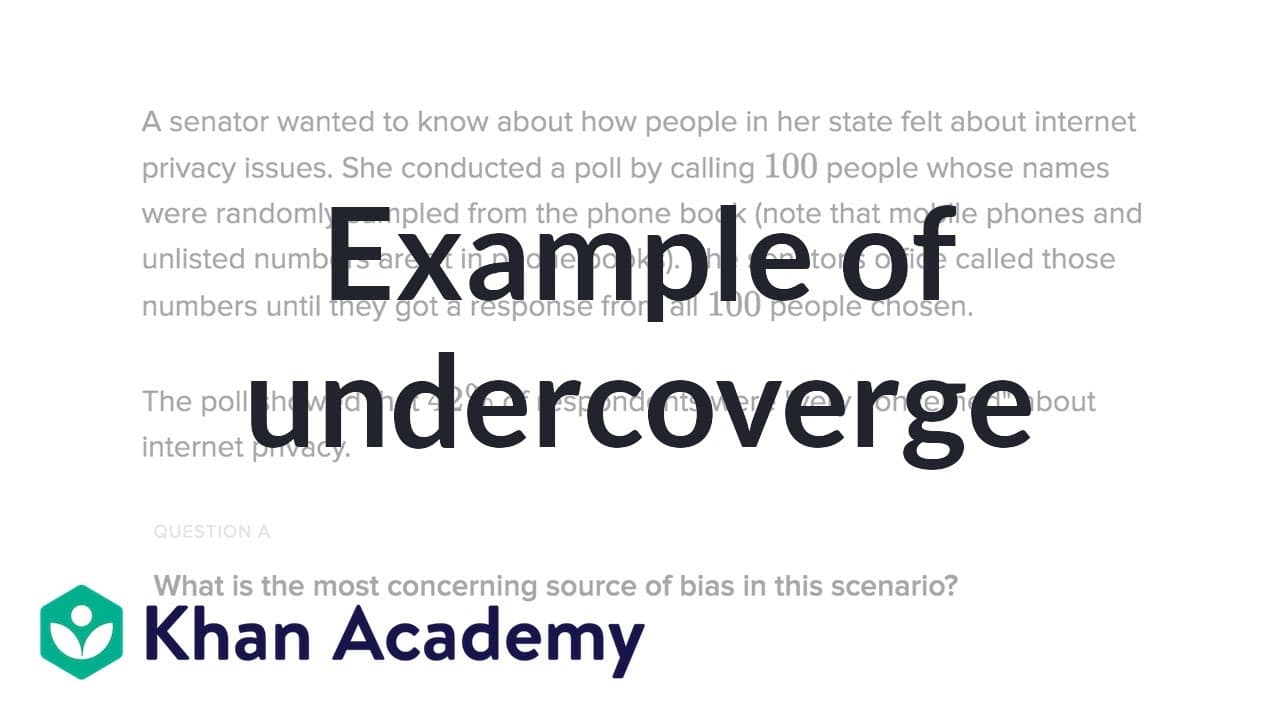
A senator conducted a poll on internet privacy by calling 100 randomly sampled people from the phone book, revealing 42% were very concerned. The most concerning bias is undercoverage, leading to an underestimate of the percentage of constituents concerned about internet privacy.
Transcript
- [Instructor] A senator wanted to know about how people in her state felt about internet privacy issues. She conducted a poll by calling 100 people whose names were randomly sampled from the phone book. Note that mobile phones and unlisted numbers are not in phone books. The senator's office called those numbers until they got a response from all ... Read More
Key Insights
- 📲 The senator conducted a poll on internet privacy by calling 100 randomly sampled individuals from the phone book, achieving a 100% response rate.
- 📱 The most concerning bias in this scenario is undercoverage, as the sample was limited to individuals listed in the phone book, excluding those who are unlisted or only have mobile phones.
- 🥺 Undercoverage likely introduces bias, leading to an underestimate of the percentage of constituents concerned about internet privacy.
- 🧑💼 Nonresponse bias is not present in this scenario since the senator's office ensured a response from all 100 individuals selected.
- 😷 Volunteer response sampling was not used in the poll, as the senator's team obtained the responses from the phone book rather than asking people to volunteer.
- 🛀 The poll results showed that 42% of respondents were very concerned about internet privacy.
- 📱 People who choose not to list in the phone book or only have mobile phones may have a higher concern for privacy, making undercoverage a significant source of bias.
Install to Summarize YouTube Videos and Get Transcripts
Explore YouTube Video Summarizer or Get YouTube Transcript Extractor
Questions & Answers
Q: What method did the senator use to conduct the poll on internet privacy?
The senator called 100 people randomly sampled from the phone book until they obtained responses from all 100 individuals chosen.
Q: What source of bias is most concerning in this scenario?
The most concerning bias is undercoverage because the sample was limited to individuals listed in the phone book, excluding those who are unlisted or only have mobile phones.
Q: How does undercoverage affect the poll results?
Undercoverage leads to an underestimate of the percentage of constituents concerned about internet privacy since the sample does not include individuals who may care more about privacy but are unlisted or only have mobile phones.
Q: Did the poll suffer from nonresponse bias?
No, the poll did not suffer from nonresponse bias as the senator's office called the selected numbers until they obtained a response from all 100 individuals chosen.
Summary & Key Takeaways
-
A senator conducted a poll on internet privacy by calling 100 randomly selected people from the phone book, achieving a response rate of 100%.
-
The poll results showed that 42% of respondents were very concerned about internet privacy.
-
The most concerning bias in this scenario is undercoverage, as the sample was limited to people listed in the phone book, excluding individuals who may have landlines but are unlisted or only have mobile phones.
Read in Other Languages (beta)
Share This Summary 📚
Summarize YouTube Videos and Get Video Transcripts with 1-Click
Try YouTube Summary with ChatGPT & Claude or YouTube Transcript Generator
Explore More Summaries from Khan Academy 📚






Summarize YouTube Videos and Get Video Transcripts with 1-Click
Try YouTube Summary with ChatGPT & Claude or YouTube Transcript Generator