What Is Bernstein’s Freezing-Freeing Hypothesis in Motor Learning?
TL;DR
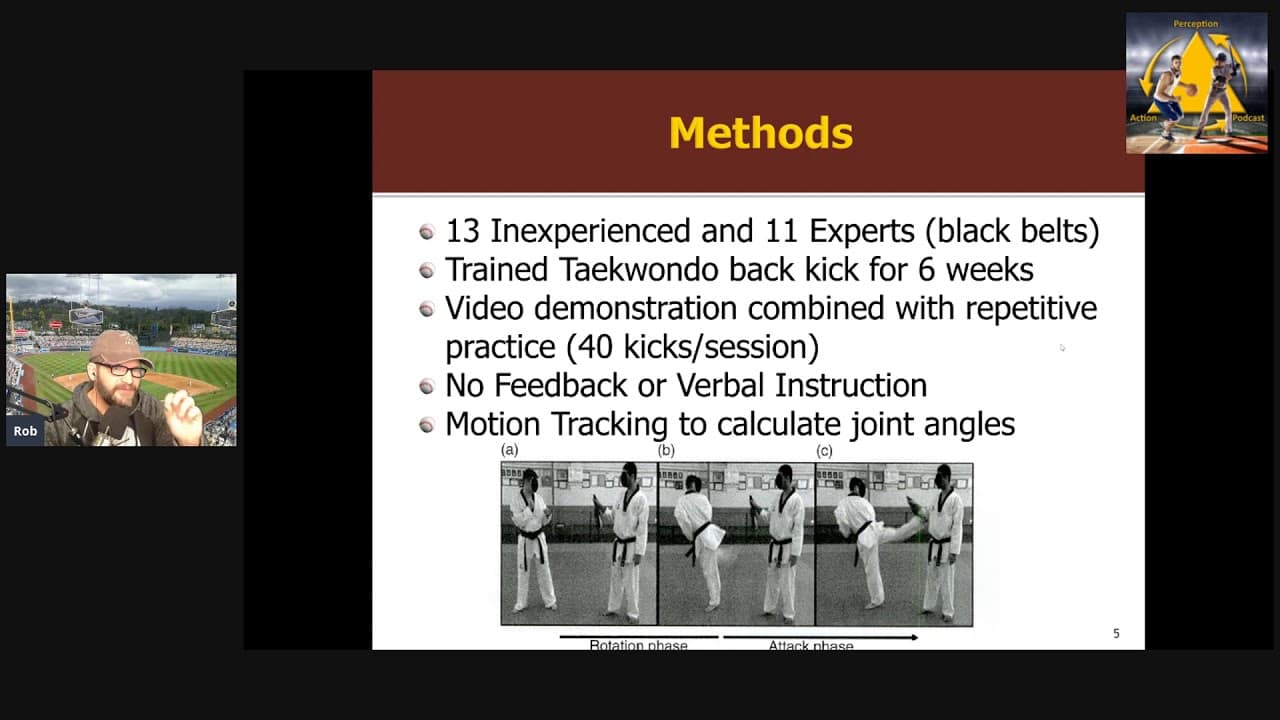
Bernstein's freezing-freeing hypothesis suggests that motor skill acquisition involves initially reducing movement options (freezing) to simplify control, followed by gradually increasing flexibility (freeing) for better performance. However, a study on inexperienced and expert Taekwondo performers showed limited support for this progression, indicating that task nature and instructional methods significantly impact movement strategies and outcomes.
Transcript
hi everyone it's rob gray from asu in the perception action podcast again and this is my 10th and final review of one of my favorite research papers from 2020. this one is looking at you know a topic that i've been really interested in the last year is is the concept of freezing and freeing degrees of freedom in movement control and in coordination... Read More
Key Insights
- Bernstein's hypothesis suggests a progression from freezing to freeing degrees of freedom in learning new motor skills, initially simplifying control by reducing options.
- Freezing involves keeping joints rigid or coupling joint movements, while freeing involves unlocking joint movement and independence for higher control.
- The study reviewed involved inexperienced and expert Taekwondo performers, using motion tracking to evaluate joint angles and movement patterns.
- Results showed that joint range of motion did not follow Bernstein's predicted pattern, often showing only freezing or inconsistent changes.
- Cross-correlation analysis revealed complex patterns, with some evidence of freeing but not the expected freezing-to-freeing progression.
- The expert endpoint in the study provided a useful comparison, suggesting that training duration alone doesn't account for deviations from Bernstein's pattern.
- The study indicates that Bernstein's progression may not be a universal strategy, with task nature and instructional methods influencing movement solutions.
- Further research should explore how instructional methods and task constraints affect the freezing-freeing progression in motor learning.
Install to Summarize YouTube Videos and Get Transcripts
Explore YouTube Video Summarizer or Get YouTube Transcript Extractor
Questions & Answers
Q: What is Bernstein's freezing-freeing hypothesis?
Bernstein's freezing-freeing hypothesis suggests that when learning a new motor skill, individuals initially simplify the control problem by freezing degrees of freedom, making joints rigid or coupling joint movements. As proficiency develops, they gradually free these degrees of freedom, allowing for more complex and independent joint movements, leading to higher levels of control.
Q: How was the study on Taekwondo kicks conducted?
The study involved 13 inexperienced and 11 expert Taekwondo performers. Inexperienced participants were trained for six weeks to perform a back kick, with training involving video demonstrations and repetitive practice without feedback. Motion tracking was used to evaluate joint angles and movement patterns, comparing pre-training, post-training, and retention tests to assess changes in joint range of motion and cross-correlation.
Q: What were the findings regarding joint range of motion?
The study found that joint range of motion did not follow Bernstein's predicted pattern of a U-shaped progression. Instead, results often showed only freezing or inconsistent changes. For example, the knee joint range of motion decreased and reached the level of experts, but did not show the expected increase indicating freeing. This suggests that the freezing-freeing progression may not be universal.
Q: What did the cross-correlation analysis reveal?
Cross-correlation analysis showed complex movement patterns, with some evidence of freeing but not the expected freezing-to-freeing progression. For instance, the hip-knee joint relationship showed significant freeing, moving towards more independence. However, other joint correlations remained consistent or showed only freezing, indicating that the hypothesized progression was not consistently observed across joints.
Q: How does the expert endpoint contribute to the study?
The inclusion of expert performers as an endpoint provides a valuable comparison, suggesting that the lack of a U-shaped progression in joint range of motion is not simply due to insufficient training duration. The expert data indicates the end point of training, refuting arguments that longer training would result in the predicted pattern. This supports the idea that the progression may not be a universal strategy.
Q: What implications does the study have for Bernstein's hypothesis?
The study suggests that Bernstein's freezing-freeing progression may not be a universal strategy for motor learning. The variability in results indicates that task nature, such as whether a task emphasizes power or precision, and instructional methods significantly influence movement solutions. This highlights the need for further research to understand how these factors shape the freezing-freeing progression.
Q: What are the potential influences on the freezing-freeing progression?
Potential influences on the freezing-freeing progression include the nature of the task, such as whether it is a closed-loop or open-loop movement, and the instructional methods used. The study suggests that different instructional approaches, such as those involving more variability and constraint manipulation, may lead to different movement solutions and affect the progression from freezing to freeing.
Q: What future research directions are suggested by the study?
Future research should explore how different instructional methods and task constraints affect the freezing-freeing progression in motor learning. Specifically, studies could investigate how varying levels of variability, constraint manipulation, and feedback influence movement solutions. Understanding these factors could provide insights into optimizing training approaches and better understanding the conditions under which Bernstein's progression occurs.
Summary & Key Takeaways
-
The study reviews Bernstein's hypothesis on freezing and freeing degrees of freedom in motor learning, using a Taekwondo kick as the task. It involves both inexperienced and expert performers, analyzing joint movements through motion tracking. Results show deviations from Bernstein's predicted pattern, with mostly freezing or inconsistent changes.
-
Cross-correlation analysis reveals complex movement patterns, with some evidence of freeing but not the expected progression. The expert endpoint serves as a comparison, indicating that training duration alone doesn't explain deviations. The study suggests that Bernstein's progression may not be universal, with task nature and instructional methods influencing outcomes.
-
Further research is needed to explore how different instructional methods and task constraints affect the freezing-freeing progression. The study highlights the importance of considering these factors in motor learning research, suggesting that the progression may vary based on the specific context and approach used.
Read in Other Languages (beta)
Share This Summary 📚
Summarize YouTube Videos and Get Video Transcripts with 1-Click
Try YouTube Summary with ChatGPT & Claude or YouTube Transcript Generator
Explore More Summaries from Rob Gray 📚
Summarize YouTube Videos and Get Video Transcripts with 1-Click
Try YouTube Summary with ChatGPT & Claude or YouTube Transcript Generator