How Do Computers Instantly Recognize Objects in Images?
TL;DR
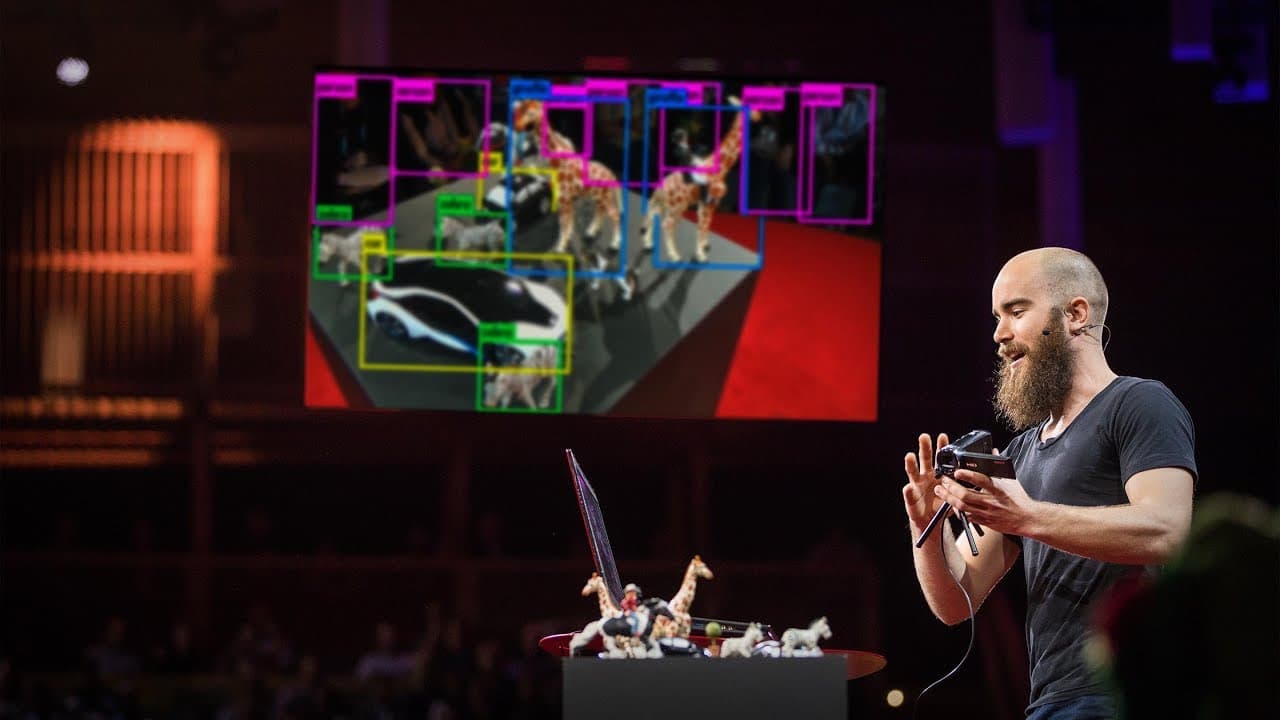
Computers can instantly recognize objects through advanced image classification and real-time object detection techniques, achieving over 99% accuracy. The YOLO (You Only Look Once) method allows for rapid processing, dropping the time from 20 seconds per image to just 20 milliseconds, enabling applications in various fields, from self-driving cars to medical research.
Transcript
Ten years ago, computer vision researchers thought that getting a computer to tell the difference between a cat and a dog would be almost impossible, even with the significant advance in the state of artificial intelligence. Now we can do it at a level greater than 99 percent accuracy. This is called image classification -- give it an image, put a ... Read More
Key Insights
- 🔍 Computer vision researchers have made significant advances in image classification, achieving over 99% accuracy in distinguishing objects like cats and dogs.
- 🐕 Darknet, a neural network framework, can classify not only dogs vs. cats but also predict specific dog breeds, demonstrating the granularity of current computer vision models.
- 🐱 Object detection is a more powerful technique where computers can identify and locate objects in an image, providing information about their size, location, and even extra details like background objects.
- 🏢 Speed is crucial in object detection, as a slower detection system may not be able to keep up with real-time changes in the environment, making it unsuitable for applications like self-driving cars.
- 🚗 The speed of object detection systems has significantly improved from 20 seconds per image to 20 milliseconds per image, enabling real-time processing and tracking of objects even on resource-constrained devices like laptops and phones.
- 👀 The YOLO (You Only Look Once) method of object detection trains a single network to simultaneously produce bounding boxes and class probabilities, eliminating the need for running a classifier thousands of times.
- 📹 Real-time video processing is now possible with speedy object detection, allowing for the identification and tracking of moving objects and their interactions.
- 🌍 Object detection systems like YOLO have broader applications beyond just image recognition, ranging from robotics and medicine to wildlife conservation, enabling researchers to detect various objects and phenomena in different domains.
Install to Summarize YouTube Videos and Get Transcripts
Explore YouTube Video Summarizer or Get YouTube Transcript Extractor
Questions & Answers
Q: What is image classification?
Image classification is the process of using computer vision algorithms to analyze an image and assign a label or category to it. It involves training a neural network to recognize and differentiate between different objects, such as cats and dogs, with high accuracy.
Q: What is Darknet and what does it do?
Darknet is a neural network framework developed at the University of Washington for training and testing computer vision models. It is used in image classification and object detection projects. Darknet allows for the prediction of specific breed types in images and provides more detailed information about the objects present.
Q: What is the difference between image classification and object detection?
Image classification focuses on assigning a single label or category to an image, while object detection involves identifying and locating multiple objects within an image. Object detection algorithms use bounding boxes to mark the boundaries of objects and provide additional information such as their relative sizes and positions.
Q: Why is speed important in object detection?
Speed is crucial in object detection because it allows for real-time analysis of images or video. In applications like self-driving vehicles or robotics systems, it is necessary to process frames quickly to track objects and make informed decisions. Slow detection methods can lead to outdated information and less effective system performance.
Summary & Key Takeaways
-Computer vision has advanced significantly in the past decade, with the ability to accurately classify images at a level of over 99% accuracy.
-Darknet, a neural network framework, is used for training and testing computer vision models, including object detection.
-Object detection has improved in speed, going from processing one image in 20 seconds to 20 milliseconds, making it possible to process video in real-time.
Read in Other Languages (beta)
Share This Summary 📚
Summarize YouTube Videos and Get Video Transcripts with 1-Click
Try YouTube Summary with ChatGPT & Claude or YouTube Transcript Generator
Explore More Summaries from TED 📚




Summarize YouTube Videos and Get Video Transcripts with 1-Click
Try YouTube Summary with ChatGPT & Claude or YouTube Transcript Generator