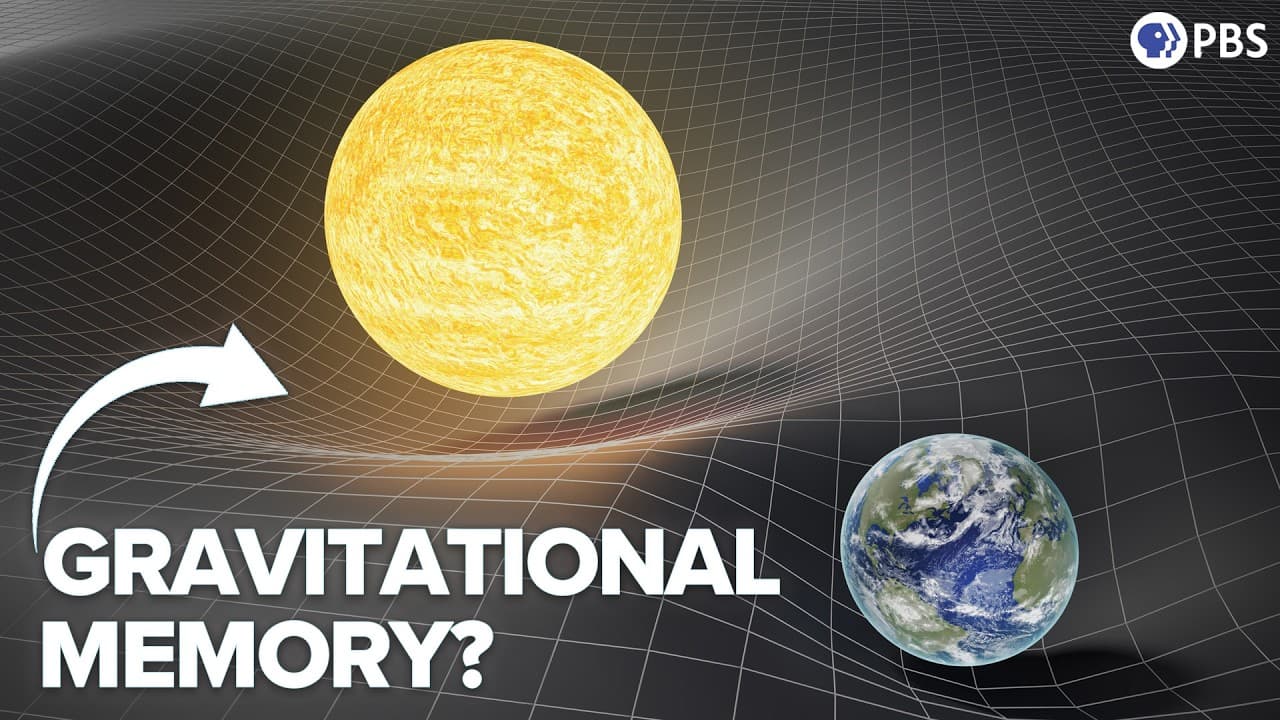
Can Space Time Remember?
TL;DR
Gravitational waves can permanently alter spacetime, leaving a memory.
Transcript
thank you to rikon for supporting PBS there are cosmic events so powerful that they leave permanent marks on the fabric of the universe itself imagine two colossal black holes spiraling towards each other they send ripples in the fabric of SpaceTime gravitational waves that we've only recently learned to sense but ripples pass leaving the pond or t... Read More
Key Insights
- Gravitational memory effects refer to the permanent changes in spacetime caused by powerful cosmic events, such as merging black holes, which leave a lasting imprint.
- Unlike typical gravitational waves, which are elastic and leave no permanent change, memory effects can warp spacetime permanently, akin to a gravitational tsunami.
- The displacement memory effect causes a permanent shift in the position of objects, while the velocity kick memory effect imparts a lasting change in velocity.
- Gravitational memory effects are a prediction of general relativity, and detecting them would further confirm Einstein's theory or reveal the need for modifications.
- Current observatories like LIGO cannot detect these effects due to their weak signals and the limitations of ground-based detection methods.
- The upcoming LISA mission, a space-based observatory, is expected to detect low-frequency gravitational waves and their memory effects from supermassive black hole mergers.
- Observing gravitational memory effects can provide additional data about the sources of gravitational waves, helping to refine our understanding of cosmic events.
- Detecting these effects could offer insights into the early universe, potentially revealing information about cosmic inflation and the universe's expansion history.
Install to Summarize YouTube Videos and Get Transcripts
Explore YouTube Video Summarizer or Get YouTube Transcript Extractor
Questions & Answers
Q: What are gravitational memory effects?
Gravitational memory effects are permanent changes in the fabric of spacetime caused by powerful cosmic events, such as the merging of black holes. Unlike typical gravitational waves, which are elastic and temporary, these effects leave a lasting imprint on spacetime, akin to a gravitational tsunami.
Q: How do gravitational memory effects differ from regular gravitational waves?
Regular gravitational waves are elastic and temporary, causing spacetime to stretch and squish in a way that returns to its original state. In contrast, gravitational memory effects result in permanent changes, leaving a lasting imprint on spacetime, similar to a tsunami in water.
Q: Why can't current observatories detect gravitational memory effects?
Current observatories like LIGO cannot detect gravitational memory effects because these effects are extremely weak and the observatories are designed to detect higher frequency signals. Additionally, the ground-based nature of these observatories introduces limitations that prevent the detection of such subtle changes.
Q: What is the LISA mission and its significance in detecting memory effects?
The LISA mission, led by the European Space Agency, is a space-based observatory designed to detect low-frequency gravitational waves and their memory effects. Scheduled for launch in 2035, LISA will use laser interferometry to detect these effects, providing new insights into cosmic events and the nature of spacetime.
Q: How can detecting gravitational memory effects impact our understanding of general relativity?
Detecting gravitational memory effects would further confirm the predictions of Einstein's general relativity. If these effects deviate from predictions, it could indicate a need to modify or extend the theory, potentially offering explanations for phenomena like dark matter without invoking new types of matter.
Q: What additional information can gravitational memory effects provide about cosmic events?
Gravitational memory effects can offer additional data about the sources of gravitational waves, such as merging black holes. This information can help refine measurements of their masses, spins, and orbital parameters, enhancing our understanding of these cosmic events and the dynamics involved.
Q: How might gravitational memory effects offer insights into the early universe?
Gravitational memory effects could reveal information about cosmic inflation, a period of rapid expansion in the early universe. Observing these effects may provide clues about the universe's expansion history and the clustering of galaxies, offering a new window into events that occurred at the beginning of time.
Q: What challenges exist in detecting gravitational memory effects?
The primary challenge in detecting gravitational memory effects is their weak signal, which is even more subtle than regular gravitational waves. Current ground-based observatories are not sensitive enough to detect these effects, necessitating the development of space-based observatories like LISA to overcome these limitations.
Summary & Key Takeaways
-
Gravitational memory effects are permanent changes in spacetime caused by cosmic events like merging black holes. These effects are different from typical gravitational waves, which are elastic and temporary. Detecting these memory effects would further confirm Einstein's general relativity or indicate a need for modifications.
-
Current ground-based observatories like LIGO cannot detect gravitational memory effects due to their weak signals. However, the upcoming LISA mission, a space-based observatory, is expected to detect these effects, providing new insights into the nature of spacetime and the sources of gravitational waves.
-
Detecting gravitational memory effects can enhance our understanding of cosmic events and the early universe. These effects could reveal information about cosmic inflation and the universe's expansion, offering a new way to test and potentially modify general relativity.
Read in Other Languages (beta)
Share This Summary 📚
Summarize YouTube Videos and Get Video Transcripts with 1-Click
Try YouTube Summary with ChatGPT & Claude or YouTube Transcript Generator
Explore More Summaries from PBS Space Time 📚
Summarize YouTube Videos and Get Video Transcripts with 1-Click
Try YouTube Summary with ChatGPT & Claude or YouTube Transcript Generator