Euler's Formula - Numberphile
TL;DR
Euler's formula, e^iπ + 1 = 0, is derived from complex numbers and trigonometry and leads to various mathematical concepts.
Transcript
So we're talking about possibly the most famous equation in maths. You've all heard of it - Euler's identity - the most beautiful equation in all of maths. e to the iπ plus 1 equals zero. We've got the five most important or famous mathematical constants: zero, 1, i, π and the number e. There's a reason this is the most beautiful equation... Read More
Key Insights
- #️⃣ Euler's formula relates complex numbers, trigonometric functions, and exponential functions.
- 💼 Euler's identity is a special case of Euler's formula, where the angle is π, resulting in an unexpected equality involving important mathematical constants.
- 😑 Euler's formula allows for alternative expressions of trigonometric functions in terms of the exponential function.
- 🔺 The various values obtained by substituting different angles into Euler's formula provide additional identities and relationships in mathematics.
- 🏑 Euler's formula has practical applications in different fields, including electrical engineering, physics, and computer science.
- 😌 The elegance and beauty of Euler's formula lie in its ability to connect seemingly unrelated mathematical concepts.
- #️⃣ Understanding Euler's formula and identity deepens the understanding of complex numbers and their geometric representation.
Install to Summarize YouTube Videos and Get Transcripts
Explore YouTube Video Summarizer or Get YouTube Transcript Extractor
Questions & Answers
Q: Where does Euler's formula come from?
Euler's formula is derived from representing complex numbers in rectangular and polar forms and comparing the two representations. It shows the relationship between exponentiation, trigonometric functions, and complex numbers.
Q: What is Euler's identity?
Euler's identity is e^iπ + 1 = 0. It is a special case of Euler's formula, where π is substituted as the angle, resulting in the surprising equality of the five most important mathematical constants: 0, 1, i, π, and e.
Q: How is cos(θ) and sin(θ) expressed using Euler's formula?
By adding and subtracting Euler's formula for e^iθ and e^-iθ, we can obtain the expressions for cos(θ) and sin(θ) in terms of the exponential function. Cos(θ) = (e^iθ + e^-iθ)/2 and sin(θ) = (e^iθ - e^-iθ)/(2i).
Q: What are some applications of Euler's formula?
Euler's formula has various applications in mathematics, physics, and engineering. It is used in signal processing, Fourier analysis, quantum mechanics, and complex analysis.
Summary & Key Takeaways
-
Euler's formula is derived from complex numbers, where a complex number is represented as x + iy, and i is the square root of -1.
-
Complex numbers can be represented in two forms: rectangular form (x + iy) and polar form (re^iθ), where r represents the modulus and θ represents the argument.
-
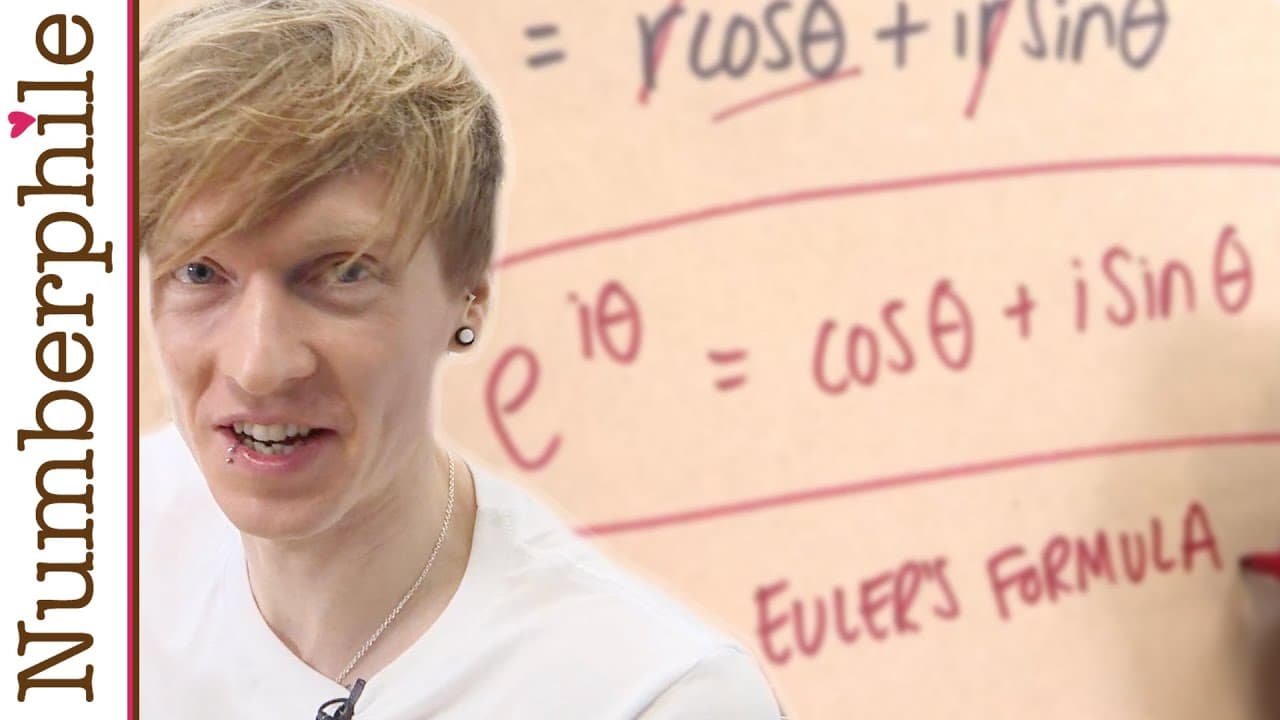
By comparing the two representations, Euler's formula, e^iθ = cos(θ) + isin(θ), is derived.
-
Euler's identity, e^iπ + 1 = 0, is obtained by substituting π into Euler's formula.
Read in Other Languages (beta)
Share This Summary 📚
Summarize YouTube Videos and Get Video Transcripts with 1-Click
Try YouTube Summary with ChatGPT & Claude or YouTube Transcript Generator
Explore More Summaries from Numberphile 📚






Summarize YouTube Videos and Get Video Transcripts with 1-Click
Try YouTube Summary with ChatGPT & Claude or YouTube Transcript Generator