Computing a Jacobian matrix
TL;DR
Partial derivatives are used to compute the Jacobian matrix, which represents a linear transformation.
Transcript
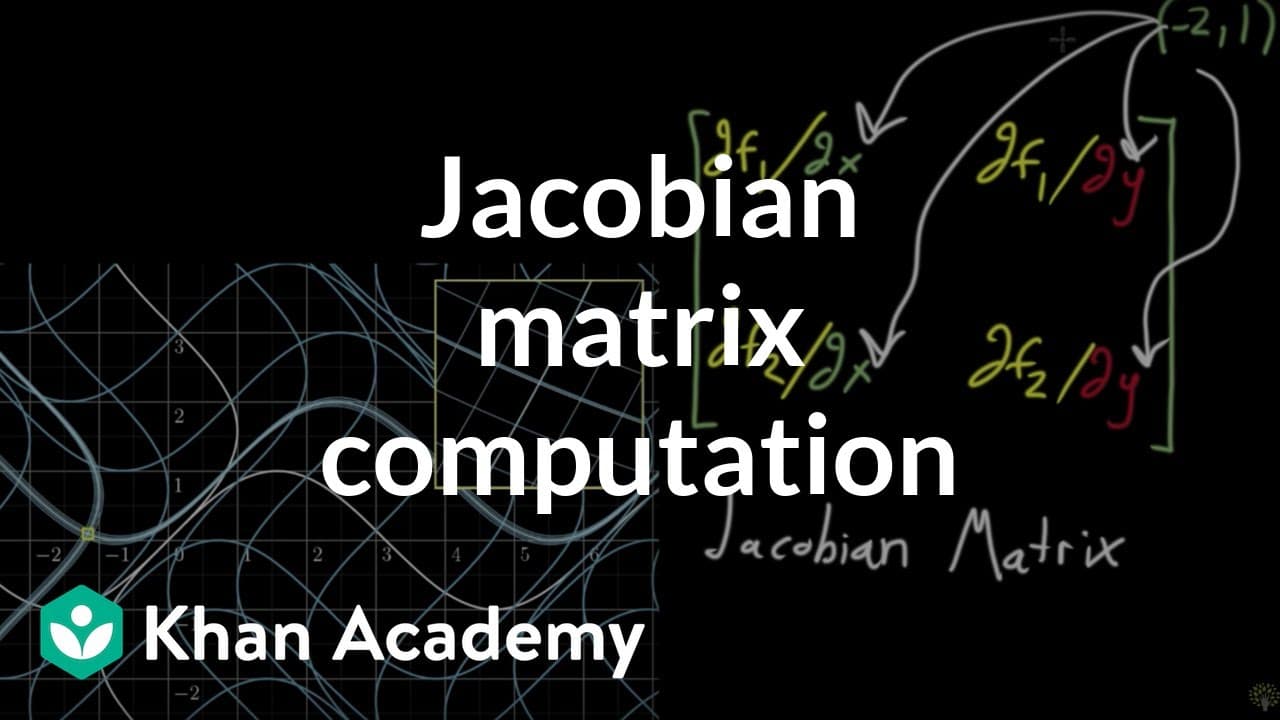
- [Teacher] So, just as a reminder of where we are, we've got this very non-linear transformation and we showed that if you zoom in on a specific point while that transformation is happening, it looks a lot like something linear and we reason that you can figure out what linear transformation that looks like by taking the partial derivatives of you... Read More
Key Insights
- 😥 Non-linear transformations can be approximated as linear transformations by analyzing specific points.
- ❓ The Jacobian matrix represents the linear transformation generated by a function's partial derivatives.
- 🫡 Partial derivatives measure the rate of change of a function with respect to each variable.
- 🛀 The Jacobian matrix visually shows the effect of the linear transformation on basis vectors.
- 😥 By calculating the partial derivatives, one can determine the linear transformation matrix for any specific point.
- 🔺 The Jacobian matrix provides a way to analyze how a small region around a point is transformed linearly.
- 🆘 The Jacobian helps understand the relationship between transformations and the variables involved.
Install to Summarize YouTube Videos and Get Transcripts
Explore YouTube Video Summarizer or Get YouTube Transcript Extractor
Questions & Answers
Q: How can a non-linear transformation be approximated as a linear transformation?
By zooming in on a specific point of the transformation, it can be observed that locally, it resembles a linear transformation. This allows us to determine the linear transformation that closely represents the non-linear one.
Q: What are partial derivatives used for in this context?
Partial derivatives are used to compute the Jacobian matrix, which describes the linear transformation. They measure the rate at which the function changes with respect to each variable.
Q: How is the Jacobian matrix computed?
The Jacobian matrix is computed by taking the partial derivatives of the given function and organizing them into a matrix. Each entry represents the partial derivative of the corresponding component with respect to the variables involved.
Q: What does the teacher mean by "taking the partial derivative of sin of x becomes cosine of x"?
The derivative of sin(x) with respect to x is equal to cosine(x). This means that when calculating the partial derivative of a function involving sin(x) with respect to x, the derivative is simply cosine(x).
Summary & Key Takeaways
-
The teacher explains that a non-linear transformation can be approximated as a linear transformation by zooming in on a specific point.
-
The teacher demonstrates how to compute the partial derivatives of a given function to determine the linear transformation.
-
The Jacobian matrix is obtained by organizing the partial derivatives into a grid, representing the linear transformation.
Read in Other Languages (beta)
Share This Summary 📚
Summarize YouTube Videos and Get Video Transcripts with 1-Click
Try YouTube Summary with ChatGPT & Claude or YouTube Transcript Generator
Explore More Summaries from Khan Academy 📚



Summarize YouTube Videos and Get Video Transcripts with 1-Click
Try YouTube Summary with ChatGPT & Claude or YouTube Transcript Generator