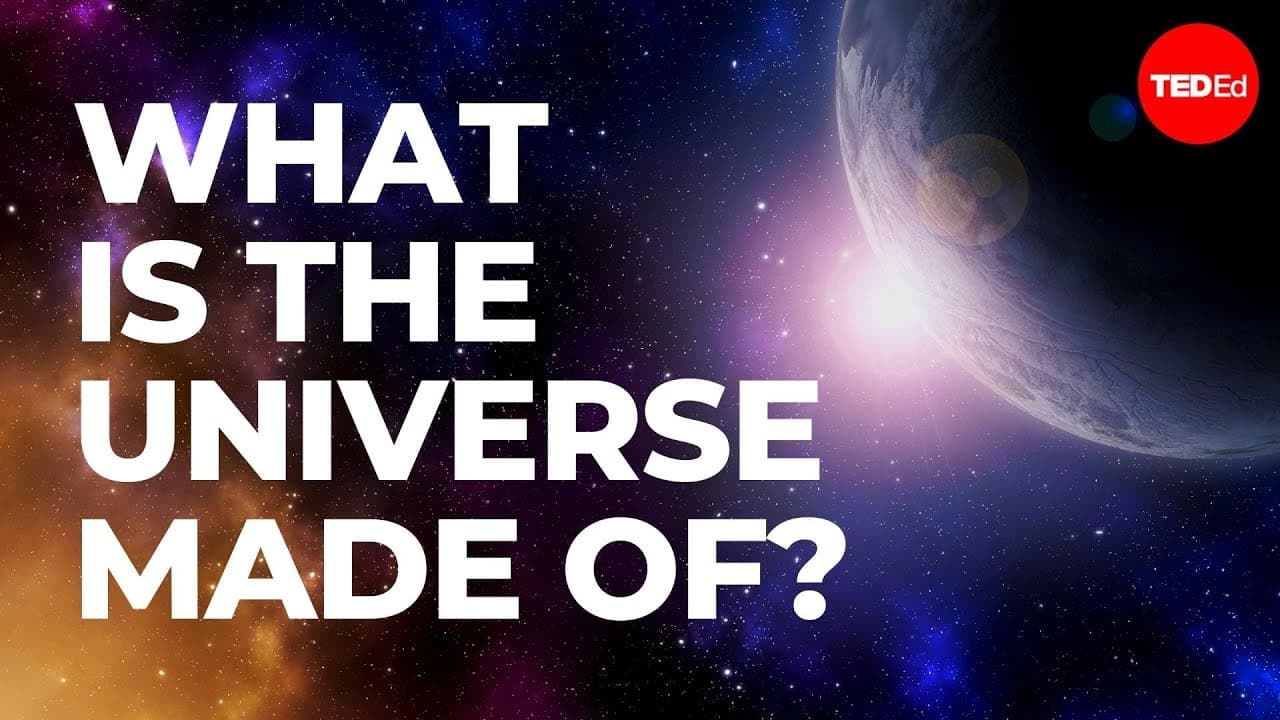
What is the universe made of? - Dennis Wildfogel
TL;DR
The atoms and elements that make up everything around us, including ourselves, were formed in stars through the process of fusion.
Transcript
All the material objects around you are composed of submicroscopic units we call molecules. And molecules in turn are composed of individual atoms. Molecules frequently break apart and then form new molecules. On the other hand, virtually all the atoms you come in to contact with through the course of your life, the ones in the ground beneath you, ... Read More
Key Insights
- 🫢 The Big Bang created a universe consisting of gas alone, primarily hydrogen and helium.
- 🎈 Gravity caused dense gas balls to form, leading to the birth of stars through nuclear fusion.
- 🤩 Fusion reactions in massive stars produced elements up to iron, while supernovae created even heavier elements.
- 💁 Elements formed in supernovae mix with interstellar gas, leading to the formation of new stars and planets.
- 🤩 The Earth and everything on it, including ourselves, are made up of atoms that were created in stars.
- ❣️ The majority of the Sun is still composed of hydrogen and helium, but it also contains heavier elements.
- 🤩 Planets, including Earth, formed from the same gas cloud as the star and predominantly consist of heavier elements.
Install to Summarize YouTube Videos and Get Transcripts
Explore YouTube Video Summarizer or Get YouTube Transcript Extractor
Questions & Answers
Q: How were atoms and elements created?
Atoms and elements were created through the process of nuclear fusion in stars. The initial simple elements from the Big Bang underwent fusion reactions in massive stars, resulting in the creation of heavier elements.
Q: What happens during a supernova?
A supernova is a powerful explosion that occurs when a massive star collapses after running out of fuel. The explosion releases an incredible amount of energy, allowing for the formation of even heavier elements.
Q: How are elements distributed in the universe?
Elements formed in stars and supernovae are ejected into interstellar space. These elements mix with existing gas clouds, leading to the formation of new stars and planets, like our own Earth.
Q: What percentage of the Sun is made up of heavier elements?
While hydrogen and helium make up the majority of the Sun's composition, two percent of the Sun is made up of heavier elements such as carbon, nitrogen, oxygen, and others.
Summary & Key Takeaways
-
All material objects consist of molecules, which are composed of atoms. Atoms have existed for billions of years and were created in places different from our planet through a process called the Big Bang.
-
The gas resulting from the Big Bang was made up of simple elements, primarily hydrogen and helium. Gravity caused dense gas balls to form, leading to the birth of stars through nuclear fusion.
-
Massive stars undergo fusion reactions that produce elements up to iron. When a star's fuel runs out, it collapses and explodes in a supernova, creating even heavier elements. These elements mix with interstellar gas, eventually forming new stars and planets.
Read in Other Languages (beta)
Share This Summary 📚
Summarize YouTube Videos and Get Video Transcripts with 1-Click
Try YouTube Summary with ChatGPT & Claude or YouTube Transcript Generator
Explore More Summaries from TED-Ed 📚


Summarize YouTube Videos and Get Video Transcripts with 1-Click
Try YouTube Summary with ChatGPT & Claude or YouTube Transcript Generator