Nobel Lecture: Rainer Weiss, Nobel Prize in Physics 2017
TL;DR
Gravitational waves are transverse distortions of space that travel at the speed of light, stretching distances in one direction while squeezing the perpendicular direction. The measurable quantity is strain: the change in distance between two objects divided by their separation. Einstein predicted them in his 1916 paper but believed they were far too weak to ever detect.
Transcript
well this is a pleasure to be here but before I start I want to acknowledge that the three of us wouldn't be here at all if it weren't for people who were in the LIGO laboratory in the LIGO scientific collaboration and in the Virgo collaboration and the Virgo experiment and since some of you are here I'm going to insist that you stand up would you ... Read More
Key Insights
- Newton's theory of gravity describes forces between masses that weaken with distance, and it works well enough to run the space program, but it is not right because it cannot handle very large masses moving at high velocities or communicate changes in the gravitational field across distance.
- Einstein's general relativity, given to the world in 1915, treats gravity as distortion of space and time; in John Wheeler's phrasing, matter distorts space and time, and then matter moves because of that distortion.
- A gravitational wave is a transverse wave that distorts space perpendicular to its direction of travel and moves at the speed of light, so when one direction expands the perpendicular direction contracts, and those motions flip back and forth.
- Strain is the key measured quantity: at any moment the change in distance between two objects is proportional to their separation, and that change in distance divided by the separation is the strain that describes the gravitational-wave field.
- The dimensionless quantity GM divided by R times C squared measures gravitational field strength; on Earth it is only about 10 to the minus 10, meaning we live in an extremely weak gravitational field, while near black holes it approaches 1.
- Einstein wrote at the end of his 1916 paper that the relevant quantity would have a practically vanishing value, concluding that since it could never be measured it was of no consequence to science; he made a mistake in that paper and corrected it in 1918.
- For two colliding trains of about 10 to the 5 kilograms at roughly 100 kilometers per hour, measured about 300 kilometers away in the radiation field, the strain comes out to about 10 to the minus 42, which is truly impossible to detect.
- For binary stars orbiting once a day about 10,000 light-years away, the strain is about 10 to the minus 23 with a period of half a day, but the energy carried off would take about 10 to the 13 years to visibly change the stars' separation.
Install to Summarize YouTube Videos and Get Transcripts
Explore YouTube Video Summarizer or Get YouTube Transcript Extractor
Questions & Answers
Q: What are gravitational waves according to Einstein's theory?
Gravitational waves are transverse waves that distort space perpendicular to the direction in which the wave travels, and they move at the speed of light. As a wave passes, one direction, such as the horizontal, expands while the perpendicular vertical direction contracts, and at any moment these opposite motions flip. Objects far from you move a lot while nearby objects barely move, producing a constant strain across space.
Q: What is strain in the context of gravitational waves?
Strain is the field quantity used to describe gravitational waves. At any one moment, the change in distance between two objects caused by a passing wave is proportional to their separation, and that change in distance divided by the separation is called the strain. Detectors actually measure the distance separations, but the strain is the quantity that describes the gravitational field in Einstein's theory, and it is the number the scientists talk about most.
Q: Why is Newton's theory of gravity considered wrong despite working well?
Newton's theory describes forces between masses that get smaller as the distance between them grows, and it is a wonderful theory that does almost everything needed, including making the space program work. However, it is not right because it has no way of dealing with very large masses moving at high velocities, and no way of communicating information in the gravitational field from one place to another. If the Sun disappeared, gravitational news of that should take about nine minutes to reach us, which Newton's theory cannot express.
Q: How did Einstein describe the relationship between matter and space-time?
In the way John Wheeler explained Einstein's theory, matter distorts space and time, and then matter moves because of the distortion in space and time. Weiss illustrated this with a jungle gym imagined with clocks at every intersection point. Far from the Sun space looks Euclidean and all clocks read the same time, but as you approach the Sun space becomes distorted and the clocks run a little more slowly, and the Earth creates a smaller dimple of the same kind.
Q: What did Einstein say about detecting gravitational waves in his 1916 paper?
At the end of his 1916 paper, Einstein described an equation relating the strength of gravitational waves to their source, the oscillations and accelerations of matter. He then made a striking statement that the quantity would have a practically vanishing value, effectively concluding that since you would never be able to measure it, it was of no consequence to science. He made a mistake in that paper, which he corrected in 1918, though the error was unrelated to this conclusion.
Q: Why did Einstein believe gravitational waves could never be measured?
Einstein was reasoning in the context of 1915 and 1916 with the sources available to him. Estimating the strain from two colliding trains of about 10 to the 5 kilograms moving near 100 kilometers per hour, measured far enough away to be in the radiation field, gives a strain of about 10 to the minus 42, which is truly impossible to detect even now. Astronomical sources like binary stars fared little better, so both technically and astronomically detection looked hopeless.
Q: What strain values did Weiss calculate for different gravitational-wave sources?
For two colliding trains of about 10 to the 5 kilograms at roughly 100 kilometers per hour, with a collision time of about a third of a second and measured about 300 kilometers away, the strain is about 10 to the minus 42. For two stars orbiting each other once a day at a distance of about 10,000 light-years, the strain is about 10 to the minus 23 with a period of half a day, which is the kind of signal modern detectors would seek.
Q: What is the significance of the quantity GM divided by R C squared?
GM divided by R times C squared is a very important dimensionless quantity that appears in the simple formula for estimating gravitational-wave strain, using Newton's constant, the mass of the objects, the distance from them, and the velocity of light squared. On Earth this quantity is only about 10 to the minus 10, meaning we live in an extremely weak gravitational field. Near objects like black holes and the early universe this number approaches 1, where gravity is enormous.
Summary
This video discusses the history and technology behind gravitational wave detection. It begins with an introduction to Newton's theory of gravity and Einstein's theory of general relativity, which introduced the concept of gravitational waves. The video then explains how these waves can be detected using interferometry, where the length of a laser beam is measured to detect changes caused by the wave. The video also discusses the challenges of building and operating large-scale detectors, including dealing with ground motion and minimizing noise. Finally, it highlights the key individuals and groups involved in the development of gravitational wave detectors.
Questions & Answers
Q: What is the difference between Newton's theory of gravity and Einstein's theory of general relativity?
While Newton's theory of gravity explains the force between masses, Einstein's theory of general relativity introduced the concept of spacetime curvature caused by massive objects. This theory allows for the prediction and existence of gravitational waves.
Q: How are gravitational waves detected using interferometry?
Interferometry is used to measure the length of a laser beam. When a gravitational wave passes through the detector, it causes a change in the length of the beam. By observing these changes, scientists can detect and study gravitational waves.
Q: What are the challenges in building and operating large-scale gravitational wave detectors?
One challenge is dealing with ground motion, which can introduce noise into the detector. To mitigate this, the mirrors and other components of the detector need to be isolated from vibrations. Another challenge is minimizing noise from factors such as radiation pressure and thermal noise. These noises can limit the sensitivity of the detector and require careful engineering and design.
Q: Who were the key individuals and groups involved in the development of gravitational wave detectors?
Some key individuals include Albert Einstein, who first predicted the existence of gravitational waves, and Joe Taylor and Russell Hulse, who indirectly detected gravitational waves using pulsars. The LIGO Scientific Collaboration and the Virgo Collaboration were also critical in the development of large-scale gravitational wave detectors.
Q: How has the technology of gravitational wave detectors evolved over time?
The technology has evolved from early bar detectors, such as Joe Weber's device, to modern interferometric detectors. These modern detectors, like the Advanced LIGO detector, use multiple mirrors and advanced techniques to improve sensitivity and reduce noise.
Q: What is the quantum limit and how does it affect gravitational wave detectors?
The quantum limit is a fundamental limit in precision measurement. In the context of gravitational wave detectors, it refers to the minimum amount of noise that exists due to the quantum nature of light. Efforts are made to reduce this noise, but it remains a fundamental limit to the sensitivity of the detectors.
Q: How do gravitational waves impact the length of a laser beam in an interferometer?
Gravitational waves cause the length of a laser beam to change by stretching and compressing space. This change in length can be measured using interferometry, where the interference pattern of the laser beam is analyzed to detect these changes.
Q: What role does vacuum play in gravitational wave detectors?
Vacuum is necessary in gravitational wave detectors to minimize the effects of air molecules and other contaminants that can interfere with the laser beam. A high-quality vacuum is essential for preserving the cleanliness and integrity of the detector.
Q: What are the future prospects for gravitational wave detection?
The future prospects for gravitational wave detection are promising. As technology continues to advance, detectors will become even more sensitive, allowing for the detection of fainter signals and a deeper understanding of the universe. Additionally, more detectors are being built around the world to enhance the global network of gravitational wave observatories.
Q: How has the study of gravitational waves impacted our understanding of the universe?
The study of gravitational waves has opened up a new window into the universe. It has provided direct evidence of phenomena predicted by Einstein's theory of general relativity and has allowed for the observation of previously invisible astrophysical events, such as the merger of black holes and neutron stars. Gravitational wave detection has revolutionized our understanding of the universe and will continue to do so in the future.
Takeaways
The video provides a comprehensive overview of the history and technology behind gravitational wave detection. It explains the differences between Newton's theory of gravity and Einstein's theory of general relativity, highlighting the importance of gravitational waves in the latter. The video goes on to describe the use of interferometry in detecting gravitational waves and the challenges associated with building and operating large-scale detectors. It also emphasizes the contributions of key individuals and groups in the development of gravitational wave detectors. Ultimately, gravitational wave detection has significantly advanced our understanding of the universe and continues to provide valuable insights into astrophysical phenomena.
Summary & Key Takeaways
-
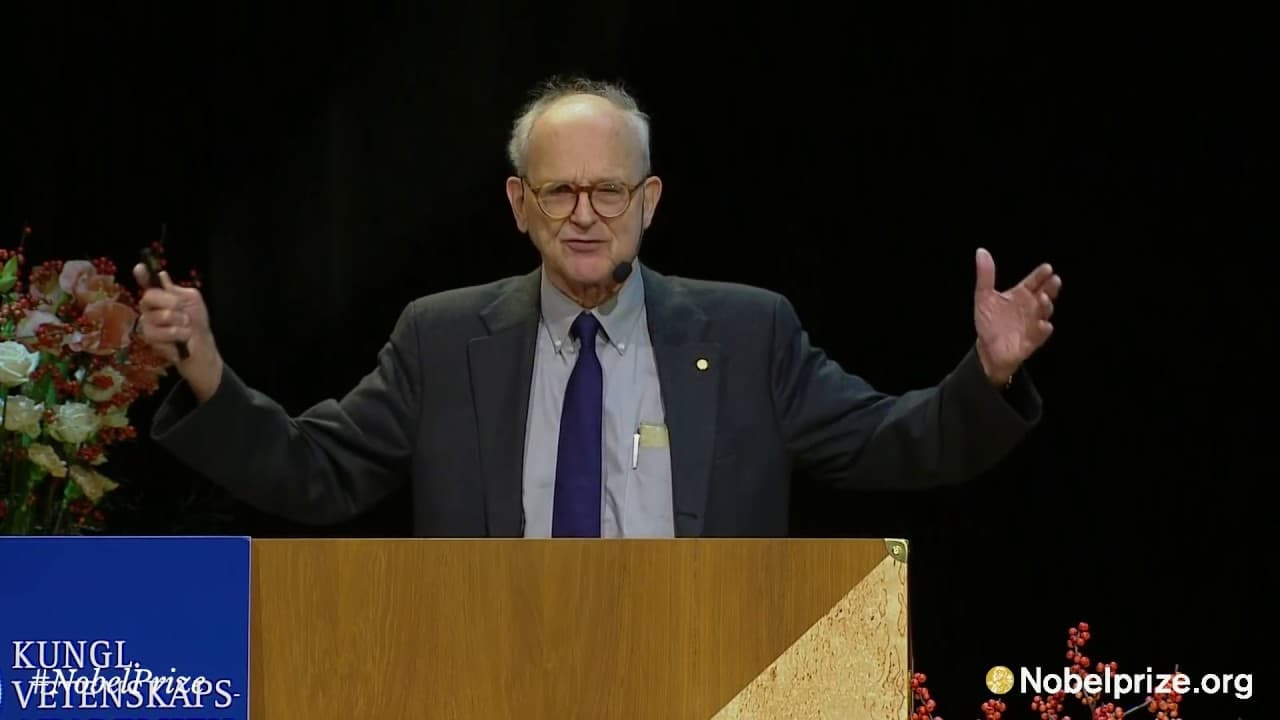
Rainer Weiss opened his 2017 Nobel Lecture by acknowledging the LIGO laboratory, the LIGO scientific collaboration, and the Virgo collaboration as the real reason the three laureates were there. He explained that his talk covers the old times, Barry covers the present, and Kip covers the future of gravitational-wave science.
-
Newton's gravity is a theory of forces between masses that weaken with distance and works well enough to run the space program, but it fails for large masses moving fast and cannot communicate field changes across distance. Einstein's general relativity replaces it: matter distorts space and time, and matter then moves because of that distortion.
-
Gravitational waves are transverse distortions of space moving at light speed, expanding one direction while contracting the perpendicular one. The measurable strain equals change in distance divided by separation. Einstein predicted these waves in 1916 but calculated their strain, such as 10 to the minus 42 for colliding trains or 10 to the minus 23 for binary stars, was far too small to ever detect.
Read in Other Languages (beta)
Share This Summary 📚
Summarize YouTube Videos and Get Video Transcripts with 1-Click
Try YouTube Summary with ChatGPT & Claude or YouTube Transcript Generator
Explore More Summaries from Nobel Prize 📚






Summarize YouTube Videos and Get Video Transcripts with 1-Click
Try YouTube Summary with ChatGPT & Claude or YouTube Transcript Generator