What Is AC Power in Purely Resistive Circuits?
TL;DR
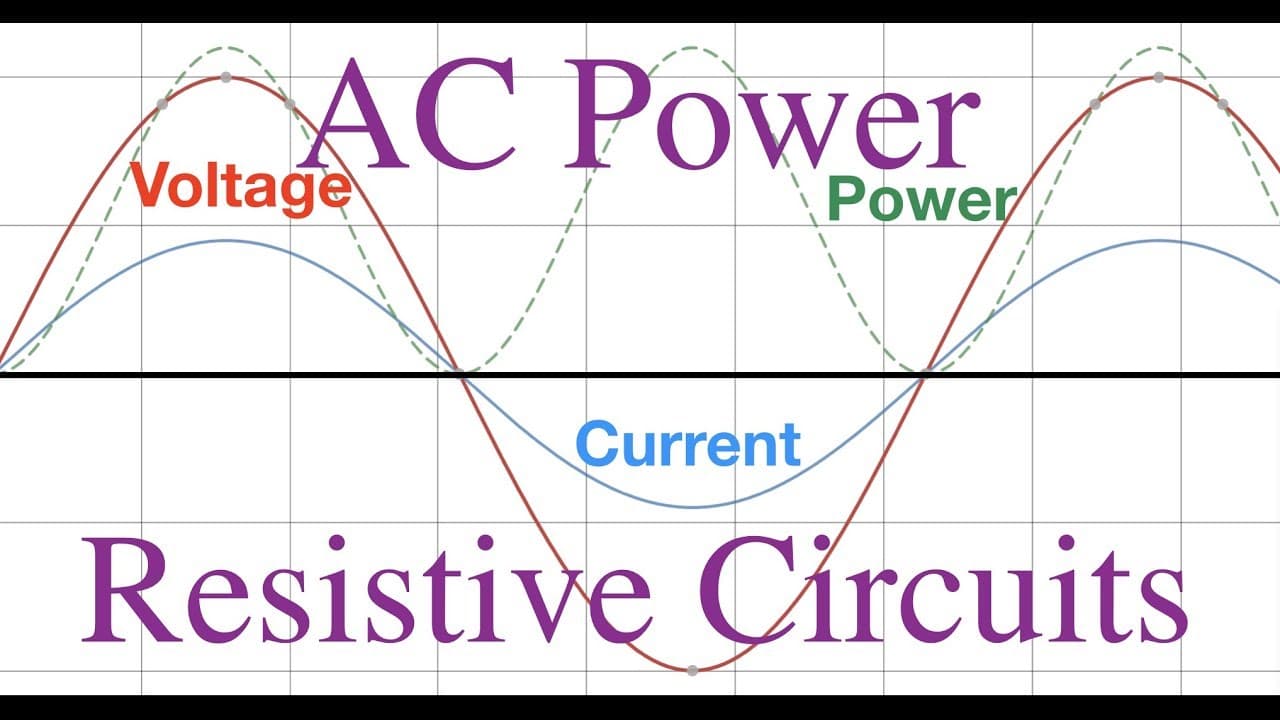
In purely resistive circuits, the current and voltage are always in phase, meaning the phase angle is zero degrees. The average power is calculated using the formula average power = RMS voltage × RMS current, and it is always positive because both positive and negative values of voltage and current contribute to positive power output.
Transcript
okay as you can see in today's video I'm going to be going over AC power for purely resistive circuits that is for circuits that contain only resistors and no inductors and no capacitors and we're going to be doing that using this diagram this graph which shows us the relationship between the voltage the current and the power the voltage is of cour... Read More
Key Insights
- ⚡ In purely resistive circuits, the current and voltage are in phase.
- ⚡ The phase angle between the current and voltage is zero degrees.
- ✊ The average power in a resistive circuit is calculated using the equation average power = RMS voltage x RMS current.
- ✊ The power in a resistive circuit is always positive because positive voltage with positive current and negative voltage with negative current result in positive power values.
- 🤪 The power waveform oscillates between positive and zero values but never goes into the negative part of the graph.
- ✊ The average power value is obtained by finding the halfway point between the minimum and maximum power values on the graph.
- ✊ Understanding AC power in purely resistive circuits is important for calculations and analysis in electronics.
Install to Summarize YouTube Videos and Get Transcripts
Explore YouTube Video Summarizer or Get YouTube Transcript Extractor
Questions & Answers
Q: What is the phase relationship between current and voltage in purely resistive circuits?
In purely resistive circuits, the current and voltage are in phase. This means that when the voltage reaches a peak value, the current also reaches its peak value at the same point in the cycle.
Q: What is the average power formula for a resistive circuit?
The average power in a resistive circuit is calculated using the equation average power = RMS voltage x RMS current. The phase angle is zero degrees, resulting in a simplified equation.
Q: Why is the power always positive in a resistive circuit?
The power is always positive in a resistive circuit because when the voltage is positive, the current is also positive. When the voltage is negative, the current is negative, resulting in a positive power value.
Q: What are the key characteristics of AC power in purely resistive circuits?
The key characteristics of AC power in purely resistive circuits are the in-phase relationship between current and voltage, zero phase angle, and always positive power.
Summary & Key Takeaways
-
In purely resistive circuits, the current and voltage are in phase.
-
The phase angle between the current and voltage is zero degrees.
-
The average power in a resistive circuit is calculated using the equation average power = RMS voltage x RMS current.
Read in Other Languages (beta)
Share This Summary 📚
Summarize YouTube Videos and Get Video Transcripts with 1-Click
Try YouTube Summary with ChatGPT & Claude or YouTube Transcript Generator
Explore More Summaries from Step by Step Science 📚


Summarize YouTube Videos and Get Video Transcripts with 1-Click
Try YouTube Summary with ChatGPT & Claude or YouTube Transcript Generator