Operation Research 3: Linear Programming Model Formulation
TL;DR
This content discusses linear programming formulation, which is a mathematical technique for the efficient allocation of limited resources to achieve maximum satisfaction or utility.
Transcript
hello everybody and welcome to lesson three linear programming formulation previously in lesson we have discussed about models in operation research we defined what model mean we also discussed about the importance of models and we also talk about the models particularly in operational research today in this lesson we are going to discuss about lin... Read More
Key Insights
- ❓ Linear programming is used to optimize the allocation of limited resources and achieve maximum satisfaction.
- ❓ It is applicable in various industries and problem-solving scenarios.
- ❓ Linearity, divisibility, certainty, and negativity are the assumptions of a linear programming model.
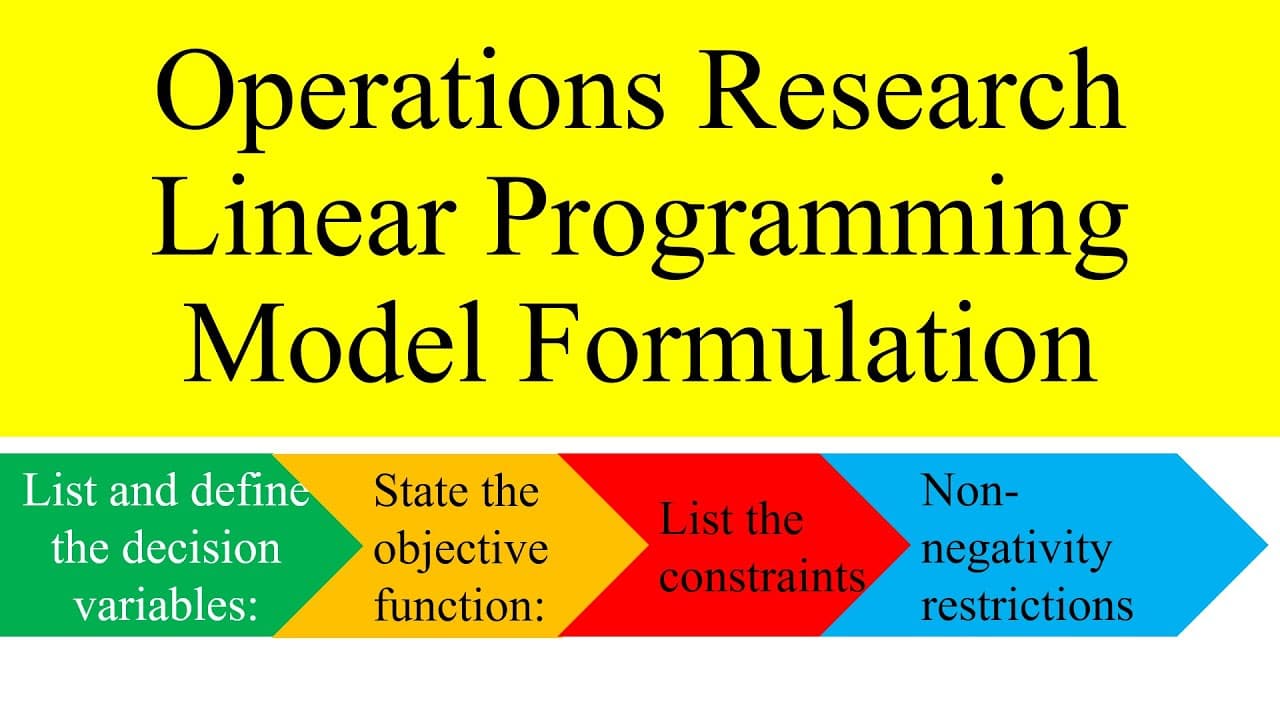
- 🚱 The components of a linear programming model include constraints, decision variables, objective function, and non-negativity restrictions.
- 💁 The standard form of a linear programming model consists of the objective function, constraints, and non-negativity restrictions.
- 🇨🇷 Linear programming can be used for profit maximization, cost minimization, and meeting requirements.
- 🍳 Tabulating data and breaking down the problem into steps can help in formulating linear programming models.
Install to Summarize YouTube Videos and Get Transcripts
Explore YouTube Video Summarizer or Get YouTube Transcript Extractor
Questions & Answers
Q: What is linear programming and how is it used?
Linear programming is a mathematical technique that allocates limited resources to achieve maximum satisfaction. It is used in various areas such as production mix, data analysis, transportation problem, and media selection.
Q: What are the assumptions of a linear programming model?
The assumptions are linearity (relationship between decision variables and constraints/objective is linear), divisibility (fractional values of decision variables are acceptable), certainty (values of parameters are known and constant), and negativity (decision variables are greater than or equal to zero).
Q: What are the components of a linear programming model?
The components include constraints (limitations or resources available), decision variables (representing the ultimate solution), objective function (mathematical representation of the objective), and non-negativity restrictions (decision variables are greater than or equal to zero).
Q: What is the standard form of a linear programming model?
The standard form consists of the objective function (maximization or minimization), constraints, and non-negativity restrictions.
Summary & Key Takeaways
-
Linear programming is a mathematical technique used to allocate limited resources to maximize satisfaction or utility.
-
It is applicable in various areas such as production mix, data analysis, transportation problem, and media selection.
-
The components of linear programming models include constraints, decision variables, objective function, and non-negativity restrictions.
Read in Other Languages (beta)
Share This Summary 📚
Summarize YouTube Videos and Get Video Transcripts with 1-Click
Try YouTube Summary with ChatGPT & Claude or YouTube Transcript Generator
Explore More Summaries from Solomon Getachew 📚

Summarize YouTube Videos and Get Video Transcripts with 1-Click
Try YouTube Summary with ChatGPT & Claude or YouTube Transcript Generator