Finding The LCM Using Excel
TL;DR
Learn how to quickly find the least common multiple (LCM) of two, three, or even four numbers using Excel.
Transcript
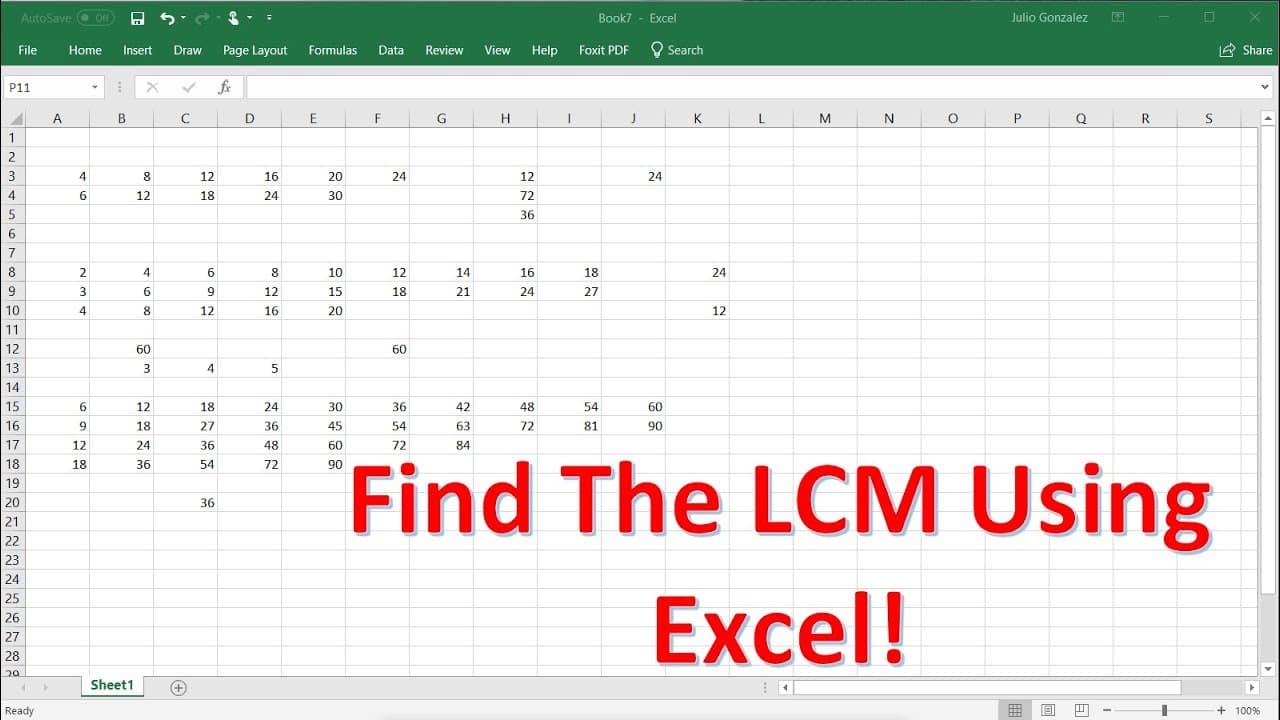
in this video we're going to talk about how to find the lcm the least common multiple of two numbers three numbers and hey even four numbers so let's start with the basics let's say if we want to find the least common multiple between the numbers four and six so one way you can do this is writing out the multiples of those numbers so let's start wi... Read More
Key Insights
- 👂 The least common multiple (LCM) can be found by listing out the multiples of each number and finding the common multiple.
- #️⃣ Excel provides a simple formula, "=lcm(number1, number2)", to find the LCM of two numbers.
- 👂 To find the LCM of three or four numbers, the same strategy of listing out multiples and finding common multiples can be applied.
- #️⃣ Multiplying the numbers together may result in a multiple of all the numbers, but it might not always be the LCM.
- #️⃣ Excel can be used to find the LCM of multiple numbers by extending the formula to include additional numbers.
- 🤝 Finding the LCM using Excel saves time and effort, especially when dealing with larger numbers.
- 😫 The LCM is the smallest common multiple of a set of numbers.
Install to Summarize YouTube Videos and Get Transcripts
Explore YouTube Video Summarizer or Get YouTube Transcript Extractor
Questions & Answers
Q: How can the LCM of two numbers be quickly found using Excel?
In Excel, you can use the formula "=lcm(number1, number2)" to find the LCM of two numbers. Simply replace "number1" and "number2" with the desired numbers.
Q: Is it always necessary to list out the multiples of each number to find the LCM?
No, in some cases, multiplying the numbers together may give you a multiple of all the numbers, but it may not always be the least common multiple (LCM). Listing out the multiples is a more reliable method.
Q: Can Excel be used to find the LCM of three or even four numbers?
Yes, you can extend the formula to "=lcm(number1, number2, number3)" or "=lcm(number1, number2, number3, number4)" to find the LCM of three or four numbers. Replace the placeholders with the desired numbers.
Q: What is the benefit of finding the LCM using Excel?
Using Excel to find the LCM provides a quicker and more convenient method, especially when dealing with larger numbers or multiple numbers.
Summary & Key Takeaways
-
The LCM of two numbers can be found by listing out the multiples of each number and finding the common multiple.
-
Excel can be used to find the LCM by using the formula "=lcm(number1, number2)".
-
To find the LCM of three or four numbers, the same method can be used by listing out the multiples of each number and finding the common multiple.
Read in Other Languages (beta)
Share This Summary 📚
Summarize YouTube Videos and Get Video Transcripts with 1-Click
Try YouTube Summary with ChatGPT & Claude or YouTube Transcript Generator
Explore More Summaries from The Organic Chemistry Tutor 📚





Summarize YouTube Videos and Get Video Transcripts with 1-Click
Try YouTube Summary with ChatGPT & Claude or YouTube Transcript Generator