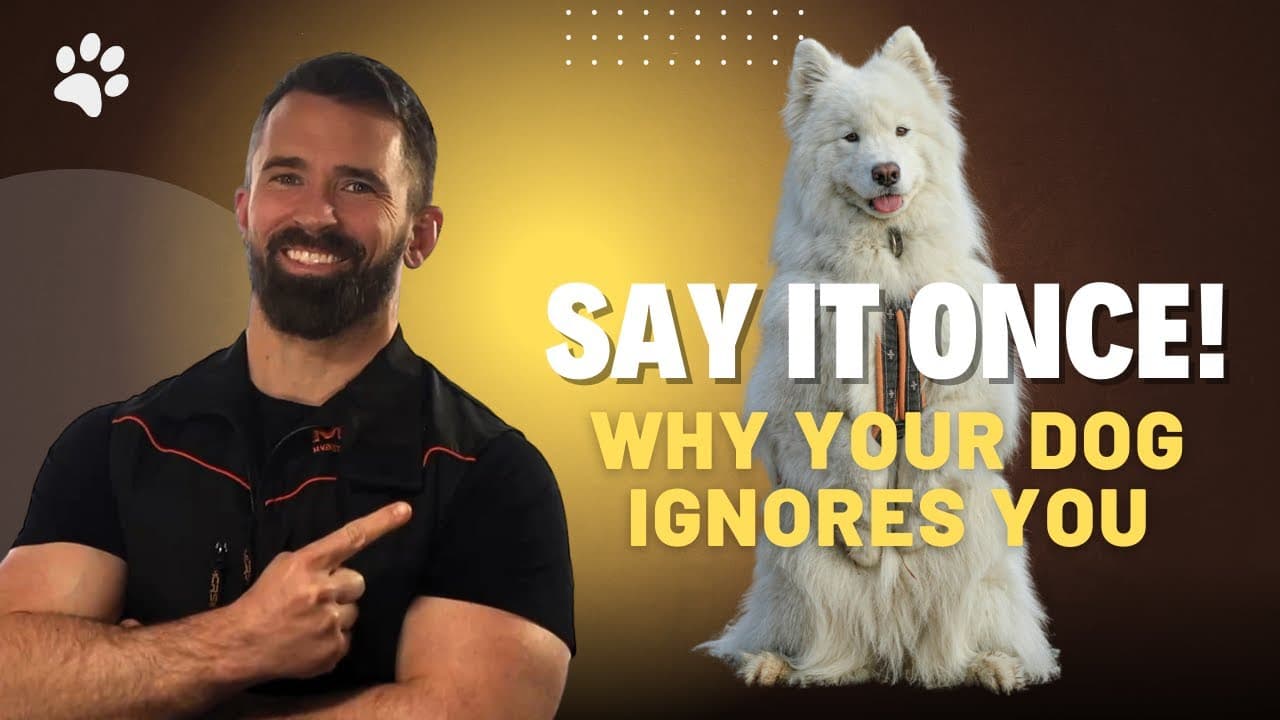
Live Q&A: Say It Once – Why Your Dog Ignores You & How to Fix It
TL;DR
Learn why dogs ignore commands and how to improve response.
Transcript
hey how's it going everyone i'm Nate Schmer and you're watching my show on dog training today we're going to be talking about adding the verbal command within our dog training and why a lot of dogs often ignore our commands or our requests for them to do specific behaviors i'm going to go over some of the most common reasons why our dogs ignore us ... Read More
Key Insights
- Dogs often ignore verbal commands due to 'learned irrelevance,' where they fail to see the relevance of the command to their actions.
- Repetition of commands without follow-through teaches dogs to ignore the commands, as they learn that the words have no immediate consequence.
- Handlers should focus on improving their skills and consistency, as effective communication and follow-through are key to successful dog training.
- Physical cues are more effective than verbal commands in the early stages of training, as dogs respond better to physical guidance.
- Motivation plays a crucial role in training; using food or toys effectively can increase a dog's willingness to perform desired behaviors.
- Randomizing rewards and gradually increasing environmental difficulty can help in making commands reliable in various situations.
- Dogs are not good at multitasking; training should focus on one command or behavior at a time to ensure clarity and understanding.
- Understanding a dog's body language and context is essential for interpreting their behavior and ensuring effective communication.
Install to Summarize YouTube Videos and Get Transcripts
Explore YouTube Video Summarizer or Get YouTube Transcript Extractor
Questions & Answers
Q: Why do dogs often ignore verbal commands?
Dogs ignore verbal commands due to a concept called 'learned irrelevance.' This occurs when dogs are repeatedly exposed to commands without any immediate consequence or relevance to their actions. Over time, they learn to tune out the commands as they do not predict anything meaningful or valuable to them.
Q: How can handlers improve their dog training skills?
Handlers can improve their dog training skills by focusing on consistency and effective communication. This includes ensuring they follow through with commands, using physical cues in the early stages of training, and maintaining a clear and structured approach. Additionally, understanding and utilizing motivation, such as food or toys, can enhance training effectiveness.
Q: What role does motivation play in dog training?
Motivation is crucial in dog training as it influences a dog's willingness to perform desired behaviors. By using food or toys effectively, handlers can increase a dog's motivation to respond to commands. It's important to ensure that rewards are meaningful to the dog and to avoid free feeding, which can decrease food drive.
Q: Why is repetition of commands without follow-through problematic?
Repetition of commands without follow-through teaches dogs to ignore the commands. When handlers repeat commands without ensuring the dog complies, the dog learns that the words have no consequence. This undermines the effectiveness of verbal commands and can lead to dogs tuning them out altogether.
Q: How can physical cues aid in dog training?
Physical cues are effective in the early stages of dog training because dogs respond better to physical guidance than verbal commands. By using physical cues consistently, handlers can help dogs understand what is expected of them, making it easier to teach desired behaviors and eventually associate them with verbal commands.
Q: What is the importance of understanding a dog's body language?
Understanding a dog's body language is essential for interpreting their behavior and ensuring effective communication. Dogs primarily communicate through physical cues and body language, so handlers need to be aware of these signals to provide appropriate guidance and feedback during training. Context also plays a crucial role in understanding a dog's actions.
Q: How can handlers ensure reliability in their dog's response to commands?
Handlers can ensure reliability in their dog's response to commands by gradually increasing environmental difficulty and randomizing rewards. This process, known as proofing, helps dogs learn to perform behaviors consistently in various situations. By making the training environment more challenging, dogs become more adaptable and reliable in responding to commands.
Q: Why are dogs not good at multitasking during training?
Dogs are not good at multitasking because they tend to focus on one task or stimulus at a time. When training, it's important to focus on one command or behavior to ensure clarity and understanding. Attempting to teach multiple commands or behaviors simultaneously can lead to confusion and reduce the effectiveness of the training.
Summary & Key Takeaways
-
In this video, Nate Schmer discusses the common reasons why dogs ignore verbal commands and offers strategies to improve their responsiveness. He emphasizes the importance of handlers focusing on their skills and consistency, as well as the role of motivation in successful training.
-
Nate explains the concept of 'learned irrelevance,' where dogs ignore commands due to repeated exposure without consequence. He advises against repeating commands without follow-through and highlights the importance of using physical cues and motivation to teach desired behaviors.
-
The video provides step-by-step strategies for building better engagement and accountability in dog training. By randomizing rewards and gradually increasing environmental difficulty, handlers can ensure their dogs respond reliably to commands in various situations.
Read in Other Languages (beta)
Share This Summary 📚
Summarize YouTube Videos and Get Video Transcripts with 1-Click
Try YouTube Summary with ChatGPT & Claude or YouTube Transcript Generator
Explore More Summaries from Nate Schoemer 📚


Summarize YouTube Videos and Get Video Transcripts with 1-Click
Try YouTube Summary with ChatGPT & Claude or YouTube Transcript Generator