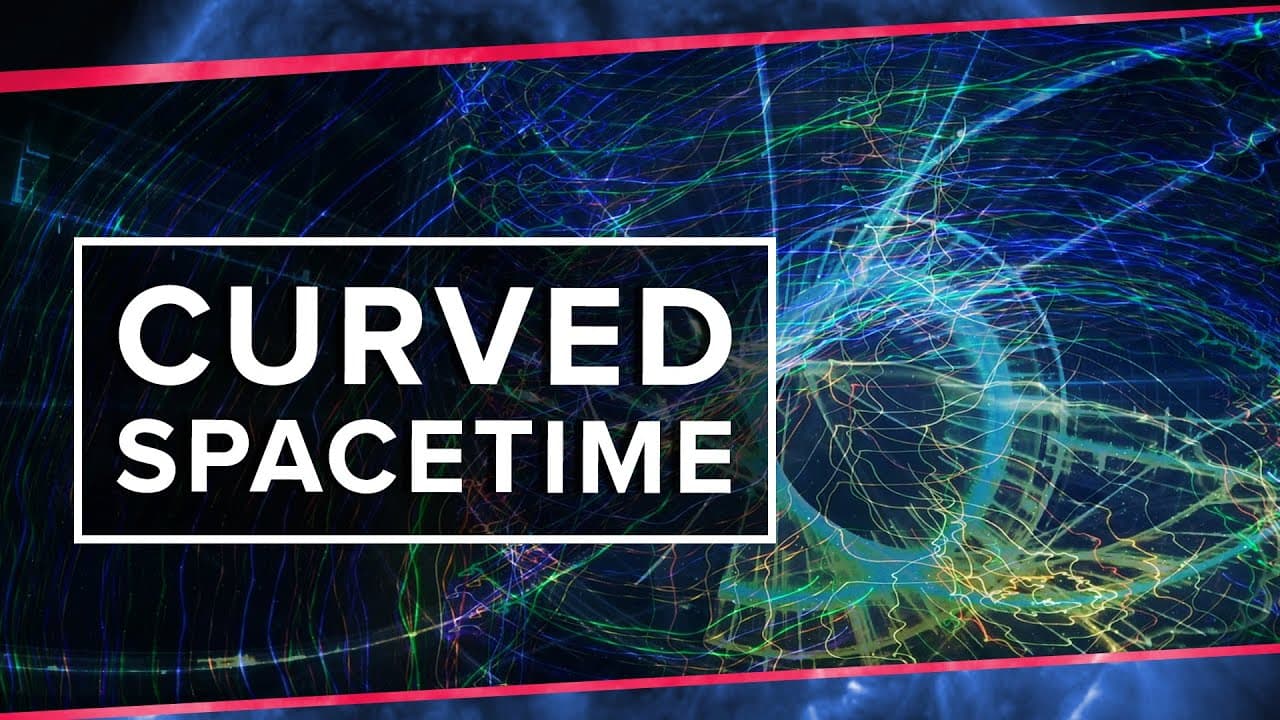
General Relativity & Curved Spacetime Explained! | Space Time | PBS Digital Studios
TL;DR
Explores Einstein's theory of curved spacetime versus Newton's gravity.
Transcript
[MUSIC PLAYING] Well, we're finally here. A synopsis of general relativity that builds on these previous four episodes. If you haven't seen them then pause me now, go watch them in order, and meet me back here after the music to hear about curved spacetime. [THEME MUSIC] Newton's and Einstein's dispute over gravity comes down to competing notions ... Read More
Key Insights
- Einstein's theory of general relativity proposes that gravity is not a force but a curvature of spacetime, contrasting with Newton's idea of gravity as a force.
- The concept of inertial frames is central to understanding the difference between Newton's and Einstein's theories, with Einstein suggesting that Earth's frame is accelerating upward.
- Spacetime curvature explains phenomena such as the falling apple's trajectory and the convergence of parallel geodesics in curved spacetime.
- Experiments show that gravitational time dilation requires spacetime to be curved, challenging Newton's flat spacetime model.
- Einstein's model suggests that local inertial frames are only valid over small spacetime patches, similar to how a grid distorts on a sphere.
- Gravitational time dilation shows that clocks at different altitudes run at different rates, providing evidence for curved spacetime.
- The Einstein equations relate the curvature of spacetime to the energy present, explaining planetary orbits and other gravitational phenomena.
- Despite the conceptual shift, the term 'gravity' persists due to its convenience and the small errors it introduces in everyday scenarios.
Install to Summarize YouTube Videos and Get Transcripts
Explore YouTube Video Summarizer or Get YouTube Transcript Extractor
Questions & Answers
Q: What is the main difference between Newton's and Einstein's views on gravity?
Newton viewed gravity as a force acting at a distance, pulling objects toward each other. In contrast, Einstein's theory of general relativity describes gravity as the curvature of spacetime caused by mass and energy. This curvature dictates the motion of objects, eliminating the need for a gravitational force.
Q: How does Einstein's theory explain the falling apple?
In Einstein's framework, the falling apple follows a geodesic path in curved spacetime. This means it experiences no force, including gravity. The apple's trajectory appears curved from an Earth-based perspective because Earth's spacetime is curved, not because a gravitational force acts on the apple.
Q: Why is spacetime curvature necessary according to experiments?
Experiments, such as those demonstrating gravitational time dilation, show that clocks at different altitudes run at different rates. This discrepancy indicates that spacetime cannot be flat, as it would be in Newton's model. Instead, the curvature of spacetime accounts for these variations in time.
Q: What role do the Einstein equations play in general relativity?
The Einstein equations relate the distribution of energy and mass in spacetime to the curvature of spacetime itself. By inputting the energy distribution of an object like the sun, the equations predict the geodesics, or paths, that objects will follow, explaining gravitational phenomena like planetary orbits.
Q: How does Einstein's theory address inertial frames?
Einstein posits that inertial frames, or reference frames with no forces acting on them, are only valid over small spacetime patches. This is because spacetime is curved. Unlike Newton's global inertial frames, Einstein's frames must be reset for each patch, similar to how a grid distorts on a sphere.
Q: What is gravitational time dilation?
Gravitational time dilation is the phenomenon where time runs at different rates at different altitudes in a gravitational field. This occurs because spacetime is curved around massive objects, causing clocks closer to a massive object to tick slower than those further away, an effect predicted by general relativity.
Q: Why do physicists still use the term 'gravity'?
Physicists continue to use the term 'gravity' because it is convenient and familiar. Although general relativity redefines gravity as spacetime curvature, using the term simplifies communication. The errors introduced by this simplification are usually negligible in practical scenarios, making it a useful shorthand.
Q: How does spacetime curvature affect planetary orbits?
Spacetime curvature, as described by the Einstein equations, dictates the geodesics that planets follow around massive objects like the sun. These geodesics appear as orbits in three-dimensional space. The curvature of spacetime causes planets to follow these paths, explaining their motion without invoking a gravitational force.
Summary & Key Takeaways
-
Einstein's general relativity redefines gravity as the curvature of spacetime, contrasting with Newton's force-based model. The theory explains gravitational phenomena through geodesics in curved spacetime, challenging traditional notions of inertial frames.
-
Experimental evidence, such as gravitational time dilation, supports the idea of curved spacetime, as clocks at different altitudes run at varying rates, indicating a departure from Newton's flat spacetime concept.
-
The Einstein equations describe how energy influences spacetime curvature, providing a framework for understanding planetary orbits and other gravitational effects. Despite its complexity, the term 'gravity' remains in use for simplicity.
Read in Other Languages (beta)
Share This Summary 📚
Summarize YouTube Videos and Get Video Transcripts with 1-Click
Try YouTube Summary with ChatGPT & Claude or YouTube Transcript Generator
Explore More Summaries from PBS Space Time 📚
Summarize YouTube Videos and Get Video Transcripts with 1-Click
Try YouTube Summary with ChatGPT & Claude or YouTube Transcript Generator