Capacitors (3 of 11) Parallel Capacitors, Voltage, Charge & Capacitance
TL;DR
Learn how to calculate the total voltage, total capacitance, total charge, voltage drop, and charge stored for capacitors in parallel.
Transcript
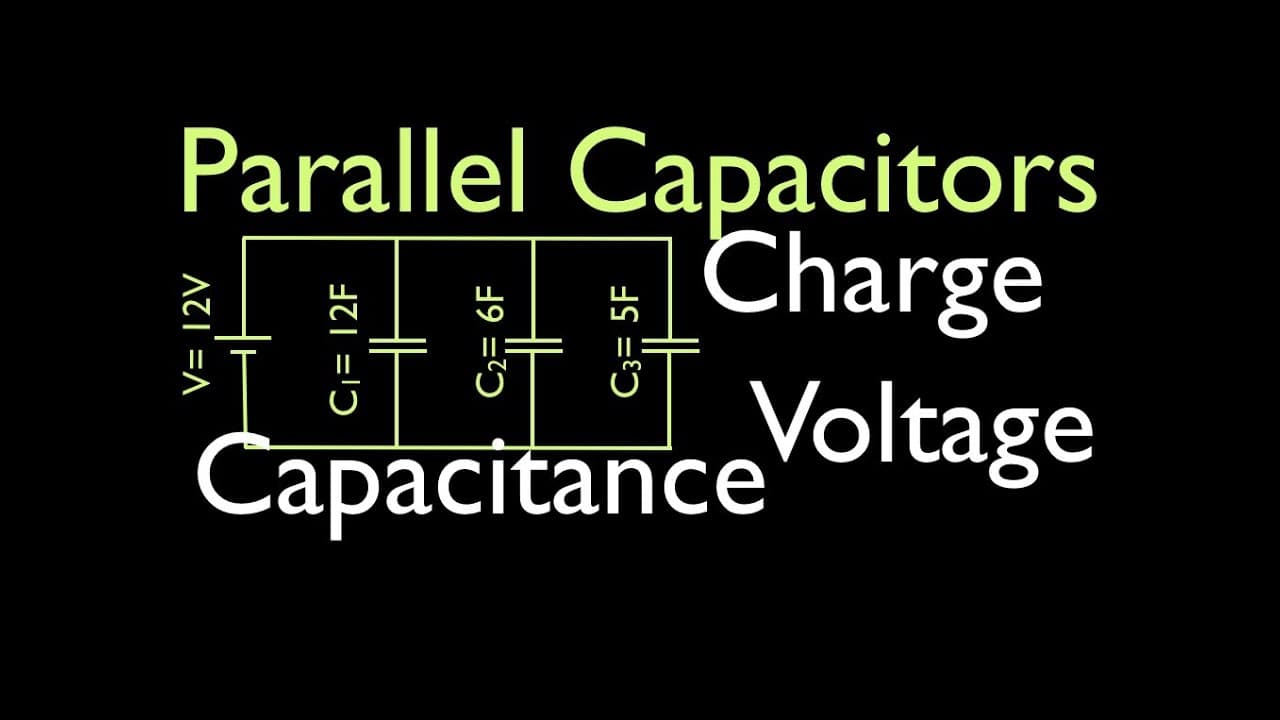
okay in today's video I'm going to go over how to determine the charge the voltage and the equivalent capacitance for capacitors in parallel now this is the circuit we're going to use and I'm going to go through all of this one step at a time and these rules and these calculations all apply regardless of how many capacitors we have in parallel typi... Read More
Key Insights
- ⚡ The total voltage in a circuit with capacitors in parallel is equal to the voltage of the battery.
- 🪜 The total capacitance in a circuit with capacitors in parallel can be found by adding up the capacitance values of all the capacitors.
- 😆 The total charge in a circuit with capacitors in parallel can be calculated using the equation q = c * V.
- ⚡ The potential difference across each capacitor in a circuit with capacitors in parallel is equal to the voltage of the battery.
- 🤭 The charge stored on each capacitor can be calculated using the equation q = c * V for each individual capacitor.
- 🈂️ The sum of the charges on each capacitor should equal the total charge in the circuit.
- ⚡ Calculating the charge, voltage, and capacitance for capacitors in parallel follows the same rules and calculations regardless of the number of capacitors.
Install to Summarize YouTube Videos and Get Transcripts
Explore YouTube Video Summarizer or Get YouTube Transcript Extractor
Questions & Answers
Q: How do you calculate the total voltage in a circuit with capacitors in parallel?
The total voltage in a circuit with capacitors in parallel is equal to the voltage of the battery in the circuit. In this case, it is 12 volts.
Q: How do you calculate the total capacitance in a circuit with capacitors in parallel?
To calculate the total capacitance in a circuit with capacitors in parallel, you simply add up the capacitance values of all the capacitors. For example, if you have capacitors with values 12F, 6F, and 5F, the total capacitance would be 23F.
Q: How do you calculate the total charge in a circuit with capacitors in parallel?
The total charge in a circuit with capacitors in parallel can be calculated using the equation q = c * V, where q is the charge, c is the total capacitance, and V is the total voltage. For example, if the total capacitance is 23F and the total voltage is 12V, the total charge would be 276C.
Q: What is the potential difference across each capacitor in a circuit with capacitors in parallel?
In a circuit with capacitors in parallel, the potential difference across each capacitor is equal to the voltage of the battery in the circuit. In this case, it is 12 volts.
Summary & Key Takeaways
-
The video explains how to determine the total voltage, total capacitance, and total charge for capacitors connected in parallel.
-
The total voltage is simply the voltage of the battery in the circuit.
-
The total capacitance is found by adding up the capacitance values of all capacitors in parallel.
-
The total charge can be calculated using the equation q = c * V, where q is the charge, c is the total capacitance, and V is the total voltage.
Read in Other Languages (beta)
Share This Summary 📚
Summarize YouTube Videos and Get Video Transcripts with 1-Click
Try YouTube Summary with ChatGPT & Claude or YouTube Transcript Generator
Explore More Summaries from Step by Step Science 📚





Summarize YouTube Videos and Get Video Transcripts with 1-Click
Try YouTube Summary with ChatGPT & Claude or YouTube Transcript Generator